The British, while otherwise a fine people, have rather screwy libel laws. In the United Kingdom, when someone sues for libel, the onus is upon the accused to demonstrate the truth of their words, rather than the accuser to prove his or her claims. That’s the center of “Denial,” an Oscar-bait drama about an infamous Holocaust denier and the professor and team of lawyers who stood up to him.
In 1996 British historian sued American academic Deborah Lipstadt (Rachel Weisz) for calling him a denier of the Holocaust in her book. He in turned sued her and her publisher, Penguin Books, in British court. The story follows Lipstadt as she navigates the byzantine peculiarities of English law. The net effect of the suit is that her team will have to prove that the Nazi regime murdered millions of Jews, and that Irving has deliberately distorted evidence in order to argue against this.
Timothy Spall gives a bravura performance as Irving, a charismatic man whom we almost feel sorry for, until the hateful words spill out of him like muck from a befouled spring. The odd thing about Irving, at least in his cinematic depiction, is that he’s a self-deluded charmer who thinks he can have it both ways: claiming that the German mass incinerators did not exist, for example, while also insisting he’s not a Hitler apologist.
Tom Wilkinson is the third leg of this story as Richard Rampton, the barrister who leads the case on Lipstadt’s behalf. A diffident man who seems to take great pains not to provide his client with any kind of comfort or emotional support, he nonetheless attacks the case with a sort of quiet ferocity.
Directed by Mick Jackson from a script by David Hare, “Denial” is a pretty straightforward (recent) historical drama, showing us a famous event and fleshing out the people and motivations that lay underneath it. There are few surprises, but the trio of performances by Weisz, Spall and Wilkinson are magnificent enough on their own to put this on your must-see list.
Bonus features are rather slim, limited to a theatrical trailer and a mini-documentary, “The Making of Denial.”
Sasha Lane sashays through “American Honey” with confidence and verve. Literally plucked off a beach by writer/director Andrea Arnold with no acting experience whatsoever, she plays the teenage protagonist in a rambling, nearly 3-hour-long contemplation of wastrel youth living and partying on the road.
The film is the spiritual successor to the oeuvre of Larry Clark and Harmony Korine -- films like “Kids” that essentially just follow young people around, observing their wild behavior without commentary. Here they are lost souls riding a bandwagon to oblivion, a dozen or so youngsters crammed into a huge van traveling from town to town, knocking on doors to sell magazine subscriptions.
You’ve probably seen these kids at your doorstep, talking about hard times they’ve been through and how you can help them reach their dreams by helping them earn “points” toward a college scholarship. Jake (Shia LaBeouf) is the oldest and savviest player in this game, donning an old sport coat and whipping up a new tale of woe based on how he reads each person answering the door.
Star (Lane) is stuck in some hillbilly town caring for a pair of kids while their mother spends her days in a stupor in a honkey-tonk bar, and the father makes increasingly disturbing sexual overtures. When she spots the magazine crew of free spirits, she hitches along on a whim.
It’s an eclectic mix of losers and wannabes, most of whom remain in the background as a sort of Greek chorus. There’s the goth girl, the surfer dude, the buff guy who never wears a shirt and has a tendency to take his junk out and wave it at people for laughs.
The main dynamic is between Jake, Star and Krystal (Riley Keough), the hardcase young woman running the show. She treats the members of the crew like lost puppies she picks up by the side of the road, and discards just as easily if they don’t play by her rules and earn money. At the end of a run, the two lowest-earning people have to square off in a fight at the “Losers’ Ball.”
Jake is her plaything, exuding an attitude of independence and brashness, but ready to serve as her chauffeur or bed partner as Krystal demands. Clearly enamored with Jake, Star is soon at odds with the boss-lady.
Things play out from there, carefree encounters punctuated by long spells inside the van, cruising along, getting high and rockin’ to some tunes. The most memorable episode is Star taking off with a trio of middle-aged rich cowboys, the type who wear 10-gallon hats and big belt buckles, but probably haven’t done any manual labor in 20 years.
I didn’t mind Arnold’s unstructured narrative, though many people may find it languid. I did wish it would round out to something more consequential than a simple love triangle. But the tour goes on, some faces disappear without warning and new ones show up to replace them.
Soon Star is now longer the newbie, but a veteran of the rainbow troupe. She finds herself by losing herself, I guess you’d say. “American Honey” is a whirlwind of a film, a harsh breeze of chaotic energy that doesn’t really have any purpose or direction, but kicks up quite a ruckus along the way.
Bonus features are deplorably lacking, consisting entirely of an interview with Keough and Lane.
In general I’m not a fan of most stage-to-screen adaptations. The mediums are lot more different than people think, and the stitch marks show too glaringly from the conversion process. Like the way the action is largely confined to one or two places, the cast is artificially small, and people have that weird habit of walking a few steps away, but the other characters continue the conversation as if they can’t be heard.
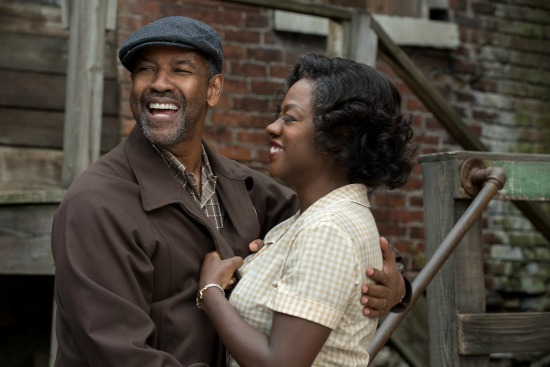
But “Fences,” directed and starring Denzel Washington from a screenplay adaptation that August Wilson did himself, is an absolute triumph. It’s a deeply affecting portrait of African-American lives in 1950s Pittsburgh, with the patriarch of a small family raging against injustice and the life that has left him feeling shackled.
Part of Wilson’s “Pittsburgh Cycle,” “Fences” is the first in what Washington has declared will be screen versions of all 10 plays. If the first is any indication, we’re about to see one of the most ambitious undertakings in cinematic history.
Certainly, “Fences” belongs on any list of the best films of 2016.
The story takes place mostly in the kitchen and cramped back yard of Troy and Rose Maxson. He’s a garbage man and she’s a housewife, living in a tidy but poor section of Pittsburgh. They’ve been married 18 years and have a son in high school, Cory (an impressive Jovan Adepo), who is a star player on the football team and has an offer to play on a scholarship in college.
Troy, though, is both a product and a rebel of his time. He had a wild youth, living as a thief and fathering another boy, Lyons (Russell Hornsby), by another woman. He gave it all up long ago to be a garbage collector, because it was a safe and stable existence. But now he’s agitating for a promotion to driver of the garbage truck, something no other “coloreds” are allowed to do.
Troy was also a star baseball player prior to integration of the sport at the professional level, and doesn’t want to see Cory go through the same disappointment that he did. The fierce nature of his love unfortunately translates into ogreish behavior that pushes the boy away, and starts a growing rift with Rose.
Over the course of the story, Troy works (in fits and starts) on building a fence in his back yard, for reasons that are apparent only to himself. I suspect it’s because Troy is a man who has a firm grasp on his own identity, and knows what things he wants to keep in his life and what he wants to keep out. His tragic flaw is the delusion that he has control over these things.
Most of the rest of the cast are carryovers from the recent Broadway stage revival. Stephen Henderson is a revelation as Bono, Troy’s coworker and best friend. Henderson takes would could have been a typical wingman role and gives Bono all sorts of depths and shades. He loves Troy and Rose, so much that he can’t stand when they begin to tear each other up. Bono is endlessly supportive but not an enabler.
Rounding out the cast is Mykelti Williamson as Gabriel, Troy’s younger brother who was left mentally shattered after being wounded during World War II. As the story opens, Gabriel has been living with Troy and Rose -- indeed, his disability checks helped buy the house -- but recently moved out to his own place. Carrying a trumpet he can’t play and a tattered vestige of his manhood, Gabriel is a pitiable symbol.
“Fences” sticks close to the play in terms of character, story and dialogue. Washington employs some subtle but effective director’s tricks to open things up, such as having the camera slowly rotate around a small knot of people having a conversation.
Washington and Davis both give powerful, Oscar-worthy turns, and the supporting cast hits all its notes squarely and true. This is the rare stage play that only grows in impact when it’s given a little more room to flourish.
That was the three-word review provided by a pal who saw the movie before me, and it sums up “Sing” better than I could.
This is a breezy, glitzy animated jukebox show in which movie stars play singing critters getting together for a big talent competition. It will probably win with most children, especially those who like pop songs and want to hear Reese Witherspoon, Scarlett Johansson and the like belting them out through the mouths of pigs and porcupines.
Grownups may find it a bit tedious -- I came awfully close to catching a few Zzzs during our screening -- but it builds a good head of steam toward a showstopper finale.
Written and directed by Garth Jennings, who also provides the voices of one of the minor characters, “Sing” is set in an all-animal metropolis very much like the one in “Zootopia,” where humans are neither seen nor heard, and may not even exist in this world. (Christophe Lourdelet is co-director.)
Matthew McConaughey, who turns out to be a real vocal chameleon between this and his voice acting in “Kubo and the Two Strings,” plays Buster Moon. He’s a koala bear charlatan who runs a grand old theater that’s had one big failure after another.
McConaughey plays Moon light and schmaltzy, employing the upper register of his voice without a hint of that famous Texas drawl. Moon is an old-school “let’s put on a show” type with a heart of gold, but isn’t above stiffing contractors and a dab of flim-flam.
With the bank threatening repossession, he comes up with an idea for a huge singing contest using local unknowns. Scraping together his last bit of cash, he instructs his elderly iguana secretary to put out flyers advertising a $1,000 prize, but through some slapstick action it gets turned into $100,000. Soon every critter in town who thinks they can warble worth a darn is beating down his door.
McConaughey doesn’t get past humming, but there is a great deal of singing, both old standards and a few new tunes. Some of the actors we already knew could sing -- Johansson, Seth MacFarlane. But it’s a treat to hear Reese Witherspoon, as hectored porcine housewife Rosita, fry up some bacon and serve it with style.
Pop singer Tori Kelly plays Meena, an elephant who takes a job as stagehand because she’s too shy to show her talent. Johansson is Ash, a surly teen porcupine rocker who gets to step out of the shadow of her controlling boyfriend. MacFarlane voices Mike, a streetwise mouse who dresses, behaves and sings like he stepped right out of Sinatra’s Rat Pack.
The real sensation is Taron Egerton, the affable Brit you may remember from “Eddie the Eagle” and “Kingsman: The Secret Service.” He plays Johnny, a Cockney gorilla who comes from a clan of career criminals, and doesn’t want to follow in the family footsteps. Egerton’s got some truly golden pipes, soft and silky.
There’s really not a whole lot of narrative ambition to “Sing.” Each character has a mini arc to travel along, and we know where they’re going to land two minutes after we meet them. But the songs are nice to listen to, the creatures are crazy cute and your kids will be entertained for 108 minutes.
“Passengers” is a lot cleverer and more contemplative than I took it for.
The trailers make it look like a dopey romance-in-space story starring the ridiculously cute couple of Jennifer Lawrence and Chris Pratt. They’re two passengers on a massive colonization ship from Earth who get woken up from hyper-sleep 90 years too early, and have to face the prospect of their own mortality while falling head-over-heels in love -- quite literally, in zero gravity suits.
Talk about the ultimate Meet Cute: “They found love along the way to a galaxy far, far away.”
Instead, director Morten Tyldum (“The Imitation Game”) and screenwriter Jon Spaights (“Doctor Strange”) give us something more ambitious and much darker. The syrupy love story is still there, but it’s leavened with moral quandaries and existential threats. The last act is pretty typical we-must-save-the-world action sequences, but what comes before sets it up convincingly.
Their ship is headed to a lush green planet across the cosmos. The Homestead II looks a lot like the ship in “Wall•E” -- a luxury ocean liner in space, with robots to cater to their every need. Except the 5,000 passengers and 258 crew are only supposed to wake up when they’re four months out from their destination.
Something goes wrong with the hyper-sleep pods, and as it happens, the two most attractive people onboard wake up. Aurora Lane is a journalist who found her life on Earth constraining and hungered for adventure. Her idea was to travel to the colony, spend a year living there and write a book about it, then travel back again in hyper-sleep, so she’d end up 250 years into the future.
Jim Preston is a much more down-to-earth guy. A mechanic living on a planet where it’s cheaper to buy new things than fix old ones -- sound familiar? -- he yearns for a place where his skillset is valuable. He dreams of building his own house on a distant planetside.
Their only other real companion is Arthur, a legless bartender android played by Michael Sheen. All the other robots are mechanized automatons, but Arthur’s been programmed to listen and react to psychological issues. He’s even smart enough to recognize his limitations.
“These are not robot questions,” he cautions at one point.
After an appropriate amount of sorta-courtship, Jim and Aurora eventually abandon hopes of saving themselves and dive deep into their “accidental happiness.”
Now, something happens in this movie that I can’t really tell you about. I kind of want to, because it’s critical to our discussion of why “Passengers” is a superior sci-fi film. Although the plot development has apparently been alluded to and/or outright discussed in articles about the movie, I can’t assume you’ve read them. The trailers certainly don’t spell it out. So I’m bound by my oath as a respectable critic not to say anymore.
…
OK, stuff that. I’ll talk about it, but not before uncorking one standard-issue Spoiler Warning®. Please, skip down so as not to ruin your experience.
Ready? Alright, the deal is that Jim’s hyper-sleep pod really does go kerflooey, but after spending a good chunk of time alone trying all sorts things to save himself, including getting back to sleep, he deliberately wakes up Aurora on his own -- after studying her profile and becoming smitten. Also, she looks like Jennifer Lawrence.
Now, it may sound creepy that a guy would do this, effectively condemning another person to death long before they reach their destination, just so he won’t be alone. And it may sound even creepier that he chooses the hottest girl on the ship to satisfy his primordial male urges.
The reason this sounds creepy is because it’s incredibly creepy and gross. Hiding-cameras-in-the-toilet creepy and gross. But because Pratt projects such an innate decency, and because the filmmakers take pains to explore the depth of his despair, we at least understand his choice without condoning it.
(Personally, I’d have woken up the person whose profile said they were a scientist who knows a lot about hyper-sleep pods, but that’s me.)
…
End Spoiler Warning®. I’d have used bigger ones but hey, these things aren’t cheap!
For those just rejoining us, suffice it to say that “Passengers” is much more than it seems on the surface. It’s a smart and sexy movie that also has some deep thoughts beyond the pretty façade. It’s less Star Wars and more Philip K. Dick.
Here's a description I found of Jerome Weidman's 1941 novel, "I'll Never Go There Anymore," unread by me:
This semi-classic Weidman novel places a handful of vibrant characters
together for a two week stay at a lonely summer cabin. "A summer
vacation thrust him into manhood."
And yet this largely forgotten book was turned into not one, not two but three disparate movies spread out over just 12 years. First was 1949's contemporaneous "House of Strangers" starring Edward G. Robinson as a corrupt New York City banker. For 1954's "Broken Lance," the story was transposed to the wide open country during the late 19th century, featuring Spencer Tracy as a hard-bitten cattle baron. Finally Esther Williams and Cliff Robertson starred in 1961's "The Big Show," set in the world of a traveling German circus.
Talk about artistic license. A summer vacation story gets turned into a film noir, a Western epic and a European flying trapeze romance?
At their hearts, though, all of the stories are about a strong father figure struggling to wrangle his offspring and deal with his own tragic choices. "Lance," directed by Edward Dmytryk, takes on Shakespearean notes at time, with the tale of four brothers vying for the scraps of dad's crumbling domain, while the once-vital patriarch slips further and further into physical and spiritual decay. Interestingly, the screenplay by Richard Murphy was not nominated by for an Academy Award -- nor did it deserve to be -- but the story by Philip Yordan actually won the Oscar. The Academy has shifted around the writing categories more than any other award area over the years, though they've been pretty stable since about 1970. Prior to 1957 there were separate story and screenwriting awards. Under modern rules, a "story by" credit means the writer had to have submitted an earlier version of the script, or at least a treatment or some kind of written product. Simply "having an idea" doesn't get you a story credit -- otherwise, a lot of producers would be considered writers. I thought Dmytryk, a journeyman with many notable credits to his name (including "Crossfire," "The End of the Affair" and "The Caine Mutiny"), does a fine job shooting the rocky vistas, making excellent use of the CinemaScope widescreen format. I did have one significant complaint, however: the lack of close-ups for Spencer Tracy. Tracy was a famously naturalistic performer, whose subtle facial cues and postures could convey a lot of emotional information with just a centimeter of movement. But Dmytryk keeps his camera at middle distance or further for nearly the entire film. That tends to let the orneriness of his character, Matt Devereaux, play out but not his little moments of self-doubt and reconciliation. Contrastingly, young Robert Wagner is given many loving close-ups as Matt's youngest (and prettiest) son, Joe. Given a slight color tinge to reflect Joe's "half-breed" Indian status, the camera swoops in adoringly for him again and again. Joe's a pretty straightforward and uninteresting character, the good son who stands by his father while his brothers all stab him in the back. Richard Widmark plays Ben, the oldest, still resentful over a lifetime of being treated more like a hired cowpuncher than heir apparent. Ben is certainly savvy and probably would make a good next-generation cattleman -- he suggests opening an office in town to negotiate the best prices with the Chicago meat markets. But Matt is an old-school authoritarian type. He expects his sons to be eternally loyal and subservient. He built an empire with his own two hands, and wants to keep it that way forever.
When the two dimwitted middle kids -- Mike (Hugh O'Brian) and Denny (Earl Holliman) -- steal a couple of old steers to supplement the meager $40 a month wage the old man gives them, he's ready to send them packing. Matt callously kills the two Mexicans who helped them, as he's done his whole life to rustlers or anyone who tried to infringe upon his land. Tin stars and courtrooms are unnecessary delays in the attainment of justice, Matt figures, strongly prejudiced toward the frontier kind. Matt doesn't kill the Indian hands who also assisted in the theft, since it's obvious Matt has a tender spot for their kind. His wife, played by Katy Jurado (who got a Best Supporting Actress Oscar nod), is addressed by all as Señora, despite being a for-real Comanche "princess" (daughter of the chief). He married her after his first wife, mother of his three oldest, died during the hard early years on the Devereaux ranch.
It's a true romance, but racial prejudice is always loitering just outside the door. Horace, the bendable governor played by E.G. Marshall, owes his position to Matt's pulling the levers of power. But when Joe starts to fall for his own daughter, Barbara (Jean Peters), the governor registers his objections while apologizing for his inability to change with the times.
Matt abruptly ends their friendship just when he needed it the most. A trial is coming after Matt and his boys raided a copper mine that was dumping its waste into his stream, killing 40 head of cattle. Despite the inconsequential nature of the loss -- representing something like 0.08% of Devereaux's massive herd -- Matt sternly orders the mine foreman, Mac Andrews (Robert Burton), to shut down or be shut down.
When the scores of miners learn their livelihood is threatened by a bossy cattleman and his four sons, they prepare to put an end to the Devereaux clan. But then Two Moons (Eduard Franz), Matt's trusted Indian foreman, rides in with their own men and lay waste to the mine.
Nobody's killed, but Matt is put on trial and his cussed obstinance on the witness stand -- repeatedly threatening the opposing attorney (Philip Ober) with bodily harm -- pretty much puts the nails in the coffin.
To save his dad, Joe claims that he started the fight and gets sentenced to three years in jail. His release from prison acts as a framing device, with Joe now the prodigal son returned to the dusty ruins of the ranch, which is gradually being turned over to oil drilling.
Matt had a stroke after losing his honor by allowing Joe to take the fall, a raging dog confined to his chair with no bite to back up the bark. He foolishly split up the ranch among his four sons as a preventive move in case the court case went against him, but that now means Ben, with the support of the brothers dim, is now in charge.
In perhaps the film's best scene, Matt begs Ben not to sell off part of the ranch to oilmen, and is haughtily refused. Widmark and Tracy really go at each other, two men who are two alike to ever really get along with each other. Matt confesses that he couldn't stand his own father's stern yoke and rode off to seek his fortune, and it's clear that he would have preferred Ben follow suit.
Really, this is what the movie should have been about. The lackluster Joe character and the needless romance aspect should all have been given the dusty boot.
At 96 minutes, "Broken Lance" aspires to be an epic Western but just doesn't have the narrative sweep and distinctive characters to go any higher than it is: a serviceable story of fathers and sons, squabbling on the squalid plains.
There’s not a lot that’s quite magnificent about “The Magnificent Seven,” though there is plenty to like. It’s got great actions scenes, twinkly anti-heroes, scornful villains, memorable supporting characters and lots of eye candy.
What it doesn’t have is any reason for existing. A remake of the seminal 1960s Western, which itself was based on Akira Kurosawa’s landmark “Seven Samurai,” this film is essentially a PG-13 nostalgia romp for its own sake.
Still, what’s not to like about Denzel Washington as creased, calculating bounty hunter Sam Chisolm? Or Chris Pratt as wise-cracking gambler/shootist Josh Faraday? Add in Ethan Hawke as a genteel Civil War legend/sharpshooter, Vincent D’Onofrio as a weirdly amusing mountain man/lunatic and a passel of other wayward cowpokes, and you’ve got yourself a movie.
You know the story: evil power-monger (in this case, Peter Sarsgaard’s sneering cattle baron) puts his boot on the collective neck of a town of farmers, who decide to hire their own gunslingers to protect them. Our seven heroes are mercilessly outnumbered, but with a little luck and some careful planning, they make a battle of it.
Director Antoine Fuqua, who’s made some stellar movies with Washington, and screenwriters Richard Wenk and Nic Pizzolatto don’t try to fancy things up beyond the essentials: stand-offs, wisecracks, a few lightly scary moments, a noble sacrifice or two. The last third of the movie is essentially one long action scene, and it’s harrowing stuff.
This film surely won’t be immortalized like the original was. But “The Magnificent Seven” has a job to do, and does it with skill.
Bonus features are decent if not especially expansive. The DVD edition comes with four making-of featurette documentaries. Upgrade to the Blu-ray version, and you add two more plus several deleted scenes.
The Blu-ray’s highlight is a “Vengeance Mode,” where you can watch the movie with key scenes broken down with comments from the director and cast.