Shakespeare has rarely translated well to film, and even when it does -- "Shakespeare in Love," "Romeo + Juliet" -- it's usually in a modernistic, revisionist way that steps outside the rigid confines of the Bard's plays. And the reason is simple: with nigh on half a millennium separating our version of the English language from his, it's very difficult for anyone who's not a PhD in literature to comprehend just what the heck the characters are saying.
"Coriolanus," based on one of Shakespeare's lesser-known works, lies somewhere in between classic and revisionist approaches. The dialogue is tweaked enough to make it so the layman can usually follow along, but the bones of the story is unchanged.
Ralph Fiennes, who also makes his directing debut, plays the title character, an over-proud general just returned triumphant to Rome. A rigid, inflexible man, he thinks his honor has won him the right to become consul, but the common people do not love him, and scheming politicians maneuver to rob him of the title. Enraged, Coriolanus joins forces with his mortal enemy to wage war against the empire.
It's grandiose, heavy stuff, and both Fiennes and Vanessa Redgrave were passed over for Academy Award nominations they probably deserved. Gerard Butler plays Coriolanus' enemy Tullus Aufidius, and the cast is rounded out by Jessica Chastain and Brian Cox.
Bonus features are the same for Blu-ray and DVD editions, and include a making-of featurette and an audio commentary track by Fiennes.
"The law is slow and careless around here sometimes. And we're here to see it speeded up."
Thus speaks the central villain in "The Ox-Bow Incident," a 1943 prairie morality tale that, in truth, contains no real bad guy. That's because virtually everyone in it is morally compromised in some way. The speaker, a vengeful cowpuncher named Farnley (Marc Lawrence), is simply the most overt about it.
This film is from director William A. Wellman; the more I see his movies, the more I become convinced this largely unheralded figure is one of Hollywood's greatest filmmakers. The screenplay is by Lamar Trotti, whose credits include "Young Mr. Lincoln" and "Drums Along the Mohawk," from Walter Van Tilburg Clark's novel.
It reminded me very much of "12 Angry Men," also starring Henry Fonda, in that it's about the pitfalls of the group mentality applied to a law-and-justice scenario. A bunch of men who are convinced they are doing right eventually come to see that they've been woefully misguided all along. With "Men" it happens before the verdict is rendered, but in "Ox-Bow" the realization doesn't occur until after three men have been wrongly hanged for crimes they did not commit.
The movie is also notable in that the story unspools in more or less real time -- Wellman includes a single fade-out/fade-in to indicate the passage of time. The film essentially only has three scenes: the first where the townsfolk learn of the murder of a local rancher and form a posse; a brief (and mostly unnecessary) interlude where they erroneously chase down a stagecoach; and the confrontation with the accused trio.
At a spare 75 minutes, "The Ox-Bow Incident" has a stripped-down feel, like the narrative has been boiled down to its barest essence.
Interestingly, Fonda is not the central character, nor is there really any protagonist in the story. Fonda plays Carter, a rather surly and hot-tempered local cowboy who gets caught up in the posse mostly out of fear -- he and his partner Art (Harry Morgan) take part because if they did not, they might be suspected of being involved in the cattle rustling and killing of an upstanding rancher named Kincaid.
Carter acts as sort of the nexus of the plot, whose own story is not central to the narrative but a figure around whom all the other characters travel in close orbit.
Carter and Art ride into town, dusty and thirsty, and find not much going on. They sidle up to the bar for some rotgut whiskey, and Carter learns that Rose has suddenly left town. She was perhaps the only unmarried woman in town under the age of 80, and if she was not exactly Carter's betrothed, then certainly he felt promises had been exchanged between them.
Agitated over stories of cattle rustling, Carter starts a fight with Farnley, getting the best of it but then getting knocked out by a bottle over the head from the bartender. Art revives him with a splash of water, explaining that Carter always feels better after a fight, win or lose. Carter grows ill and stumbles into the street to retch his guts out.
Still bent over, he complains to Art: "Holy cow, now I'm gonna have to start all over again!"
Instead, everyone is riled up by the news of the murder of Kincaid and the theft of his cattle. The sheriff is out of town, but the lackadaisical deputy Mapes (Dick Rich) decides to commission a posse. From the beginning it is clear that they're looking for a purpose, a cure for their idleness, more than justice -- that, and the thrill of seeing somebody swing.
The town drunk (Paul Smith) uses a rope to act out a googly-eyed, tongue-lolling imitation of a man being hanged. It's funny the first time he does it, less so the second, and positively chilling when he does it in front of the accused to taunt them.
Perhaps the film's one major flaw is a chance encounter with a stagecoach along the trail. Stupidly, the posse gives pursuit, instigating the stagecoach hands into shooting Art in the arm. After running them down they learn the coach contains Rose and her new husband, a rich and snooty type from San Francisco. It seems like this sequence is setting up the narrative for more developments, but we never see the newlyweds again.
While the scene has its own momentum, plot-wise it's dead weight.
The most enthralling section is the quick capture and long "trial" of the three men, including Dana Andrews as Martin, the leader, and Anthony Quinn as Juan Martinez. Martin insists they bought the 50 head of cattle from Kincaid wish cash, although they lack a bill of sale. After trying to escape, Juan is also found to be carrying Kincaid's fancy engraved pistol. The third member of the accused is a feeble-minded old man.
The posse includes a large cast of characters. Beyond Farnley, the self-appointed leader is Tetley (Frank Conroy), a former Confederate major who still wears his gray battle uniform 20 years after the end of the war. Tetley is imperious, with a thick veneer of polite gentility masking his harsh, uncompromising ways. He mostly comes along as a way to instill some manhood in his gentle-minded son (William Eythe).
Jane Darwell, forever Mrs. Joad from "The Grapes of Wrath," has a disturbing turn as a hard-bitten woman who's as bloodthirsty as any of the men. She has several scenes where she cackles with glee at the plight of the three accused men, and it's positively vile.
The group also includes Davies (Harry Davenport), an elderly store owner who tries unsuccessfully to have the men brought back to town for a trial, and Sparks (Leigh Whipper), a negro preacher who acts as the moral conscience of the group.
Once the interrogation gets underway, there's a doomed, haunting feel to the movie, as the audience surely knows how things will end. Martin tries to reason with his captors, then pleads with them, and finally begs them. This draws a sharp retort from Darwell's character to "take it like a man."
The film ends on a bit of a false note, as Carter reads the letter Martin has written to his wife and children, asking them to forgive the men who murdered him in the name of justice. The language is rather highfalutin for a humble farmer, and it's doubtful any man not a living saint could summon that sort of big-hearted perspective a few minutes before is to die for a crime he had nothing to do with.
Still, "The Ox-Bow Incident" is a riveting story about how right and wrong are sometimes hard to distinguish, and why laws are necessary to keep justice out of the eager hands of the unruly mob.
"Men in Black III" gets brownie points simply for not being "Men in Black II."
It's been 10 years since "MIIB," and while I've completely forgotten the plot of that movie, the bad taste it left in my mouth lingers. I remember thinking it was one of the laziest sequels I'd ever seen, simply taking the quirky original film and repackaging its key elements for a cynical, money-grubbing do-over.
Despite that, it made something like a half-billion dollars, so the question becomes: why did it take a decade to make another movie?
The jaded, cynical critic in me can't help but take note that the careers of star Will Smith and director Barry Sonnenfeld have not exactly been afire as of late.
Sonnenfeld's been stuck doing low-profile television since the disastrous "RV" six years ago, which also pretty much marked the end of Robin Williams as a leading man. Smith hasn't starred in anything since 2008, when he gave us the lackluster "Seven Pounds" and the lackluster-er "Hancock."
Even if "MiB III" exists simply to gobble up cash and rejuvenate some careers, it's a reasonably engaging bit of disposable entertainment.
It's not nearly as funny as it ought to be, and I kept feeling like the characters were explaining the movie to me rather than letting it just happen. But there's plenty of slapsticky action, more enjoyably scary/goofy aliens, and a few unexpected poignant moments.
Agents J (Smith) and K (Jones) are back as footmen in the Men in Black, a super-secret agency serving to protect the many alien species that are secretly residing on Earth (and the humans from them). Their jobs and their relationship have grown stale, with J frustrated with K's inability to ever open up to him.
"I'm getting too old for this. I can only imagine how you feel," J riffs after a particularly nasty dust-up in a Chinese noodle shop.
Unfortunately, a superbad dude named Boris the Animal -- "It's just Boris," he repeatedly insists, not that anyone pays any attention -- breaks out of Lunar Max, the alien prison on the moon. A creepy alien with camera lenses for eyes and a pet that lives inside his hand and spits deadly spikes, Boris (Jemaine Clement) swears vengeance on K, who blew his arm off back in 1969.
Boris goes back in time and alters the temporal reality so K no longer exists. Now it's up to J to travel back to the days of hippies and decent rock 'n' roll and put things right.
Josh Brolin plays the young K, expertly mimicking Jones' curt mannerisms and high-pitched Texas drawl. The '60s-era aliens are a trip, made up to resemble extra-terrestrials from movie and TV of that time.
I really enjoyed Michael Stuhlbarg as Griffin, the sole survivor of his alien race who can see across the dimension of time and envision all possible outcomes at once. He's a got a daffy lost-puppy vibe, sweet-natured but with a bit of bite.
There's also a clever bit where J and K encounter Andy Warhol, who turns out to be another Men in Black agent in deep undercover (Bill Hader) to infiltrate the counterculture. "I'm so out of ideas I'm painting soup cans and bananas!"
The run-up to the big showdown is a blur of chases and quips, culminating in a fight on the launch pad of the Apollo 11 rocket as it's getting set to shoot the moon. There's also something about an ArcNet protecting the earth from a Boglodite invasion, and a love flame for K (played by Alice Eve when young and Emma Thompson when not) and a half a dozen other untidy story threads that screenwriter Etan Cohen never bothers to knit together.
It's hard to say that "Men in Black III" is worth the wait, since I don't get the sense much of anyone was really waiting for it. But now that it's here, at least you won't feel like zapping yourself with one of the MiB forget-it-all gizmos after watching it.
World War II movies are something I just can't get enough of, and well-done films that focus on the war in the air are few and far between. Aviation films made during and in the years after the war tended to rely on stock footage for the combat scenes, with results that felt constrained by their eras.
Strange that now that Hollywood has all sorts of computer-generated tricks up their sleeves, they haven't tried very often to go back and tell some of these stories with more engaging fighting scenes. "Red Tails" attempts exactly that.
This movie, produced by George Lucas and with CGI provided by his legendary Lucasfilm special effects studio, contains some of the best air combat scenes ever captured on film. Imagine the best video game every made, and "Red Tails" puts you in the cockpit as American pilots engage in dogfights and bombing runs.
It's pulse-pounding, engaging stuff.
Alas, the characters and storyline have all the depth of a video game, too. Ostensibly the tale of the all-black pilots from the Tuskegee training program, "Red Tails" in actuality is an amalgamation of seemingly every cliché ever contained in a war movie.
The troubled squadron leader with a drinking problem? Check. The bed-hopping lothario who thinks he's fallen for The One? Check. The wild hot dog ace who suddenly loses his nerve? The racist white general trying to keep the African-American heroes from earning their glory? Check, check and check.
It's too bad that anytime the movie isn't in the air, the audience will want to check out.
Say what you will about Lucas' wobbly instincts as a filmmaker, but the man knows how to load up a video release with goodies.
The Blu-ray/DVD combo pack of "Red Tails" is stuffed with all sorts of extras, including "Double Victory," a documentary on the actual Tuskegee Airmen.
There are also featurettes on director Anthony Hemingway, composer Terence Blanchard, the entire cast and Lucas himself.
Other features focus on the creation of those amazing air combat scenes.
"Wing and a Prayer" would be little remembered as a rather standard World War II propaganda movie, except for a couple of things. The first is the absence of an obsessive focus on a disparate cast of characters with predictable geographic backgrounds and personalities -- the tough guy from New York, the laconic Texan, the All-American Midwesterner, etc. I've written before about my fatigue with the whole "swell bunch of guys" thing in war pictures.
What stands out more about this 1944 movie directed by Henry Hathaway is its innovative battle scenes. It combines some convincing footage of real planes photographed on an aircraft carrier with stock battle footage. For once, the stock stuff is actually blended well into the action, so the cutaway moment isn't totally obvious like it usually is when using canned stuff.
Even better are several scenes where Hathaway juxtaposed actors in the foreground against a background of battle footage. Though the combination isn't seamless, it was still impressive for its day -- perhaps one of the first uses of a "green screen" type of technology.
I was also impressed with a tactic employed by Hathaway during the climactic battle. Since it would have been unfeasible to depict a battle between American planes and Japanese carrier fleet while the war was still ongoing, the director cuts away to the captain on the bridge listening to the radio byplay among the pilots and their crewmen. He orders this piped through the ship's P.A. system, so we watch as the sailors react to the pilots' exultant shouts after shooting down a Zero, their screams of pain and their shouts suddenly being cut off.
At first I thought it to be a corny cost-saving measure, but Hathaway expertly manipulates the verbal diaspora so the audience feels like it's in the middle of the action, despite no corresponding visual element. One exchange is particularly memorable, as a pilot learns his gunner is paralyzed and cannot bail out as their stricken plane careens toward the ocean. "Guess we'll take this last ride together..."
Of course, it was probably not technologically possible to beam the entire radio transmissions of a flight of bombers throughout an aircraft carrier, and even if it was I seriously doubt a naval commanding officer would do so. But as I said, it makes for an effective narrative ploy.
"Wing and a Prayer" got its title from a hit song that came out in 1943, and its plot from a fictionalized version of events leading up from Pearl Harbor to the Battle of the Coral Sea and eventually the Battle of Midway. Sometimes subtitled "The Story of Carrier X," the film follows a single carrier as it runs a series of maneuvers meant to distract and misinform the Japanese high command into thinking the American Navy is dispersed and disorganized.
Their orders are simple: fly missions to look for the enemy, then run away as soon as they're spotted. Needless to say, the pilots are dismayed at fleeing from the enemy. Eventually, of course, they get to have their big fight.
An interesting thing about "Wing and a Prayer" is how subservient characterization is to the plot. If the theme of this movie, like many of its ilk, is that "we're all in this together," then it's underscored by having no one character stand out.
Dana Andrews is ostensibly the lead playing the redoubtable commander of the pilots, though a close second is Hallam "Oscar" Scott, a callow young pilot whose cocksure nature is not matched by his prowess at the plane's controls.
In an interesting ploy, Scott (William Eythe) is supposed to be a movie star who joined up to fight. He got his nickname from the Academy Award statue he won and carries with him in the cockpit as a good luck charm. The rest of the crew beg him for stories of kissing Betty Grable and other big Hollywood stars, and in one scene they watch one of her movies, "Tin Pan Alley."
The third lead is Bingo Harper, the taciturn flight commander played by Don Ameche. It's an unrewarding part, as Ameche scowls his way through the entire movie, his character's stubbornly by-the-book ways earning no adoration from the rowdy pilots. In the end he's portrayed as an honorable man of duty who sublimates his emotions to protect the entire ship.
Also notable in the sprawling cast is Charles Bickford as the grizzled captain, Kevin O'Shea as a veteran ace battling the shakes, Richard Jaeckel as an underage gunner and the inimitable Harry Morgan as a loudmouth ensign.
The planes used in the movie were SB2C Helldiver bombers and TBF Avenger torpedo bombers, sturdy little ships with a crew of three. Curiously, I noticed that the pilots fly almost the entire time with the glass cowl of their cockpit slid back, exposing them to the wind and elements. I suppose this must be historically accurate, since a contemporaneous movie made with the cooperation of the Navy surely wouldn't get such an important detail wrong.
I don't have a problem with video game movies. I like video games, and I like movies, and despite the protestations of some cinematic purists, it's a natural fit for flicks that just want to give a good time.
The problem with "Battleship" is that it spends so much time denying that it's a video game before turning on the fireworks that everyone came to see.
Yes, yes, the movie is actually based on the classic Hasbro board game, in which opponents try to blindly guess where their enemy's battleship is. (And, at least in my case, attempt to stave off mind-numbing boredom while playing it.)
But it's a big-budget special effects summer movie, make no mistake.
To those wondering what the heck the game has to do with the film: yes, there is a sequence about halfway through where the good guys use a clever trick using a grid-like pattern to track the alien boogums they're fighting. And, of course, nearly all the mayhem takes place aboard Navy vessels.
If you're looking for metaphysical ruminations about the first contact between man and an alien race, you won't find them here. The aliens come to Earth for purposes never really made clear, other than they're here to give humans something to shoot at.
They come out of the ocean in big seafaring hovercraft-y things that sort of jump around the water's surface and cfhange shape. Think "Transformers" meets "Independence Day" meets "War of the Worlds," and you've got a pretty good handle.
Eventually they do emerge from their ships, and are surprisingly un-buggy and humanoid. They could be first cousins to the blue dudes in "Avatar," but they favor mechanistic armor and weaponry over a biometric hair hookup.
Liam Neeson is featured prominently in the film's trailers, but it's just a walk-on role as the stern admiral, who promptly gets sidelined as soon as the sea spray hits the fan. The real star is Taylor Kitsch as Alex Hopper, a ne'er-do-well rebel who joins the Navy as a last resort, and somehow ends up commanding the battle against the aliens.
Kitsch has presence as an action star, but the wind-up involving Alex's transformation from zero to hero takes way, way too long. It's 45 minutes or so into the movie before the critters from outer space show up, and until then it's a bunch of familiar pabulum about learning to grow up, work as a team, etc.
Director Peter Berg and screenwriters Erich and Jon Hoeber cling so desperately to the idea that their movie is about the human element, when Alex and all the rest (including singer Rihanna) are really just arcade avatars ready to be put through their paces.
Brooklyn Decker plays Alex's love interest, who just so happens -- gosh! -- to be the daughter of the mean ol' admiral. Decker has the notable luck to be featured in two big Hollywood releases this week (the other is "What To Expect When You're Expecting"), but neither one is much to brag about.
Gregory D. Gadson, an actual Army veteran who lost both his legs in Iraq, has a solid turn as a disgruntled war veteran who rediscovers his inner warrior battling the aliens.
Now, the movie is named "Battleship," but of course battleships are military anachronisms -- huge, hulking behemoths designed to batter the enemy with its huge guns. The Navy prefers fast, nimble destroyers these days. There's a turn of events late in the going that rectifies the discrepancy, which is both extraordinarily unlikely and a cheap applause moment.
There are a few times in this movie to cheer and thrill, but the filmmakers don't seem to want to own up to its bubblegum nature. The worst kind of video game movies are those that pretend not to be.
Unless you're pretty slow on the uptake, you already know that "What to Expect When You're Expecting" bears little relation to the self-help book aimed at educating pregnant women about the little darlings growing in their bellies.
In fact, it's such a deliberate departure, one wonders why the producers insisted on keeping the title, other than nefarious purposes to lure in millions of moms and mama wannabes, who don't really require much luring for bubbly romantic comedies.
Of course, this is the same industry that is also this week releasing a movie based on a board game about sinking military naval vessels, so starting off assuming the worst is probably going to work out pretty well.
There is no advice to be contained in the movie version of "WTEWYE," which is what I will call it henceforth, since I don't feel like typing it all, plus it seems like that would come out "wha-TOO-wee," which is good aural representation of how I felt about it.
Directed by Kirk Jones from a script by Shauna Cross and Heather Hache, "WTEWYE" feels like it was cooked up in a Hollywood laboratory ruled by poll-testing tubes and focus group beakers. Despite this, there actually are a few moments that shine.
The story takes a disparate group of five women, loosely interconnected and located mostly in Atlanta, who learn they're to become mothers right around the same time. There are also their male counterparts, plus friends, relatives, various hangers-on and a walk-on by some unrelated fathers known simply as The Dudes Group (more on them in a bit).
Now, that is a whole heapin' lot of characters to keep straight, let alone make them believable and identifiable. The result is that one couple's story works so well that I was annoyed whenever the movie focuses elsewhere, two other orbits of pregnancy feel forced and faked, another is really just a secondary story to the first one, and the last one has no purpose for even existing.
A quick run-down:
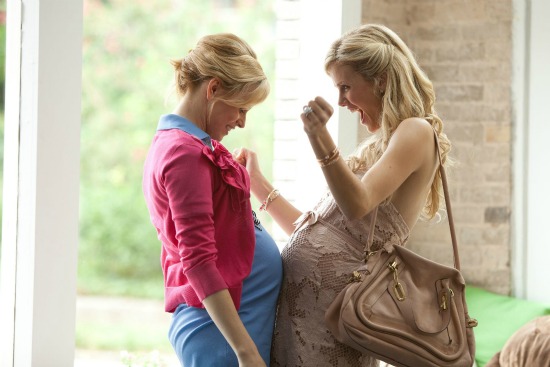
Jules (Cameron Diaz) is a celebrity fitness trainer who just won a "Dancing with the Stars"-type reality show and fell in love with her gorgeous dancer to boot. They're rich, famous and busy, and find there's not much they truly agree upon.
Wendy (Elizabeth Banks) runs a store called The Breast Choice devoted to everything about having a baby, but she and her hubby Gary (Ben Falcone) have had trouble conceiving on their own.
Gary's dad Ramsey (Dennis Quaid), a retired race car driver, knocks up his second wife with twins. She's younger than Gary, a plastic-y Barbie type who makes pregnancy look like a breeze.
Holly (Jennifer Lopez) and Alex (Rodrigo Santoro) can't get pregnant, so they look to adopt a baby from Ethiopia. Alex is getting cold feet, which gives Holly the jitters.
The last couple is Rosie (Anna Kendrick) and Marco (Chace Crawford), early-20s owners of competing food trucks and recovering from a high-school split. They get back together for a one-nighter, she gets knocked up, and then they have a lot of Very Important discussions to share.
I genuinely enjoyed the Wendy/Gary storyline, with Banks getting some of the best lines and scenes as a woman who's spent her adult life pushing the motherhood-is-magic theme, only to find it's more about cankles and hemorrhoids. "I didn't get 'The Glow,' I just got bacne."
The one with the young kids is given the shortest shrift, which is OK since it feels like it was only included to rope in a certain demographic.
The Dudes, a club for dads to hang out with their kids, are also worth a laugh or two, with their mantra of total acceptance of each other's substandard parenting. But their sequences bring the movie to a dead stop.
I wasn't expecting much from "WTEWYE," but audiences certainly deserved more than this.
1.5 stars out of four