Showing posts with label George Segal. Show all posts

Monday, February 27, 2017

Reeling Backward: "Carbon Copy" (1981)


I remember "Carbon Copy" as one of the first "grownup" movies I was allowed to see in the theaters. It's a film that's more notable for its place in cinematic history than the actual merits of the flick itself, though those are not inconsiderable.

Topping the list is the film debut of Denzel Washington. If you were to draw up a list of the greatest film actors of the past 30 years, here would be mine (in no order): Meryl Streep, Morgan Freeman, Tom Hanks, Anthony Hopkins, Denzel Washington. Oh, and Jeff Bridges... he's quieter than the rest, but no less deserving.

Washington gets the "...and introducing" treatment here at the end of the opening cast credits. It's not exactly an auspicious debut for someone of his stature, and the film has largely been forgotten today.

Mostly that's owing to its racial themes, which were mildly progressive for 1981 but seem hopelessly antiquated -- even a little insensitive -- for today. Not to mention that almost instantly obsolete title, a reference to an early form of document reproduction that I would guess few under age 40 even recognize.

Screenwriter Stanley Shapiro had a busy career for three decades, a comedic master who was nominated for the Oscar four times, winning once for 1960's "Pillow Talk." This was back in the day when the Academy wasn't shy about recognizing funny movies, unlike today.

(Unless it's comedy of the pitch-black variety, a la "About Schmidt" or "The Descendants.")

Shapiro's last feature film credit was the wonderful "Dirty  Rotten Scoundrels" in 1988. His screwball comedy roots and rapid-patter style of dialogue are evident in "Carbon Copy," a movie that always seems like it's in too much of a hurry. Scenes race to their conclusion like the spirit of Louis B. Mayer was sitting behind director Michael Schultz with a stopwatch.

Speaking of Schultz, he was a notable African-American director working in mainstream Hollywood for decades, with credits like "Sergeant Pepper's Lonely Hearts Club Band," "Car Wash" and a number of Richard Pryor comedies. Approaching age 80, he's still active in television today working on popular series like "Arrow" and "Black-ish."

Washington's character starts at the forefront of the story, and gradually gets pushed aside. "Carbon Copy" is really a star vehicle for George Segal, who plays Walter Whitney, a harried 41-year-old Los Angeles corporate executive squeezed from all sides by his shrew wife, Vivian (Susan Saint James), and his boss, Nelson (Jack Warden), who's also his father-in-law.

Then 17-year-old Roger Porter (Washington) shows up on is doorstep, claiming to be his son from a long-ago romance with an African-American woman. The setup is that Walter truly loved Roger's mother, but sold out to marry into money and the big time. Nelson insisted that Walter cover up the romance so as not to upset the WASP elite of San Marino, a tony suburb of L.A., as well as change his surname from Weisenthal to Whitney, for similar reasons.

Walter's not a bad guy, but he's reaping the whirlwind of bad life choices all coming back to haunt him at once.

The movie opens on an... uncomfortable note. Walter awakens Vivian with demands for sex, the result of long pent-up frustration, which grow increasingly strident, only to be dispelled when the maid walks in on them with a silver breakfast platter. Vivian even whips out the "r" word, and she quickly reports the whole episode to daddy, resulting in a talking-to from the old man.

Nelson is a real piece of work. He's an old-school sort who believes it's the duty of the rich and powerful to stay that way. But he's got his charms.

On the one hand, he wields the carrot of reminding Walter that he can become The Man one day if he follows the straight-and-narrow path, while also threatening the stick of blackmailing him about his black bastard son and Jewish heritage.

Nelson genuinely wants Walter to follow in his footsteps, even if he has to hammer his feet to a pulp to make the shoes fit. "Learn to trust unhappiness, Walter," he counsels.

Washington is a revelation from the moment we first lay eyes on him. Just 23 when the movie was shot, he's a lithe and charismatic presence from the get-go. He adopts the demeanor of a streetwise tough, waltzing into Walter's office and admiring all the trappings: big oak desk (soon adorned by Roger's feet), three-piece suits, expense account lunches, Rolls Royce company car, etc. He makes out like he's looking for a payday.

In the end, it's revealed that Roger is actually a smart, hard-working kid who graduated from high school early and is already in his second  year of pre-med at college. He just wanted to meet his old man, take his measure and see what happens next. Part of him would take great delight in seeing his world unravel -- which is exactly what happens. But he finds himself burdened with a growing fondness for Walter.

Questions of parentage are quickly set aside for storytelling convenience -- despite the only ostensible proof of progeny being some old letters of his mother's Roger found after her death. (Speaking of which: for someone who just lost his mom, he doesn't seem very broken up about it.)

The movie doesn't take time to really explore how a middle-aged guy like Walter feels about having a black son, moving right into screwball comedy territory. First he introduces Roger to Vivian as their summer guest as part of a program for underprivileged kids, after convincing her that all the other rich wives of San Marino will want "one" -- and she'll be the first.

Mere minutes into this new arrangement, however, Walter corners his wife with a hypothetical about accepting Roger if he were his "natural" son, just as he has (grudgingly) accepted and adopted her daughter from a previous marriage, a spoiled brat of the first order. When she takes the bait and Walter reveals that Roger really is his son, everything falls apart quickly.

He's thrown out of the house, loses his job, has his Rolls impounded and all his credit cards cut up, his assets frozen, etc. His oldest friend and attorney (Dick Martin) even drops him as a client to represent Vivian in the divorce. The lawyer he refers him to -- of course a black guy, played by Paul Winfield -- tells Walter all he's got in the world is whatever he has in his wallet, some 62 dollars.

He explains to Walter that he's being forcibly put through "social menopause:" "You're going through a change of color, Mr. Whitney. You don't want to play the game as a white man, so they're going to let you watch it as a black man."

That's of course going too far. Being a penniless, socially outcast white man in 1981 was still preferable to most iterations of black life of that era. Read a certain way, the film is a cautionary tale during the early days of Reagan.

Anyway, Walter and Roger suffer the life of paupers -- for a few days. He can't get a job after being blacklisted, so he takes to day labor cleaning out horse stalls (still wearing his three-piece to the gig). This leads him to reflect upon his new life of shit, and the resolve it brings. "I'll shovel it. I'll live in it. But I won't take it."

Meanwhile, Roger pawns his golf clubs and other stuff for cash to get them by another day. He also reveals that he has a car of his own that he bought for "$14 and a toaster," which is a comically battered 1959 or '60 Chevrolet Bel Air, the front end mangled and one tire wobbling like a dancing hippo.

"Carbon Copy" takes the issue of divisions between black and white and between rich and poor and turns it into a prank, a springboard for laughs rather than social observation. For example, there's a scene where Walter, desperate for cash, challenges an out-of-shape father and son to a game of basketball for five bucks, thinking he's got a ringer because every black kid can play hoops, right? And of course Roger turns out to be completely inept, sailing the ball eight feet over the backboard.

We're never quite certain of how deeply the film is in on its own joke. Is that scene funny because of Walter's presumptions about black athletes, or our own? Are we laughing at the African-American who can't shoot a basketball, or at Walter for assuming that he could?

Thank God, at least the movie doesn't have a dancing scene.

I can't quite bring myself to dislike "Carbon Copy," however. The dialogue is still snappy even if the plot feels like it's hopped up on speed. And the cast is a pure pleasure: the folksy, slightly neurotic charm of George Segal, and young Denzel Washington feeling his oats on the big screen.

Sometimes great things arrive unheralded.


Monday, January 13, 2014

Reeling Backward: "The Hot Rock" (1972)


"Not me. I’ve got no choice. I’m not superstitious, and I don’t believe in jinxes, but that stone’s jinxed me and it won’t let go. I’ve been damn near bitten, shot at, peed on, and robbed. And worse is gonna happen before it’s done so I’m taking my stand. I’m going all the way. Either I get it, or it gets me!"

That's a line of dialogue from "The Hot Rock" that I'm not sure if it came out of the typewriter of screenwriter William Goldman or author Donald E. Westlake, who wrote the book. I highly suspect the former, because Goldman -- one of the most celebrated script men of all time -- has a penchant for giving main characters long-ish speeches where they more or less tell you everything you need to know about them.

That line is from Dortmunder, a career thief played by Robert Redford, talking about a massive diamond he and his team are after at the behest of an African diplomat named Dr. Amusa (Moses Gunn). Dortmunder has had a run of bad luck during his life in crime; indeed, as the story opens he's just getting out of a long prison stint.

He takes the job, even though he has every intention of taking up the plumbing trade he learned behind bars, because his brother-in-law Kelp (George Segal) convinces him to. It's fun to see Redford play a character who is inherently pessimistic and downbeat -- he even chews a special medicinal gum to soothe his pre-ulcerous stomach.

They case the museum where the diamond is held, leading to another great exchange of dialogue as he explains their likelihood of success:

Dortmunder: "It's good, and it's bad. There's a guaranteed return, and that's good. But the guarantor is Amusa, and Amusa's a rookie, and that's bad. But it's an easily transportable object, and that's good. Only it's in a rotten position in the museum, 30 steps to the quickest exit, and that's bad. And the glass over the stone, that's bad too, because that's glass with metal mixed in it, bulletproof, shatterproof. But the locks don't look impossible, three, maybe five tumblers. But there's no alarm system, and that's the worst, because that means no one's going to get lazy watching, knowing the alarm will pick up their mistakes. Which means the whole thing has got to be a diversion job, and that's good and that's bad, because if the diversion's too big, it'll draw pedestrians, and if the diversion's not big enough, it won't draw that watchman."
Kelp: "Dortmunder, I don't know where the hell you are, or what the hell you're saying. Just tell me, will you plan the job?!?"
Dortmunder: "It's what I do."

The basic joke of this comedy-caper is that the crack team of criminals are very good at what they do, but something always seems to go wrong and they keep having to steal the same diamond over and over again.

They successfully distract the guards by having their wheel man, Murch (Ron Leibman), crash a car in front of the museum and pretend to be injured, while their explosives guy, Greenberg (Paul Sand), portrays a doctor helping out. But things go awry and Greenberg is arrested after swallowing the diamond.

Then it becomes a prison break movie, with Dortmunder and the team forced to get Greenberg out. Then they learn he stashed the diamond in the holding cell at the 9th Street police station, so they have to break in there with the help of a helicopter and more diversions.

Finally, after learning Greenberg's father, a slimy attorney played by Zero Mostel, has double-crossed them all and hidden the diamond in his bank safe deposit box, they have to break into there, strong-arming the bank clerk with the help of a hypnotist.

The movie's not terribly funny, but the caper bits are really inspired and nerve-wracking. Director Peter Yates, know for "Breaking Away" and "Bullitt," has a tight feel for action scenes, while simultaneously knowing how to make each character vivid and distinct.

The film contains several notable aspects. While they're flying the helicopter to the police station, Murch -- a novice at piloting a chopper, but insisting "I can drive anything!" -- nearly crashes into the South Tower of the World Trade Center, which was then still under construction. Christopher Guest makes his film debut with a bit part as a cop at the police station.

I also thoroughly enjoyed Robert Redford in a non-golden boy role, playing a man who's a ball of nervous energy and low expectations for himself. The part at the end where Dortmunder, having successfully retrieved the diamond from inside the bank, walks away is just a treat.

He finally has a bounce in his step, and Redford practically floats above the sidewalks of New York City, almost seeming to dance his way into the arms of long-elusive success.


Monday, November 18, 2013

Reeling Backward: "King Rat" (1965)


"King Rat" is very different from your typical prisoner of war movie. It's not about grand escape attempts or antagonism with their captors -- indeed, the Japanese do not even show up until more than 30 minutes in, and only appear briefly a few more times.

Although its main character is a flimflam man who unofficially rules the camp through his scheming and black market deals -- much like William Holden in "Stalag 17" 12 years earlier -- it's not really about that, either. Rather, it's a deep and probing look at the relationship between two very different men, and how the travails of imprisonment push them to form inseparable bonds ... or not.

Corporal King (George Segal) is the ruler of the roost, despite having one of the lowest ranks in the POW camp. He has a senior sergeant (Patrick O'Neal) as his personal lackey, and gives impertinent answers to any query by an officer into his doings. Peter Marlowe (James Fox) is a terminally stiff-upper-lip British lieutenant who speaks the local dialect, and is recruited by King as his interpreter and right-hand man.

At first Marlowe is mortally insulted at King's offers to pay him for his services, insisting that's not how an English gentleman conducts himself. He helps King, but only out of a sense of friendship -- though he does accept food, favors and later a little cash for his efforts. It's a delicious exploration of the differences between American and British culture, with the latter considering it humiliating to be seen striving too much.

King, meanwhile, is an enterprising soul. Indeed, capitalism seems to be the only thing residing in his nature. Everything to him is a contest, a game of one-upmanship, a quest for profit.

The sale of a Rolex watch from an older British officer to one of the prison guards is instructive. The officer wants at least $1,200, knowing the watch is worth 3,500. King, acting as the middleman with Marlowe translating, talks the guard up from 400 to 2,200. But he tells the officer he only got 900, leaving him with 810 after King's 10% commission.

He then gives Marlowe his cut of $108, who doesn't want to take it, seeing it as a form of theft. But King fills him in. The guard will quickly resell the watch at a handsome profit, so he's happy. The watch was actually a fake, so the officer thought he was fooling both King and the guard, so he's happy. King duped them both and, being the smartest, took the lion's share of the stake. Reluctantly, Marlowe claims his share.

In this sense, "King Rat" is less about a con man than how that man relates to others in horrible circumstances.

The thing that really stood out for me about "King Rat" was how well writer/director Bryan Forbes, adapting the book by James Clavell, depicted the plight of the prisoners of the Changi prison camp near Singapore -- mostly Brits and Aussies but a few Yanks, too. Either they exclusively hired actors and extras who were extraordinarily skinny, or the cast members were deprived of food to get just the right look.

Remember when Christian Bale famous starved himself for "The Machinist?" That's what most of the men we see are like -- hollowed-out chests, sunken cheeks, toothpick arms and legs, stark rib cages. They're filthy, wear scraps of rags that used to be their uniforms, and have open sores or wounds.

Food is the number one concern of their daily existence. Each man exists on a quarter-pound of rice per day, and dysentery and other disease are rampant.

Forbes makes the audience really feel their hunger. The only other movie I can think of that even comes close to projecting the same level of desperation is "Empire of the Sun."  I think of the way all the animation goes out of the men's faces when a tasty morsel is shown in their presence. They practically turn into slavering dogs.

Speaking of dog: perhaps the most pivotal scene in the movie is when King cooks a stew of dog meat for his closest chums, i.e., the people who work for him as various henchmen in his nefarious activities. The dog was the pet of one of their fellow prisoners, who was ordered to put it down when it killed one of the camp's valuable egg-laying hens. King "acquired" the carcass, but makes a point of not telling his guests it's dog until he's dishing out plates and they're literally slobbering at the smell.

This sets off a brief but not terribly enthusiastic debate about the ethics of eating a friend's beloved pet. The men are just looking for King to give them an excuse to indulge. They want him to convince them it's silly to waste the flesh when people (but not them) are starving: "Meat's meat," he says, with characteristic bluntness. They happily give in to his urging, and we get the sense the entire endeavor was about King testing their loyalty.

King's other significant protein enterprise is with rat, giving the book and film its name. They get their hands on a male and female rat and begin breeding them -- with the unwitting help of a British officer and zoologist, whom they bribe to tell them all about the gestational periods and eating habits of vermin. Once their rat operation is big enough, they start selling off the meat, passing it off as mouse deer, a local delicacy enjoyed by the natives.

Two notable things about the rat meat business: they only sell to high-ranking officers, "majors and above." Even King has his principles, and feeding rat to his fellow enlisted men and junior officers just seems wrong (and risky). Also, they only cut off the hind legs at first, so the animals can continue living ... and making more little rats.

King differs from the other prisoners in keeping an appearance virtually unchanged from what you'd see of soldiers on their home base: crisp clean uniform, neatly trimmed and combed hair, fresh shave and manicure. Though Segal is slim as an adolescent boy, he seems well-fed by the standards of the prison.

He struts around the camp like a peacock, drawing the stares and resentment of the half-dead, bedraggled creatures around him. He also provokes the ire of Grey (Tom Courtenay), the provost-marshal, aka chief law enforcement officer in the camp. A snide protector of the old world order, Grey is incensed at seeing an upstart American running roughshod over the rules -- and enlisting British officers into his criminal web.

Justice is harsh and quick at Changi prison, and stealing food is seen as the worst possible crime. Early on, when one of the bags of rice comes up a couple of pounds short, the suspected (though never proven) culprit winds up face-first in a borehole. The prisoners use these to collect cockroaches and other bugs for protein -- and also as a way to execute offenders in a dark and cruel manner.

The film concludes on a note that is simultaneously joyous and depressing. Marlowe's arm is injured and turns gangrenous, precipitating the need for an amputation. King sticks his neck way out to obtain the medicine necessary to save his life and the arm. Marlowe returns the gift with his unwavering loyalty.

But one day out of the blue, the Japanese commander announces that his country has surrendered, and the war is over. Soon after a lone British soldier (Richard Dawson!) walks up and disarms the guards, officially ending the prisoners' captivity.

After a period of shock, the POWs go into a wild jubilation at the end of the war, but King retreats away from his criminal activities and his friendship with Marlowe. He knows the real world is about to reassert itself, and he'll go back to being a lowly corporal on the make. He abruptly snubs his British mate, calling him "sir" like it's a vile insult.

As he rides away from the camp with the other American soldiers, I think King really did feel a sense of affection for Marlowe. But he's also a hardcore pragmatist, and he knows that clinging to a false sense of equivalency will only lead to disappointment.

This is a strange and beautiful film -- it earned Oscar nominations for black-and-white cinematography and art direction/set decoration -- and a coldly compelling one. Its harsh and authentic depiction of POW life, and its total lack of sentimentality in its main character, are unique among other World War II movies.

"King Rat" hasn't maintained much of a reputation as the years have raced on. But I deem it a forgotten minor masterpiece.


Monday, October 22, 2012

Reeling Backward: "The Bridge at Remagen" (1969)


By 1969 American attitudes about warfare had changed considerably due to our being mired in Vietnam, and it's hard not to miss how this was reflected in war films about previous conflicts.

"The Bridge at Remagen" wears the clothes of a heroic war picture, but it's got a hippie-pacifist bent to it. And it's not just that the soldiers are depicted in a more realistic way, or that the story focuses more on the madness of war rather than the "band of brothers" ethos that had ruled heretofore.

What's most notable is the way the soldiers, both American and German, talk back to their superiors and defy orders that they consider inhumane or illogical. At one point, a surly sergeant belts a major after he's ordered them to undertake a dangerous mission that will cost many of them their lives. The major lies on the ground sputtering ineffectually about a court-martial, while his attacker ignores him and turns away to go about his duty.

I.e., in these sorts of pictures the soldiers do what's expected of them, but not before letting everyone know how they really feel.

In a John Wayne picture, this would be played out as the cowardly youngster cracking under pressure and taking a swing at the officer bearing the lonely burden of command. (The Duke probably also would've blocked the punch or decked the kid in retaliation.) In "Remagen," it's a rah-rah moment where the righteous upstart gives it to The Man.

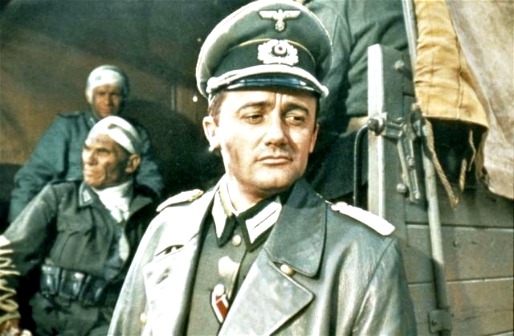
George Segal plays Lieutenant Hartman, a young and effective platoon leader who's sick to death of the war. He and his men have been the bleeding edge of the Allied advance for awhile now, and they're bone-tired and fed up. When they get picked to lead the assault on the Remagen Bridge, Hartman can barely contain his anger.

Hartman is respected by his men because he's a cautious leader who strives to keep casualties to a minimum, but is not well-liked. And that's because he does little to curry their favor or loyalty. When one of his underlings calls him a cold bastard, he wheels on him and demands to know how much the man owes him in gambling debts. "$78.50 ... that's all you're worth to me," he sneers.

Of course, in the end Hartman manages to start behaving more in the mold of a kindler, gentler commander. As they take the bridge inch by bloody inch, the pain of every man who falls is etched on his face. In the end he "captures" the bridge head by wandering in a daze toward the German line, and is greeted by the enemy commander waving a white flag.

It's an act of resignation, not heroism, but the result is the same.

His right-hand man and antagonist is that surly sergeant, Angelo, played by Ben Gazzara. Angelo has a habit of raiding all the dead corpses for loot which he then sells to his fellow soldiers, bragging that he intends to come out of the war a rich man. Hartman expresses his disgust, but doesn't lift a finger to stop him. He also stops Angelo and the other men from raping a French woman they stumble across, and in return she offers herself to him as a reward -- which he refuses. He's just too exhausted to summon up even lust. Then comes the order to take the bridge.

Speaking of that bridge. Remagen was notable because it was the last intact bridge over the Rhine River, with the German fatherland lying upon the other side. A later, superior WWII movie, "A Bridge Too Far," would chronicle a failed plan by the Allies to capture other bridges leading into Germany in 1944. By the spring of 1945 as depicted in "Remagen," the Germans had destroyed all the other bridges and were waiting to blow up this one only because a large part of their army was still trapped on the wrong side.

Robert Vaughn plays Kruger, the German major who's tasked with destroying the bridge. His commanding general, a friend, secretly gives him an order to hold the bridge for as long as possible so the retreating German forces and civilians can get across. Kruger is promised 1,600 men and prime weapons and explosives to do his job, but upon arrival finds only 200 soldiers, most of them wounded or reserves who are green boys or old men, and weak industrial explosives.

This was another reflection of the times in which the movie was made. Rather than portraying the Germans as all vicious Nazis, or even as noble enemies, "Regmagen" shows the Germans as being a reflection of the Americans. Though the footmen don't give lip to their officers quite like the Americans do, the officers do question and twist their orders if they deem them inappropriate. Vaughn plays Kruger as a man of steely conviction whose resolve is drained by the ordeal.

Director John Guillermin stages some well-crafted battle scenes, including complex sequences involving tanks, mortars and artillery. It was interesting to me in that it actually showed how the foot soldiers interacted with the heavier arsenal. Usually we just see things from the perspective of the dogfaces on the ground. The tanks also move incredibly fast -- I'm not sure if I've ever seen another film where the steel beasts are shown rumbling along at breakneck speed like that.

The screenplay by Richard Yates and William Roberts is pretty much all Hollywood hooey, with the exception of what happened to Kruger and his superior officers -- they were executed for allowing the bridge to be taken by the Americans. Their intentions were good, trying to save countless thousands of German lives, but they still failed in their mission, though largely through no fault of their own.

As Kruger is about to be shot, he hears planes flying overhead and asks, "ours or theirs?" Told they are those of the enemy, he ponders, "But who is the enemy?" It's a heavy-handed moment, where one of the characters essentially blurts out the entire theme of the movie. Always better to show, not tell.

2.5 stars out of four


Friday, April 30, 2010

Reeling Backward: "Ship of Fools" (1965)


There's a lot of stuff to like about 1965's "Ship of Fools" -- aptly described as "Grand Hotel on a boat." But overall it's a heavy-handed bit of social commentary along the lines of "On the Beach," which was recently featured in the Reeling Backward column.

That's no surprise, since both films were directed by Stanley Kramer. Kramer had a long and illustrious career as a producer and director, and often gravitated to material with a social conscious. Often the results were sublime ("Guess Who's Coming To Dinner," "Judgment at Nuremberg") but sometimes it feels like a big lecture.

The cast of "Ship" is huge -- Lee Marvin, Janet Leigh (in her final film role), Simone Signoret, Jose Ferrer, Oskar Werner, George Segal, Heinz Ruhmann, Michael Dunn, Jose Greco, and on and on.

It's all one big circus of human frailties and prejudices. It's set aboard a German ocean liner in 1933, just when Nazism is on the rise. Virtually every Western society is represented, and almost always in a negative light.

The only truly good characters are the outcasts: The Jew and the dwarf. They sit together at their own dining table, even though the rest of the German passengers get a seat at the captain's table.

Dunn, who was one of the first Little Persons to have a serious dramatic film career, even takes on the role of the narrator who addresses the audience directly at the beginning and end -- not so subtly indicting those watching the movie for having the same flaws as the poor creatures they just watched.

Leigh is great as Mrs. Treadwell, an aging divorcee whose bitterness about the tatters of her own hopes and dreams seems to infect all of her interactions.

Marvin has an awful role as a racist American Southerner and ex-baseball player whose biggest problem in life was that he couldn't hit the outside curve ball. He spends most of the movie tomcatting after this feminine object or that. He's depicted, quite explicitly, as an ape.

I could spend a lot of time describing the rest of the characters, but I think you get the idea.

The centerpiece of the film is the plight of the ship's Dr. Schumann. Disaffected and estranged from his family on shore, he falls for a rich Mexican woman whose paramour has been deposed. Because of her habit of aiding the poor and needy, she's being deported to Spain, a country she's never been to.

A high-class drug addict, she gloms onto Shumann for her fix, but they soon recognize the same world-weary resignation in each other. Their romance is doomed from the start, and they both know it, but they can't help stirring the embers of their youthful passions.

I also liked Jose Ferrer in this film -- but then, it is virtually impossible not to like Jose Ferrer in anything. He plays a rich industrialist and early proponent of eugenics and Nazism. A raconteur who enjoys shunning those who do not live up to his definition of proper Germans, he spends most of his time chasing a nubile blonde German half his age. There's no meanness to the performance, though, but rather the wayward pride of a man who has confused patriotism with elitism.

There's a lot to take in with "Ship of Fools." But its high-mindedness gets the better of it.

2 stars out of four