Showing posts with label film. Show all posts

Friday, July 24, 2009

Johnny Got His Gun

It's been said that every war movie is an anti-war movie, but I'm not sure that's true. "The Green Berets" is an overtly pro-war movie, with John Wayne making the case for American involvement in Vietnam. Even "Saving Private Ryan" and other films that extol the tremendous human cost of war do so through thrilling action scenes that are often as attractive as they are repulsive.

Dalton Trumbo's 1971 film "Johnny Got His Gun" is the epitome of a truly anti-war movie. Made during Vietnam but set during World War I, it looks contemptuously upon not only those two wars but all armed conflict between men. Old men are meant to sit at home and send young men to war to die, is the explicit message. Even the defense of democracy is something to be sneered at.

The protagonist is the ultimate figure of sympathy: An injured American G.I. Not only that, but he's injured so badly that almost no one would want to continue to live in his condition. But the Army doctors keep him alive as a way to help scientific research of traumatic injuries.

Joe -- played by Timothy Bottoms, in his very first film role -- has lost both his arms and both his legs, and even his face has been obliterated -- "scooped out" by an artillery blast, to use his words. He cannot talk, eat, smell, see or hear. In essence, he is a stump of flesh attached to a brain, but one which cannot communicate with the outside world. All he can do is move his head a little, and feel vibrations when someone walks into his room.

The thought of living like this is abhorrent to most people, including me. Unable to connect with the real world, Joe spends most of his time remembering his life, or dreaming, or a hallucinatory combination of the two. Joe has long conversations with his father (Jason Robards), who offers him some advice on his current predicament. He also gets some help from Jesus (Donald Sutherland), who chats with Joe and some of his fellow soldiers, who all seem to know how and when they will die.

Trumbo, who had one of the great screenwriting careers, also directed this film -- his only stint behind the camera. It's too bad, because he showed himself to be an able and imaginative director.

For instance, he makes the bold choice to portray all the present scenes in gauzy black-and-white, which lends them a somewhat dreamlike feel, while Joe's hallucinations are crisp and colorful.

The film plays out as something like a parable, with Joe as the pure and innocent who has been used shoddily by an uncaring world devoted to war and power. It would make a wonderful play, with Joe never emerging from beneath his mysterious tent of white hospital sheets and mask to hide his destroyed face.

(UPDATE: After writing this, I find that actor Ben McKenzie has done a stage version which is also being turned into a film.)

The military doctors keep Joe carefully locked away from the rest of the population, surmising that his condition would shock and anger other wounded soldiers. One nurse is sympathetic, though, and opens the shutters and strokes his forehead and unmarred chest tenderly.

"Johnny Got His Gun" isn't a film for everyone. It's not overtly violent or gruesome, but the horrid existence of this unfortunate young man is in some ways more disturbing than the goriest horror film. Such is war.

3 stars

Wednesday, July 22, 2009

Review: "(500) Days of Summer"


"(500) Days of Summer" is a thoroughly charming romantic comedy that's not built like a standard romantic comedy.

There is no contrived meet-cute moment. There is no long and arduous delay before they realize they are in love, with unlikely obstacles preventing the recognition of their passion. There is a big stumbling block that comes along to drive them apart, but it does not play out like a Julia Roberts or Sandra Bullock vehicle.

The stars are Zooey Deschanel and Joseph Gordon-Levitt, two twentysomething Gen-Yers with quirky personas and indie film cred. We believe them as a couple, and we believe them when they're threatening to split up. Their connection and the dissolution of it are both convincing, and entertaining.

Gordon-Levitt plays Tom, trained as an architect but working at a greeting-card company as a writer. I liked how even though this occupation is supposed to represent a dead end in Tom's life, it's still presented as a pleasant to work filled with people who get more fulfillment out of writing pithy sayings for cards than Tom does. Clark Gregg plays the boss, and when Tom is going through a rough patch with Summer he politely inquires about his employee's black mood, and switches him over to funeral and sympathy cards. In today's labor environment, this man qualifies as a saint.

Tom's life changes when Summer starts working at the company. He's totally smitten with her, but tries to hide it behind a veil of nonchalance. His dude-friends (Geoffrey Arend and Matthew Gray Gubler) and precocious preteen sister (Chloe Moretz) urge him to go for it. Tom would probably keep on dithering, until Summer corners him in the office copy room and plants a kiss on him.

Marc Webb directs from a script by Scott Neustadter and Michael H. Weber. All are relative newcomers (this is Webb's first feature film, and the second for the writers, who also paired up on this spring's "Pink Panther 2"), and bring a fresh voice and breezy tone to this genre.

The story is told in a non-linear fashion, with the title referring to how many days since Summer and Tom first met. It switches all around, though, so early on we know that they break up, at least temporarily, somewhere in the low 300s. Days 50-100 or so are the magic time, when they're in that "stupid love" phase, trying out the beds at the IKEA store while people are watching them.

Summer is upfront with Tom, explaining that she doesn't want a relationship right now. But he's a bit of a romantic, believing that the minute he laid on Summer he knew she was the one for him.

There's a magical scene where Tom is overjoyed after his first night with Summer, which builds into a big musical number in the park that bears a suspicious resemblance to the one in "Enchanted." I nearly fell over laughing when he checks his reflection in a window, and he's feeling so great he sees Han Solo staring back at him.

I won't say anything about how "(500) Days of Summer" ends, other than it's probably not what most people are expecting -- but it feels right. This delightful, smart and funny flick just fits.

3.5 stars

Monday, July 20, 2009

Reeling Backward: "Harold and Maude"


"Harold and Maude" is short, simple and perfect.

I first saw this wonderful movie in college, when I was about the age of Harold, the death-obsessed protagonist who falls in love with an 80-year-old woman. I figured it would be an absurdist comedy -- a 20-year-old boning a woman four times his age?!? -- but instead discovered a joyous movie about living life to its fullest, and in your own way.

I got to thinking about it again while reviewing "Adam's Rib," which Ruth Gordon co-wrote. It's astonishing to think that she was such a talented screenwriter -- thrice nominated for an Oscar -- and then transitioned into an onscreen performer. She'd made bit appearances here and there, but really launched her acting career in 1965, just shy of her 70th birthday.

Think about that. It sounds like a parlor joke: "Well, I got too old to be a writer so they made me an actress instead."

She went onto two more Oscar nominations for acting, including a win for "Rosemary's Baby." She was not nominated for her performance in "Harold and Maude," though, which is a travesty since it's the performance of her career.

Maude is a force of nature, but never feels like a cinematic contrivance. This vivacious, impish oldster meets Harold, who like her enjoys anonymously attending the funerals of strangers. She steals cars as a way of shaking people out of the comfort of their normal lives.

There's a great scene where Harold makes her a button at the carnival that says, "Harold loves Maude." She calls it the best present she's received in years, then immediately flings it into the harbor. He looks at her with astonishment: "Now I'll always know where it is."

The humor in the film comes from the tension between Harold and his mother, who wants to marry him off, or see him join the Army, or do anything besides mope around and pretend to kill himself. The scene where she invites a blind date for Harold, who arrives at their mansion only to see Harold apparently immolate himself, is a comedy classic.

People tend to think of "Harold and Maude" as a Hal Ashby film, but he merely directed it. It was dreamed up by Colin Higgins as an original screenplay -- his first feature film. He also wrote "Silver Streak," "Foul Play" and "Nine to Five" before dying young in 1988.

The final topping on the cake for this film is the soundtrack, comprised mostly of Cat Stevens songs. They just seem to capture the essence of the movie, in much the way the Simon and Garfunkel soundtrack did for "The Graduate" a few years earlier.

"Harold and Maude" is a movie about love, and hope. Even though the two main characters seem obsessed with dying -- one as an escape, the other as a release -- it is only because they found so much in life that made it worthwhile.

4 stars

Friday, July 17, 2009

Another video clip from "9"

I've posted about this forthcoming movie before, which I'm eagerly looking forward to. It's an animated film based on an Oscar-winning short from a few years ago. Check it out.

The film, appropriately enough, is being released on 9/9/09.


Reeling Backward: "Panic in Year Zero"


The early 1960s were the height of the Cold War, when the possibility of nuclear annihilation was a very real thing. We tend to look back on that era with a bashful nostalgia -- duck 'n' cover and all that. But to the people who lived in that time, the idea was pervasive that even if they survived a nuclear war, they'd have to struggle to survive in the chaotic aftermath.

"Panic in Year Zero" exists as a perfect document of those fears and mindset. It has a fairly mild message to it, personified by a typical middle-aged dad who finds himself doing all sorts of terrible and callous things in order to ensure his family's survival. "I went looking for the worst in others, and instead I found it in myself," he realizes near the end.

The father is portrayed by Ray Milland, who also directed the film. Nearing 60, paunchy and with a not very convincing hairpiece, Milland was in 1962 nobody's idea of a matinee idol. But he had a lengthy career, first as an able leading man -- he won the Best Actor Oscar for 1946's "The Lost Weekend" portraying a chronic alcoholic -- and then segueing into roles in cheap, schlocky films, and finally a third act on television. In all, he worked steadily for more than 55 years. Few could say as much.

I haven't been able to find any information on the budget for "Panic," but it's rather obvious that it was a cheapie. The entire cast probably doesn't number even a couple dozen, and most of it was shot outdoors as the family roughs it after the nuclear blast destroys their home in Los Angeles.

I have to admit to a certain affinity for stories like this, where people wander the wasteland after society's rules have broken down, and they must impose a new order of their own making. Stephen King's "The Stand" remains one of my favorite books, and "The Road Warrior" is a film I return to year after year, always finding something new.

The Baldwins were on their way to a weekend getaway when the mushroom cloud appears behind them. The father quickly surmises that they've got to find a safe place to hole up. After dodging insane traffic on the highways, the father takes increasingly desperate steps to protect his wife and teenage son and daughter.

First they buy a ton of groceries. When the hardware store owner won't let the father purchase handguns without a waiting period, he robs him. When a price-gouging gas station owner attempts to charge him $3 per gallon of gas -- how outrageous! -- he punches him out and takes off without paying. Later, he even lights the highway on fire so they can stop traffic and get across. At least one innocent motorist is consumed in the flames.

They finally find a cave, and set about building a stable camp life. Even when radio broadcasts announce that the military has set up refugee camps, Mr. Baldwin refuses to budge. It's more than about safety. The father has seen his world turned upside down, and his own vision of himself as a civilized man, too. At least out here I have some measure of control, he says, even though there are looters and rapists about.

"Panic in Year Zero" isn't a particularly good or bad movie, but the enjoyment in watching it today comes from the peek it gives us into Cold War mindsets of that era. The way people thought probably closely resembles how we all felt in the days after Sept. 11. It's been almost eight years without another large-scale attack on American soil, and it's amazing how fast complacency has crept up on us again. Somewhere in between paranoia and ignorance lies wisdom.

2.5 stars

Wednesday, July 15, 2009

Review: "Rudo y Cursi"

I'm not sure if I can remember a movie that started out so strong and took such a misguided turn as "Rudo y Cursi." This saga about two brothers who are picked literally off a dirt field to become national soccer stars begins as an insightful and vivacious portrait of rural Mexican life. Once they become rich and famous, though, it quickly devolves into a predictable and tiresome morality play that feels like a close cousin of those trashy telenovellas.

Gael Garcia Bernal and Diego Luna became international stars when they starred in "Y Tu Mama Tambien" eight years ago as lusty graduates out for a wild spin. "Rudo y Cursi" reteams them along with Carlos Cuaron (brother of Alfonso), who wrote the screenplay for "Mama" and this film, and also picks up directing duties.

Beto (Luna) and Tato (Bernal) are brothers -- or possibly half-brothers; it's not entirely clear -- who work collecting bananas in an outlying Mexican province. They're considered the best soccer (or football, as it's known everywhere in the world except the U.S.) players around, with Tato a flamboyant and prolific scorer and Beto (nicknamed "Rudo") a pugnacious goalie.

One day a recruiter named Baton shows up. While waiting for his flashy sports car to get fixed, he catches their game and immediately offers a pro contract -- but only to one of them. He already has too many clients and can only handle one more. The brothers agree to a penalty kick to decide, with the headstrong Beto instructing the somewhat dimwitted Tato to kick to his right. Alas, they get the my right/your right thing screwed up, and Tato gets the shot at the pros.

This infuriates Beto, since playing pro soccer has always been his greatest ambition, while Tato dreams of becoming a famous singer. Beto has his own problems, since he keeps gambling away the meager earnings his wife puts away for their two small children.

For awhile Tato rides the bench on his team, and Beto stews back at home. But then Baton calls up Beto for his own shot at fame, and Tato finally gets on the field and makes an immediate impact. Nicknamed "Cursi" by the media, soon he's got a swank house, a big SUV, a music video in rotation, and his girlfriend is the TV celebrity he used to slobber over back at his little village.

It's right around this time that the whole movie heads south. Given Tato's misplaced conception about both his musical abilities and the devotion of his lady, and Beto's inability to stay away from the poker table, the rest of the movie sets itself up exactly the way you would think. The last 45 minutes or is just waiting around for the inevitable to dominoes to fall where they must. Frankly, I was just waiting impatiently for the movie to end.

It's too bad, because the first half of "Rudo y Cursi" is as interesting and viscerally engaging as any film I've seen this year.

2.5 stars

Tuesday, July 14, 2009

Review: "Harry Potter and the Half-Blood Prince"


The Harry Potter saga is wrapping up, so one should think the next-to-last film would feel like it's building toward something monumental. (Well, next-to-next-to-last. They're splitting up the seventh and final book into two movies.)

Instead, "Harry Potter and the Half-Blood Prince" is disjointed and rambling. It finally gathers itself up for a powerful and tragic final act. But it dawdles excruciatingly along the way.

For a story in which this universe's version of the dark lord, Voldemort, is closing his black fist around the magical world, "Prince" seems awfully concerned with kissy-face. I realize Harry, Hermione and Ron are nearly grown now, and the various romantic entanglements hold a great deal of charm for the legions of fans. Still, it's hard to build a forbidding mood with so much snogging going on.

Harry (Daniel Radcliffe) and the gang seem to be a in a good place as their sixth year at Hogwarts begins. They fought off a usurpation of Hogwarts and the Ministry of Magic that Voldemort was secretly behind. Harry's relationship with headmaster Dumbledore (Michael Gambon) is stronger than ever, and the elder wizard enlists Harry's aid in dealing with Horace Slughorn (Jim Broadbent), the newest Hogwarts professor.

It seems the doddering Slughorn has an important memory regarding Voldemort, who used to be a student of his, but refuses to share it. Harry's assignment is to get him to spill the beans -- or, in this case, the misty magic memories they can pull out of their heads.

Meanwhile, romance blooms unhindered among the student body. I won't belabor all the details -- mostly because I can't grasp them all myself. Suffice to say that Hermione (Emma Watson) loves Ron (Rupert Grint), who's too busy dealing with an overly aggressive admirer to notice. Harry in turn fancies Ron's sister Ginny (Bonnie Wright), but doesn't want to rock the boat with his best friend.

The villainous work is left to Professor Severus Snape (Alan Rickman), who seems more foul-tempered around Harry than ever, and Draco Malfoy (Tom Felton), Harry's schoolyard nemesis since the day he arrived at Hogwarts. For the first time, Felton is given more to do than sneer and bully, and reveals Draco as a more layered character than we've seen before. It's clear that he's doing Voldemort's bidding, and keeps tinkering with a magical contraption in the Hogwarts attic, but his true motives are unclear.

The film's title comes from a mysterious potions textbook Harry acquires early in the school year. Its former owner, who calls himself the half-blood prince, has scribbled all sorts of helpful notes in the book that allow Harry to excel at brewing magic, thereby impressing Slughorn.
Director David Yates and screenwriter Steve Kloves, both Potter veterans, work their magic as best they can, but this chapter of the saga written by J.K. Rowling simply lacks cohesion. "Harry Potter and the Half-Blood Prince" is the spell that fizzled.

2.5 stars

Wednesday, July 8, 2009

Review: "Moon"

"Moon" is fully aware of the tradition of movies like "2001: A Space Odyssey" where people venture out into space and go totally off their gourd. The existential angst-in-space thing has been done well, and been done poorly (see "Solaris" ... or rather, don't). With "Moon," director Duncan Jones and screenwriter Nathan Parker take us to familiar territory, and yet make it seem fresh and vibrant by playing against our expectations.

Sam Rockwell, a character actor who tackles leading-man roles in smaller films like this, plays Sam Bell. He's an astronaut in the near future who's living on the moon, collecting energy from the lunar rocks that is used to power nearly the entire Earth.

It's a one-man gig, and needless to say Sam is crushingly lonely as he nears the end of his three-year hitch. He's looking forward to getting back to his wife and the daughter he's never met. Because of persistent satellite problems, he can only communicate with them through prerecorded videos.

Sam's only company aboard the space station is Gerty (voiced by Kevin Spacey), a robot caretaker very much in the tradition of HAL from "2001." Gerty moves around the base via system of track embedded in the ceiling, has a single camera eye and emotes via a screen that displays smiley (or not) faces.

There really isn't that much work to do other than occasionally driving out to the collectors to pick up a canister of condensed gas, which are returned to Earth via rocket probes. So Sam bides his time exercising, tending to his plants and working on a tiny model city.

One day on a routine trip, Sam is distracted and crashes his moon truck into the collector. He wakes up back at the base, with Gerty telling him he was injured in the accident. Gerty tries to lock him up in the base, but Sam manages to talk his way out and makes it back to the crash site, where he finds an injured astronaut who looks just like him.

This is merely the beginning of the story, but it's impossible for me to say more without ruining the film.

If you're like me, I thought I had the entire movie figured out at this point. Jones and Parker know what the audience is thinking, though, and use it to their advantage, dropping hints and possibilities.

For awhile, the two Sams steer clear of each other, and we wonder about them. Are they two sides of the same personality? Is one a clone of the other? Hallucinations of a dying Sam, still stuck out on the barren moonscape?

The answer is teased out, and when it arrives it lands with the impact of a giant asteroid. Rockwell plays the two Sams as similar yet distinctly different, like twin brothers raised in separate circumstances. The "old" Sam is peevish and sarcastic, while "new" Sam is more of a hothead.

Gerty's role in the scheme of things is somewhat in limbo. He was programmed by the corporation that owns the base, but seems to have a genuine desire to help Sam in any way he can.

"Moon" is a hard movie to review, since to tell you how wonderful it is I have to give everything away, which I will not do. But here's this: Now that the Oscars have expanded the roster of Best Picture nominees to 10, hopefully it will allow outstanding smaller films like this to make the list.

3.5 stars

Wednesday, July 1, 2009

Review: "Public Enemies"

"Public Enemies" is a slick and stylish drama about John Dillinger and a few other infamous gangsters of the Great Depression era, and the G-men who hunted them down. I'm not sure it really adds up to much, but director Michael Mann ("Heat," "The Insider") spews out such a dense and enchanting cloud of period atmosphere, we don't mind so much that the story occasionally gets lost in the fog.

Johnny Depp gives a fairly straitlaced (for him) performance as Dillinger, playing the Indianapolis-born bank robber as man who (in his own words) likes spending money, movies, fast cars and women. He has an almost icy confidence, brushing aside lawmen and their schemes to catch him as if they were minor annoyances.

The script, by Mann, Ronan Bennett and Ann Biderman, strives to preserve the bulk of historical accuracy regarding Dillinger, but takes a few liberties. For instance, there's a scene right at the height of the manhunt for him when Dillinger is dropping a girl off to get her waitressing license, which happens to be at Chicago police headquarters. So he decides to go in and wander around -- even popping in at the FBI office dedicated to capturing him.

Such a thing is part of Dillinger's legend, and adds to the cinematic version of Dillinger as a man who thought he could always skate by on guts and smarts. And Dillinger really did hide out in the open, bribing police to protect him and making little attempt to conceal his identify from everyday folks.

One day while enjoying the fruits of a recent heist at a nightclub, he spots Billie Frechette (Marion Cotillard). While having their first dance, she lets him know she is part American Indian and a mere coat-check girl, facts which put some men off. He returns her honesty by telling her he's John Dillinger, public enemy numero uno.

Christian Bale plays Melvin Purvis, the FBI man assigned to bring Dillinger in. It's not really a mano-e-mano type of relationship like Elliot Ness vs. Al Capone in "The Untouchables." Bale and Depp share only a single scene together, after Dillinger has already been captured (temporarily) by some other lawmen, and taunts Purvis for killing Pretty Boy Floyd with a shot in the back.

Much of the movie's charm comes in crisply-edited depictions of actual Dillinger exploits, such as when he escaped from a Crown Point, Indiana, jail with the use of a wooden gun. There's a terrific scene where Dillinger, having stolen the female sheriff's personal Ford, is idling at a stoplight as a small army of soldiers guards the area. Mann just languidly cuts between Depp, the red light and the soldiers, and lets the moment simmer.

Other capers are just as enjoyable, though clearly pure fiction. One bit has Dillinger and his gang sitting in a movie theater when an announcement comes up about them, warning that Dillinger could be sitting right next to you, and imploring the audience to look around.

The G-men parts of the movie aren't nearly as enticing, with Billy Crudup as a power-hungry J. Edgar Hoover using the press to garner support for increased federal crime fighting power. There's also a subplot about Dillinger getting spurned by the organized mob that's mostly dead end.

At 139 minutes, "Public Enemies" is a bit long-winded. It may not be anything more than a good cops-and-robbers yarn, but the parts that do sing, sing brightly and smart.

3 stars

Friday, June 19, 2009

Reeling Backward: "Fury"

"Fury" is one-half of a great movie.

This 1936 film was Spencer Tracy's big break-out role, and also marked the Hollywood debut of the great German director Fritz Lang, who had wisely fled to the States in the wake of Hitler's rising persecution against the Jews. Alas, his American films would never reach the pinnacle of "Metropolis" or "M."

The first, and best, half of "Fury" is an exploration of mob mentality, as innocent everyman is persecuted for a crime he didn't commit. The second half is a revenge story/courtroom drama, as Tracy connives to get his comeuppance against those who did him wrong.

The second half is not bad -- it's just that we've seen it a million times before. The revenge story is a common cinematic theme, in everything from "The Count of Monte Cristo" to "Darkman."

And the fact that Tracy's character, Joe Wilson, does not actually participate in the trial (because everyone thinks him dead) means he's essentially on the sidelines. So most of the attention is focused on his fiance, Katherine Grant, who does the whole damsel-in-emotional-distress thing. Perhaps this is not a coincidence, since Katherine is played by Sylvia Sidney, who was a bigger star than Tracy at the time, and in fact got top billing in the film.

Joe basically just hangs out in a seedy motel, listening to the trial on the radio, and occasionally manipulating events in his favor.

The first half is where Fritz Lang really shines. Joe is on his way to marry Katherine after a long separation, and gets pulled over by some bumpkin deputies. He bears a superficial resemblance to the description of one of a trio of kidnappers, so he gets hauled into jail until the district attorney can figure out whether he's really involved.

But one of the deputies, angry at being teased at the local barbershop about their lack of progress on the kidnapping case, blurts out that they've got a man in custody. A whispering campaign -- perpetrated mostly by women, interestingly -- soon reaches the ears of some rowdies at a local bar, enjoying the suspension of Prohibition. They convince themselves the man must be guilty, and don't want to wait for the law to take its meandering course.

The group keeps saying they just want to talk to Joe Wilson to ascertain the truth for themselves, but it quickly devolves into mob mentality, with a lynching the inevitable outcome. Meanwhile, Joe cowers in his jail cell with his dog, Rainbow, who escaped his own confinement to be with his master.

There's a great scene where the mob is confronting the sheriff, who refuses to give in. Lang sends his camera fleeing over the faces in the crowd, showing how their passion is stirred by the shared sentiment. It's as if the crowd is a dutch oven, melting the diverse ingredients into a single concoction, and heating it to boiling point.

Despite the way it careens into a totally different track halfway through, "Fury" is a worthwhile look at a rising star, and the devolution of the crowd.

3 stars


Wednesday, June 17, 2009

Review: "The Proposal"


"The Proposal" starts out as a really great screwball comedy, with Sandra Bullock and Ryan Reynolds trading fast-paced zingers with enough snap and zest to make one recall "His Girl Friday." Then, inevitably, it contracts a case of the sappies and gets all serious and gooey, and lines up all the clichés of the romantic comedy, and hits them like tripwires.

Bullock plays Margaret Tate, the boss from hell, who clocks around her New York publishing office in high heels that herald doom on the march. Indeed, the cubicle worker drones send text alerts that pop up on every computer when she's on the move, warning "the witch is on her broom," so they can duck for cover.

It would be the duty of Margaret's assistant, Andy Paxton, to inform her about nasty messages like that, if he weren't the one sending them. After three years of mindless toadying, he's desperate to be promoted to book editor.

So desperate, in fact, that when Margaret curtly informs him that they're going to be married, he goes along with it. It seems she's a Canadian with immigration problems, and unless she gets hitched, and soon, she loses her job and her home. Andy extracts a promise to be promoted, so both of them look upon it as a mutually beneficial business arrangement.

Until, that is, they fly up to visit Andy's parents (Craig T. Nelson and Mary Steenburgen) in remote Sitka, Alaska, to play up the charade for an immigration investigator who smells fraud. Of course, while basking in the glow of Andy's good-hearted family -- not to mention forced to share a bedroom -- they suddenly realize that they are, in fact, in love.

Ugh.

Now, it is a long-standing Hollywood tradition to make us believe that a man and woman can fall in love in a matter of days. But frankly, Margaret and Andy are so much more entertaining when they hate each other, that when they start to exchange doe-eyed stares, it's a comedown.

Especially with so much delicious repartee flying, courtesy of rookie screenwriter Peter Chiarelli. I loved the moment when Margaret first sees Andy's parents' palatial home, and accuses him of being "an Alaskan Kennedy." Another funny bit is when they're boning up on personal information a couple should know about each other, and she quizzes him what her allergies are, and Andy immediately comes back with: "Pine nuts -- and the full spectrum of human emotion."

Director Anne Fletcher also does a wonderful job of staging a delightfully daffy scene where they catch each other in the buff. With so many movies using naked men for comedic purposes lately, it's nice to see Bullock get in on the nude (well, nude-ish) escapades.

There's plenty more funny stuff going on, including the town's lone Latino who moonlights as its only male stripper, and Betty White as Andy's rambunctious grandmother, who knits fertility quilts and performs Indian chants in the woods.

If only "The Proposal" had stuck to its excellent comedy instincts, and shunted the lovey stuff aside, it would have audiences begging to say yes.

2.5 stars

Monday, June 15, 2009

Reeling Backward: "Catlow"


Alright, here's something I didn't know existed (and probably would have been perfectly content never knowing): A Leonard Nimoy nude scene.

Yes, really.

It's from this 1971 Western starring Yul Brynner called "Catlow." I believe it's just been released on DVD for the first time. It's a moderately entertaining star vehicle for Brynner as a rapscallion cowboy bandit. There's so much humor and hijinks, in fact, that you'd almost have to call it a Western comedy.

Nimoy, fresh off the cancellation of "Star Trek," plays the heavy, a bounty hunter by the name of Bill Miller. Nimoy actually makes for a convincing villain, with his aquiline features and a full beard. He's sorta got that whole "evil Spock" thing going on.

Anyway, at one point Catlow corners Miller while he's in the bathtub, and there ensues a rather lengthy fight scene with Nimoy in the buff. I guess it's supposed to be an intense scene, but for obvious reasons I found it pretty hilarious.

And before you ask: No, you don't get see little Spock. Shame on you.

"Catlow" is based on the Louis L'Amour novel, and was directed by Sam Wanamaker with a screenplay by Scott Finch. They're both TV guys, and it shows. The level of humor is pitched right at television level, as are the production values in general. Although there are a few bloody spurt scenes, using that incredibly orange fake blood they used during that period.

The main interaction is between Catlow and Ben Cowan (played by Richard Crenna), a lawman with a warrant for Catlow's arrest. The two men are old friends -- and possibly once partners in crime -- who enjoy a bantering game of one-upmanship. Cowan repeatedly arrests Catlow, only to have Catlow escape with the aid of his gang or some clever sleight of hand.

Catlow's got a bead on $2 million in hidden gold, and Cowan is trying to recover it for the American government, with the Mexican army trying to stake its claim, too. Oh, and Catlow has a Mexican girlfriend whose loyalties are constantly in question. Nimoy is the X factor, hired by a Catlow enemy to take him out before the lawful authorities can nab him.

All in all, it's not a bad flick, although as I say the level of sophistication is pretty low. I enjoyed it in part just because I love hearing Yul Brynner talk; somehow I find it enjoyable and hoot-worthy simultaneously. Brynner was apparently mostly Russian, although he sometimes claimed Japanese ancestry in an attempt to seem more exotic.

2.5 stars


Friday, June 12, 2009

Reeling Backward: "Pumping Iron"

It is more interesting to talk about "Pumping Iron" than watch the movie, although as documentaries go, it's not bad. Make that "docu-drama," for in subsequent revelations about the 1977 movie that propelled the fortunes of Arnold Schwarzenegger in particular and weight lifting in general, its participants cheerfully admit that most of the film is fake.

Well, the intense training is real, as is the competition, such as it is. Although I must confess I am one of those people with a very narrow definition of what constitutes a sport. Basically, my rules are that a game must be won by objective criteria only -- most points scored, fastest time, etc. Anything where you go out and do your thing, and then after you're done some judges tell you how well you did, is by definition subjective and therefore not a sport. That knocks out about half the Olympic events.

But anyway, what I mean is that the 1975 Mr. Olympia and Mr. Universe contests were not rigged, and therefore are real as depicted in "Pumping Iron." But virtually all the drama about Schwarzenegger as the playful, egotistic champion vying against the humble upstart, Lou Ferrigno, was brazenly manufactured in order to make the story more interesting, and therefore garner enough attention from financial backers to complete filming.

In the making-of documentary included with the film's 25th anniversary DVD, Schwarzenegger confesses that he was never worried about Ferrigno, who didn't even come in second. Schwarzenegger won his sixth consecutive Mr. Olympia title, and promptly retired from professional bodybuilding to pursue a career in Hollywood. Ferrigno went on to his own slice of fame as TV's Incredible Hulk.

Schwarzenegger also reveals that he lied about skipping his own father's funeral to train for a competition, and myriad other things he says or does in "Pumping Iron," simply to build up his persona. It's even revealed that Schwarzenegger intended to retire after his fifth Mr. Olympia title, and only went for a sixth so he could star in the movie.

Similarly, a lot of the other little conflicts in the movie were engineered by filmmakers George Butler and Robert Fiore, including the theft of a contestant's T-shirt by a competitor in order to psyche him out. Although how these hulking giants, who must go through shirts like dental floss, could be so upset about a missing T-shirt as to throw off their performance is beyond me.

I don't necessarily blame Butler and Fiore. The film is only about 84 minutes long, and as Schwarzenegger himself says, if all you had was footage of them lifting weights and posing, it would get very boring rather quickly.

Still, "Pumping Iron" is a watershed in filmmaking because it not only shined a spotlight on the weird little subculture of bodybuilding, but actually made it acceptable for mainstream society. Suddenly, action movie stars all had to be bulging with inflated muscles.

Now to bodybuilding itself.

I have always considered bodybuilding ridiculous, puzzling, and harmful. Watching the movie, we are presented with a group of men whose most ardent passion is watching themselves in the mirror. They lift weights not to grow stronger, but to look stronger. Take a look at the bodies of Olympic weightlifters, and you'll see they bear little resemblance to the tanned, swollen limbs and torsos popping with veins of the bodybuilders.

Then there's the posing. They practice for endless hours in the mirror, smearing oil on their bodies and tanning in the sun. Then they gather together for a flex-off.

A sport? This is narcissism organized into competitiveness -- two of the worst traits of masculinity.

3 stars


Thursday, June 11, 2009

Review: "Pelham 1 2 3"


The remake of "The Taking of Pelham 1 2 3" manages a curious thing: A hostage standoff in which the audiences identifies with both the criminal and the representative of order whose job it is to take him down.

John Travolta plays the subway terrorist, who icily executes hostages while spewing some wild babble about getting revenge on the city of New York. Decked out in a handlebar mustache and neck tattoo, Travolta de-glams with a vengeance for this role, even eschewing the hair pieces he's been wearing in recent years for a thin patch of scruff.

And yet, there's something about the dude, who calls himself Ryder, that makes you want him to succeed -- or at least keep his game going a little longer. Perhaps it's his don't-give-a-flip puckishness, and his stated ambivalence about whether he lives or dies. Yes, he's doing this to get rich, demanding $10 million in one hour before he starts killing innocents.

But Travolta's impish performance stresses Ryder's perverse sense of pride. He feels like he was persecuted for the sort of corruption that is a matter of course in the city's corridors of power, and before his own wick burns out he wants New York's lords of power to know he knows they're all the same.

Denzel Washington plays Garber, a dispatcher for the city's rail department. In the 1974 original, Garber, played by Walter Matthau, was a transit cop who had to negotiate the byzantine bureaucracy of municipal government to prevent people from dying. Here Garber is a nondescript worker drone, who gets tangled in the mess only because he's the one who answers the radio when Ryder calls in with his demands.

Garber is immediately likeable. He's highly competant at his job, unlike the political flunky who runs the dispatch headquarters. And when Ryder offers to let all the hostages go in exchange for the mayor (played by James Gandolfini), it's Garber who ends up putting his own neck on the line. That earns the respect of Ryder, who calls him "the last friend I'll ever make."

Most of the movie is a verbal game of cat and mouse as Garber keeps talking to Ryder, while navigating the increasingly deep political web in which he gets tangled. At one point, we learn some information about Garber that would cause us to lose respect for him. But the way in which this tidbit is drawn out only makes us root more for him.

There's a great scene where they're trying to rush the $10 million to the subway before the deadline, and there's some intense cross-cutting of Ryder issuing threats over the radio with the police car carrying the money careening through city traffic, getting into increasingly serious mishaps along the way. Suddenly the mayor turns to his aide: "Why didn't we put the money in a helicopter?" It's the sort of thing smarter audiences demand of dramatic thrillers, so we feel good that someone onscreen saw fit to ask the question -- even though it is never adequately answered.

"Pelham" was directed by Tony Scott from a script by Brian Helgeland ("Mystic River"), and manages to be a better-than-average potboiler, while offering a tantalizing first-time pairing of two veteran actors. Travolta and Washington skillfully play off each other, even though we don't see them together till near the end. The wait, and the ride, is worth it.

3 stars

Buy tix for Transformers: Revenge of the Fallen!

Review: "Imagine That"


It's hard to even remember now when Eddie Murphy was the most cutting-edge comedian on the planet. In his stand-up bits and early film roles, he pulled out daring riffs that brazenly touched the third rails of race, gender and social divisions, and paved the way for guys like Chris Rock and Dave Chapelle.

I don't mind that Murphy has morphed into the king of family comedies. He's nearly 50 now -- though he barely looks different from his "48 Hours" days -- and even the hippest prankster must give way to daddy roles. But sometimes, as in his new film "Imagine That," it frankly seems like he's not trying very hard.

"Imagine" is the sort of film that's aimed squarely at children, but will leave most children bored for long stretches. As for the parents, they'll appreciate some of the tender moments where Murphy, playing a bad dad who works all the time, learns to bond with his daughter and live life a little.

But that probably leaves 80 of the movie's 105 minutes that don't seem to be made for anyone.

The movie's saving grace is Yara Shahidi, who plays Murphy's daughter, Olivia. She's cute as can be, of course, but also manages to project some pretty complex emotions for a tyke.

Olivia's problem is that she's living in a fantasy world, and doesn't want to come out. With the aid of a special blanket called a Goo-ga, she communicates with a trio of princesses and a queen. This causes big problems at school, and between daughter and father. It doesn't help that Evan (Murphy) is a financial investor who lives, breathes and eats his work.

When his ex-wife Trish (Nicole Ari Parker) asks him why he even agreed to become a parent, he mumbles that "I didn't think I'd be so bad at it."

Lo and behold, it turns out the Goo-ga really does have magical powers, and can help Evan pick the right companies to invest in. He needs the help, because his workplace rival is Danny Whitefeather (Thomas Haden Church), an American Indian who works some hokum about "dream sparrows" and mystic waterfalls into his pitches, and wows the clients.

So soon Evan is doing things like dancing in public and singing ridiculous songs to appease some invisible fairies with names like Sapata and Kupata, and delighting his daughter in the process.

Little kids will likely giggle at the notion of a grown-up acting the fool, but often these scenes devolve into moments that are just plain uncomfortable -- such as when Evan sneaks into a neighbor's house where Olivia is at a sleep-over so he can steal the Goo-ga for a big presentation he has the next morning.

It's hard to imagine that we used to look forward to a new Eddie Murphy movie, instead of wondering if it'll be tolerable. "Imagine That" manages to meet our shrunken expectations.

2 stars

Wednesday, June 10, 2009

Stars with scars


I've been thinking lately about stars with scars.

Hollywood being as obsessed about looks at is, you'd think that having a noticeable facial scar would be an impediment to stardom. In fact, a number of very famous film actors have survived and thrived in the movie biz despite having damaged features.

For the purpose of this discussion, I'm limiting the topic to stars with scars on their face. Elizabeth Taylor had a tracheotomy scar on her neck, but that's easy to hide with jewelry and makeup.

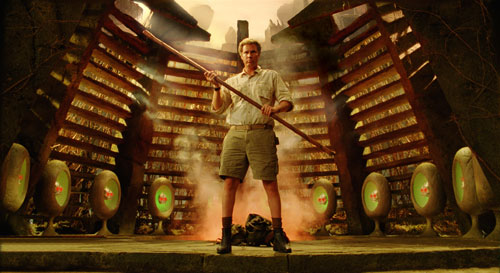
In modern times, no scar is probably more famous than the one on Harrison Ford's chin. The actor got it in the 1960s during a car accident, and it's become such a part of his onscreen persona that they've actually written it in to several of his characters. In "Indiana Jones and the Last Crusade," a young Indiana (played by River Phoenix) is shown getting the scar while trying to handle a bullwhip for the first time.

Similarly, Humphrey Bogart's mouth was probably the most distinctive thing about him. His scarred lip and slight lisp are the result of an altercation with a prisoner while he was in the military police (according to the most prevalent version of its story). Coupled with his strained, gravelly voice, his damaged mouth gave his speech a slightly indistinct character.

Van Johnson's career nearly ended, along with his life, when he was in a serious car crash while shooting "A Guy Named Joe," which was to be his big breakthrough role. Co-stars Spencer Tracy and Irene Dunne reportedly insisted that Johnson not be kicked off the film, and he was absent for a long time while a metal plate was put in his forehead. The scarring smoothed out considerably as the years went by, and in photos taken in the 1950s and beyond you can hardly make it out, but it's extremely noticeable in "Joe" and "The Caine Mutiny."

I've read various accounts of the deep vertical mark on Joaquin Phoenix's upper lip. Seeing as how it runs from his nostril to the opening of his mouth, it would seem to be a harelip, otherwise known as a cleft palate. Phoenix himself has claimed it is merely a birthmark. My guess is it's the resulting scar from corrective surgery performed when he was a small child. If you Google cleft palate surgeries and look at photos of how people with this condition looked before and after surgery, you'll see features that greatly resemble Phoenix's.

In male actors, scars like these are usually seen as distinguishing marks that make them stand out from the thousands of other handsome actors trying to make it big. Some women have found success despite facial scars, although they tend to be small and less noticeable than the men's.

I have to admit that I didn't even know Tina Fey had a scar until several years after she was on "Saturday Night Live." The scar on her left cheek is the result of a random knife attack that happened when she was a child. With Hollywood makeup and lighting, it's barely noticeable, and Fey apparently does not like to talk about it.

Sandra Bullock has a small but rather deep scar beside her left eye. It reportedly was the result of normal childhood rambunctiousness when she fell into a creek.

Diane Lane has a scar very similar to Bullock's, but near her right eye. I haven't been able to find anything about how she got it.

I've always thought Queen Latifah is a very attractive woman, despite not conforming to mainstream standards of beauty. She has a rather large vertical scar on her forehead, the result of tripping over a phone cord while playing with her brother at the age of three, gashing her head open.

UPDATE: I made this little collage of star photos myself, and in retrospect should have made it much larger. In the photos I selected, their scars are quite visible. But it was a big pain in the keister, and frankly I'm too tired to redo it.

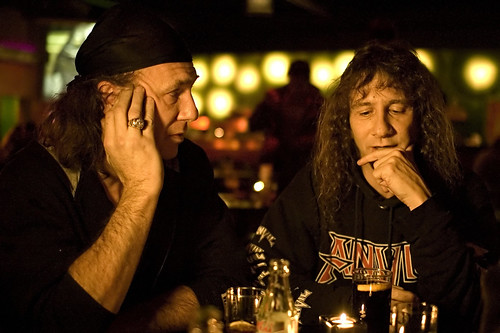
Review: "Anvil! The Story of Anvil"


The act of watching "Anvil! The Story of Anvil" lies somewhere between schadenfraude and sob story. At times you feel guilty pleasure at watching the pathetic story of a pair of heavy metal rockers who are somehow both has-beens and wannabes. The next moment, you feel sympathy as their hopes of fame and fortune keep getting raised and then dashed.

Steve "Lips" Kudlow and Robb Reiner had a dream when they were teenagers, one millions of teens have had: To become rock 'n' roll stars. Now it's more than 30 years later, they never made it, and brutal truth be told, this real-life "Spinal Tap" is not good enough to make it. Except they're still pursuing the dream with all the vitality and self-delusion of a 15-year-old shredding chords in a garage somewhere.

The doc is directed by Sacha Gervasi ("The Terminal"), who used to be a roadie for Anvil back when they were on the cusp of fame.

He opens in 1984 at a huge metal concert in Japan featuring bands that would all (except one) go on to sell millions of records. Figures like Lars Ulrich from Metallica and Slash from Guns N' Roses talk about how Anvil influenced them, and put on live shows that made them envious.

Cut to today: Kudlow, known to everyone as Lips, is trudging through the Canadian snow delivering meals to schools. Working for a catering service doesn't pay much, but it's a steadier gig than playing music in tiny bars in front of a couple dozen fans.

The film really belongs to Lips, even though Robb is supposed to be an equal partner in their boyhood fantasy. But Lips is such a compelling figure, so utterly guileless and naked in his desire to make it big, that at first one thinks the whole movie is a put-on.

Soon it becomes clear, though, that he really has sacrificed everything for the gods of rock, and truly believes that someday they'll smile on him.

Others, including Robb, are not convinced. Robb's sister puts it flatly: "It's over. It's been over for a long time." Even Lips' wife, while completely supportive of his dreams, seems to recognize his chance was blown.

The film follows the band through one disappointment after another. Their manager, the girlfriend of one of the temporary band members, books them on a disastrous European tour. She barely speaks English and can't even arrange adequate transportation. When Lips stands on a metro station, staring forlornly at the empty tracks and says, "We missed our train," his yearning hits the audience like a power chord.

The absolute low point comes when they arrive two hours late for a gig, put on a show for the handful of people who remain, and Lips nearly gets into a fight with the club owner who refuses to pay them.

They start work on a new album -- their 13th -- by borrowing money from a relative. The pressure drives a wedge between Robb and Lips; but we sense it is fleeting, because there have been a hundred such quarrels like this before.

"Anvil! The Story of Anvil" is sad, funny, touching, and loud.

3 stars

Friday, June 5, 2009

Review: "Land of the Lost"


Two words: Sleestak porn.

Yes, in case you were wondering how the film version of "Land of the Lost" would go, it's full-out Will Farrell bumpkinness coupled with gross-out humor perfectly pitched to the mentality of a 14-year-old.

Thus, there's a scene where Farrell and his gang witness a pair of the slow-moving reptile man knocking boots ... er, claws. Mercifully, it's more implied than seen, since this is a PG-13 flick.

Look, it was obvious to all concerned that the only way to translate this phenomenally cheesy time-traveling kids' show from the 1970s to the big screen was to go the parody route. I mean, would you rather have seen a super-serious version with a lantern-jawed hero and a ton of CGI stunts?

Well, there's still plenty of computer-aided action, mostly due to a grumpy T-rex that chases around Ferrell, Danny McBride, girl scientist Anna Friel and Chak-Ka -- a prince among the ape-men. That's pretty much the whole movie -- big action scene interrupted by goofy one-liners from Ferrell and McBride.

A few jokes hit the mark. There's one bit where Ferrell gets bitten by a prehistoric mosquito, which proceeds to suck out enough blood to supply a small blood bank. And in another genuinely funny scene, Ferrell instructs his team to douse themselves from a large jug of dinosaur urine in order to hide their scent, which turns into an inquisition about how exactly he acquired said urine.

But the rest of it is pretty dreary stuff, and there are long stretches where the movie drags almost to a dead halt.

I don't mind the idea of making fun of kitschy old TV shows. But if you're going to do that, it should at least be ... fun.

Review: "Tyson"

The idea of spending 90 minutes alone with Mike Tyson probably scares most people half to death. But "Tyson," the new documentary by James Toback about the infamous boxer, surprises with its fascinating portrait of a compelling and unexpectedly sympathetic figure.

The movie is essentially the audience alone with Tyson, looking directly into the camera and talking about his life. There is some archival footage, old photographs and home movies. But for the most part it's just the man, talking unblinkingly about the rage inside him, and how he's struggled -- usually unsuccessfully -- to master it.

Toback (who last directed the tidy erotic thriller "When Will I Be Loved" starring Neve Campbell) employs overlapping split-screens as he weaves together more than 30 hours of footage of the ex-champ. Even though Toback has known Tyson since he was 19, the director wisely does not impose himself in the picture. Rather than appearing as interlocutor, Toback provides the answers while eschewing the questions.

That's why the film has such a confessional feel to it -- a man trying to make a new start in life by unburdening himself of his grotesque past.

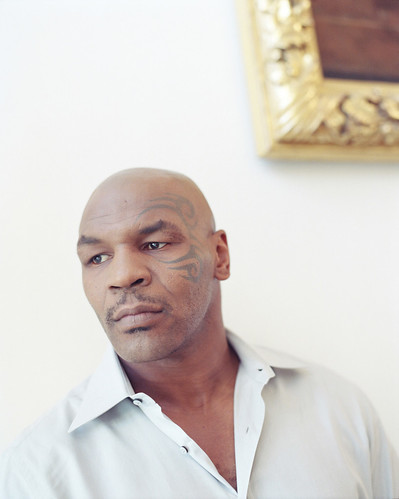
The Tyson we see before us barely resembles the 20-year-old who became the youngest heavyweight champ in 1986. Gone are the gold teeth, '80s fade haircut and playful public persona. Tyson is older, lumpier, and with the Maori facial tattoo he got an a whim, he resembles a grizzled junkyard dog with a jigsaw face. The brutal physique that earned the label "Iron Mike" is gone; when he pulls up his shirt to reveal another tat he got while in prison, his belly lops over his belt.

Right away, he startles us by revealing that he was a shy kid who was bullied and robbed in his rough neighborhood. He took to boxing, and later to street thuggery, as a way to protect himself, psychologically as much as physically.

The relationship with elderly trainer Cus D'Amato, who died right before Tyson won his first belt, is fleshed out satisfyingly, despite being a familiar story. Many have wondered, as Tyson himself does, if he still would have wallowed in the excesses of sudden fame and fortune if his mentor were around a little longer.

Tyson also touches on his short-lived marriage to actress Robin Givens, a public spectacle that he takes responsibility for, while deflecting some of the more outrageous claims.

The infamous ear-biting of Evander Holyfield is explored in full. While not in any way excusing himself, Tyson's account shows how some foul tactics by his opponent, coupled with Tyson's feelings of persecution, drove him to "just want to inflict pain" -- simultaneously degrading himself and his sport.

Interestingly, the one misstep Tyson refuses to acknowledge is his rape of a Miss Black America contestant in Indianapolis, for which he served three years in prison. He refers to the victim as "that wretched swine of a woman." Why he would freely admit to all the other shameful things he's done in his life, from robbery to drug abuse, without confronting this one, is perplexing.

But that's the often mesmerizing portrait we see in "Tyson," a contradictory figure who went as high and low as one can go in his sport, and in life.

3.5 stars

Thursday, June 4, 2009

Review: "American Harmony"


They say that every good story needs conflict, but there's not much discord in "American Harmony."

Sure, this documentary centers on a competition, between barbershop quartets from all over the country vying for the top prize. But it's more a pageant of hugs and well-wishes than in-your-face standoffs. The snarkiest moment comes when a contestant's wife texts him, calling a competitor's performance "weak."

But even if you aren't a fan of barbershop -- I am -- you'll find this movie an enjoyable plunge into a slice of Americana. And it goes without saying that it's impossible to keep from humming or tapping your toe afterward.

The most amazing thing about the International Championships of Barbershop Singing is that the winner has to call it quits. Once they win a gold medal, that group is forbidden from competing ever again. Imagine if the reward for winning the Super Bowl was that the team had to be split up and all the players sent to other franchises.

That's why Max Q is such an odds-on favorite going into the 2007 contest, which was held in Indianapolis. It's an all-star foursome of superstars within the world of barbershop, including Tony DeRosa and Jeff Oxley, who have each won the top prize (with other groups) twice before. Oxley is a confident competitor, but lead singer DeRosa admits to getting the jitters.

One of the best aspects of the film -- a hallmark of any good documentary -- is that it immerses you in a world that you may not know much about, and that even seems strange or silly to you. But by seeing what this endeavor means to its participants, we come to understand their little piece of society.

So it's tantalizing to watch these guys in their normal lives -- and most of them are very normal indeed: Middle-aged husbands and workaday drones. But in the subculture of barbershop, they're the Michael Jordan or Peyton Manning of their day.

The main competition to Max Q is OC Times, a group of twentysomething upstarts from California. They're handsome and polished and not a little cocky, yet still eager and a little bedazzled by their burgeoning fame. There's a great scene where Shawn York, who's an anonymous manager of a Chick-fil-A, takes a photograph of their poster outside New York's Lincoln Center, where they will perform in a few hours.

There are a couple of other groups who don't get quite as much time in the spotlight, but add layers to the picture. Vocal Spectrum is a bunch of kids fresh out of college who can't believe they're competing against guys they grew up idolizing.

Reveille is on the other side of the journey, an aging and decidedly frumpy foursome who use comedy in their performances to make up what their singing lacks. But a health issue for one of its members adds a somber tone to their yuks.

"American Harmony," directed by rookie filmmaker Aengus James, may take the soothing route rather than trying to conjure up some dramatic tension. But like the delicious sounds it spotlights, sometimes the right tone is one you create yourself.

3 stars