Showing posts with label henry fonda. Show all posts

Monday, October 10, 2016

Reeling Backward: "How the West Was Won" (1962)


By 1962 Hollywood knew the jig was up.

Audiences, with expanding options of quality programming on television, would no longer automatically show up to the cinemas for whatever fare they had thrown together. Actors and directors were tired of being workhorses for the studios, told to go here and do that, and wanted the power to pick their own projects. Certain quintessentially American genres, notably the musical and the Western, were increasingly seen as creaky and worn out.

The Golden Age, for good and naught, was waning -- and everyone knew it.

The reaction from Tinseltown, at least for awhile, was to deliver things TV couldn't: color pictures, big action spectacles, widescreen formats, stereo sound, 3-D imagery and so on. One of the big ideas was Cinerama, which stretched an extremely wide image across a huge curved screen, so the audience literally felt like the movie was wrapping around their field of vision.

To get some perspective, the aspect ratio of most films today is 1.85 to 1, width to height. Modern flatscreen TVs are 1.78, so when movies are played on them you only get a little bit of black bar at the top and bottom. (Rarer) widescreen movies are usually 2.35, so the bars are much bigger. Cinerama was 2.59, so when I watched the film on my set the film only occupied the middle third or so of the screen.

Only two major feature films were made using this process, which involved shooting with three separate 35mm cameras and then using a trio of projectors in the theater.  "How the West Was Won" was a big success, the second highest-grossing film of that year, but it was too expensive to outfit more than a handful of theaters with the setup.

When shown as a single image on a flat screen, the three pieces tended to not match up well, with noticeable lines during bright scenes. Since most theaters didn't undertake the upgrade, this is how most audiences saw it. Despite its early success, Cinerama died a quick death.

MGM undertook a restoration of the movie in 2000, and new Blu-ray editions include a version that simulates the curved Cinerama look. I've included two stills of the same scene above so you can see the marked difference in presentation.

Filmmakers didn't like the logistics of shooting in Cinerama, either, since it required them to position the actors and backgrounds in such a way that the performers might not even be looking at the person they were talking to in the scene. John Ford, who directed one of the film's five sequences, complained that you couldn't shoot closer than the waist up, which limited the ability to give audiences an emotional connection with the characters.

Much like the green screen technology of today, the final result could be fabulous, but required a talented and attentive cast and director to preserve the performance aspect.

The visual look of the restored "How the West Was Won" is often breathtaking, with glorious vistas of the American fields, rivers and mountains. Narratively the story spreads over 50 years, from 1839 to 1889, covering the settlement of Ohio, the gold rush, the Civil War, the building of a transcontinental railroad line and the height of the outlaw era. It's all told through the eyes of a single family, as subsequent generations grow up and move on further West.

The final movie was a languid 164 minutes, but includes lengthy musical overtures (by Alfred Newman) at the beginning, middle and end that probably consume at least 20 minutes on their own. Everything about the film telegraphs that it wants to be seen as an old-school epic, but really it's several small, barely interrelated stories strung together.

In a gimmicky move, different directors were hired for the five sections, though Henry Hathaway helmed most: the first, second and fifth. Ford directed the third and shortest section on the Civil War, which is really more of a vignette than a true standalone story. George Marshall oversaw the fourth and probably best sequence on the often merciless drive to connect the railroads from east to west.

It was nominated for a bunch of Academy Awards, including Best Picture, and won three for Sound, Editing and James R. Webb's screenplay -- thought it did not get a nod, notably, for directing.

The film also has the prerequisite "All Star Cast," though most of them have very fleeting parts. John Wayne is in it for about two minutes, along with Henry Morgan, playing great Union generals Sherman and Grant during the Civil War section. Jimmy Stewart has a bigger part as a frontier trapper who falls for one of the daughters (Carroll Baker) of cantankerous pioneer Zebulon Prescott (Karl Malden) in the first sequence. Stewart gets stabbed by some river pirates (led by the great Walter Brennan) but survives to win the girl.

Henry Fonda and Richard Widmark turn up in the railroad section as, respectively, a fiercely independent scout and the hardcase overseer of the building operation, who's willing to break the treaty with the Arapaho Indians and start a war if it'll mean shaving a few days off his schedule.

Gregory Peck plays a gambler who courts, then deserts, then nabs again one of the Prescott daughters, played by Debbie Reynolds, who wants to marry a rich husband and move back East but ends up as a saloon showgirl instead. Robert Preston plays the wagon train master who pitches his own woo at her, telling her about the matching suitability of his huge ranch and her ample child-bearing hips, but she's looking for a little more romance. Thelma Ritter plays an over-the-hill female pioneer who desperately wants to get married; I kept thinking she would hook up with the Preston character.

Eli Wallach turns up in the last sequence as Charlie Gant, a particularly nasty outlaw who avoided jail years ago and is back to torment the lawman who killed his brother. They each put lead into the other they still carry, so there's no love lost. It seems like a clear precursor to Wallach's Spaghetti Western roles later on.

Really the biggest star in the picture in terms of screen time is George Peppard playing Zeb Rawlings, the son of the Jimmy Stewart and Carroll Baker characters. He's the main character in the last three sequences. In the Civil War he's a scrappy young recruit who becomes disillusioned by the senseless killing. In the railroad section he's a U.S. Cavalry officer charged with keeping the peace, who continually butts heads with the Widmark villain. Finally he's the marshal, now with a wife and kids of his own, who faces off with Charlie Gant, as Debbie Reynolds returns as an aged doyenne of San Francisco who wants to spend her last years on a ranch.

Spencer Tracy narrates the tale with openings to each sequence, plus a flowery speech at the end about how the suffering and triumphs of those Western pioneers allowed us to have all the great stuff we have today. It's a little disconcerting as the airborne camera swoops over the vistas, which gradually become more and more occupied with the mark of humanity, including highways and smoke-belching factories. I suppose in 1962 those things were seen as hallmarks of progress rather than urban sprawl.

I guess I like the idea of "How the West Was Won" more than the totality of the movie itself. It's generally quite entertaining, and even grand at times. But it feels more like a lot of haphazard pieces washing down the current of history than a coherent film.


Monday, July 7, 2014

Reeling Backward: "Advise & Consent" (1962)


"Advise and Consent" is a film of firsts and lasts.

It was the final film for the great Charles Laughton, already declining from cancer. Wrapped in a colorless, shapeless suit like a shroud, his once-expansive frame had shriveled down to merely bulky. He plays Seabright "Seab" Cooley, a wily old curmudgeon representing South Carolina in the U.S. Senate, who positions himself as the chief antagonist to Robert A. Leffingwell, the president's nominee for Secretary of State.

Laughton cackles and minces, cajoles and bullies, as the situation warrants. His voice had lost some of its power, and you can hear at a couple of points that his lines have been dubbed over. Contrastingly, it was the first film role for Betty White, playing a young female senator who gets accused of using "her sex" to her advantage.

It was one of the earliest mainstream movies to tackle McCarthyism head-on, or at least just off to the side. During the confirmation process, Leffingwell is discovered to have participated in some Communist meetings back when he was at university, though he never joined the party.

Still, the trial-like subcommittee hearings have all the fire and brimstone of the real anti-Communist witch hunts. Merely the accusation of Communist affiliations is enough to scuttle one's political career, and even eliminate the possibility of a job in academia.

It was also one of the first movies to tackle homosexuality head-on, with an upright young senator (Don Murray) from Utah -- named Brigham, too, in case the suggestion that he's a Mormon wasn't already underlined enough -- being blackmailed for a romance with another soldier during the Korean War.

That was a bold topic for director Otto Preminger to take on in 1962, though the portrayal of gay men isn't exactly progressive. The senator's trip to New York to find his old lover turns into a descent into Dante's inferno, with a parade of effeminate man-boys and a nightclub full of tilted wrists and gay Lotharios. (One of the oldest cruelties inflicted against homosexual men is the mythology that they're attracted to essentially every straight guy they meet.)

Still, the film is clear in pointing out that it's not the senator's affair that constitutes a great sin, but the way it's used against him by a political rival to torture his wife and family life, eventually spurring him to take his own life in his senate office.

"Advise & Consent," written by Wendell Mayes based on the novel by Allen Drury, was not considered a particularly successful film at the time. It got middling reviews, so-so box office, and failed to receive any Academy Award nominations -- though Laughton got a BAFTA nomination and Burgess Meredith won the award for supporting actor from the National Board of review for his portrayal of a dim, easily-manipulated former associate of Leffingwell.

It's too bad, because I thought it a terrific political thriller chocked full of top-notch performances. In writing the Reeling Backward column for almost five years now (!), I've often encountered supposedly great movies that I found to be undeserving of their reputations -- and enjoyed taking them down a peg or five. Even more rewarding, however, is discovering an amazing picture that has, for one reason or another, largely been forgotten.

Leffingwell is played by Henry Fonda in typical upright straight-man mode, who lies about his leftist associations during the confirmation hearings, and then immediately confesses to the president (Franchot Tone) and requests that his name be withdrawn. But the POTUS is dying, and wants to make sure his foreign policy gains are cemented under Leffingwell's able hand, since he -- and most everybody -- has a low opinion of his amiable vice president and successor, "Happy" Harley Hudson (Lew Ayres).

Ayres is wonderful in his small but pivotal role, giving Hudson a kind of self-effacing nobility. Being the vice president, he says only half-jokingly, "is a sort of disgrace, like living in a mansion with no furniture."

Ostensibly the star of the picture, Fonda is actually pretty peripheral to the story, other than the extended sequence where he testifies before the subcommittee, and later interrogates and discredits the Meredith character. He's less a fully fleshed character than an ideal, a New Age man who believes in laying aside the "outworn" policies of treating the Soviets as implacable enemies to be destroyed.

This positions him in opposition to the prideful Cooley, in addition to a vague dust-up between the two years earlier. Seab is a master manipulator, offended that Leffingwell's nomination is poised to upset the genteel comity of the Senate, turning it into  "a cockpit of angry emotion" -- nevermind that he's the one who will be doing most of the antagonizing. Even the way Seab pronounces the name seems distasteful to him, as if he's being mocked -- "laughing well."

Even if he's a self-aggrandizing egomaniac, Seab is at least demonstrated to have some redeeming qualities in the end. That can't be said for Fred Van Ackerman, a junior senator who charges himself with being Leffingwell's main defender. Played by George Grizzard, Van Ackerman is a small, effeminate man/boy who always keeps a cadre of silent gray-suited men around him, dubbing them his "brain trust."

They also carry out his dirty work, like threatening the Mormon senator, Brigham Anderson, charged with shuttling Leffingwell's nomination through the process. When Anderson learns of Leffingwell's perjury, he refuses to pass him through. He ends up trapped between his conscious and the threats to his family, and he wilts under the pressure. This is actually the weakest part of the film, as it's given too much screen time and sucks much of the momentum out of the political intrigue, which is where the real juice is.

I also enjoyed Walter Pidgeon as Bob Munson, the patrician Senate Majority Leader, who tries to be accomodating as possible to the various whims and outsized personalities of his coalition. Gene Tierney has a small role as his political patron and secret girlfriend, and Peter Lawford turns up as a womanizing senator with a trick or two up his sleeve.

All of these figures are the same political party as the president, though which is never explicitly stated. The film came out in 1962 but seems very much a product of 1950s mentality. It's interesting, though, that this is the rare political film where the opposition party never really comes into play. Most such films make the primary villain a member of the opposite party, such as the similarly themed "The Contender" from 2000.

The film is also notable for portraying the White House Correspondents Dinner, quite possibly the first mainstream movie to do so. Then as is now, it's depicted as a chummy affair where politicians and press agree to treat everything off-the-record, yet somehow a lot of news always ends up getting made. The president uses the occasion to castigate his foes and affirm his support for Leffingwell.

The final sequence, building up to and featuring the roll call vote for Leffingwell's nomination, is a master class in cinematic tension. The prospects for Leffingwell rise and recede, even as the names are called one after another. Munson would seem to have marshaled his forces and have it in the bag, but then some last-minute events throw everything into doubt.

I'm not quite sure why "Advise & Consent" was not greeted more enthusiastically at the time. To me it's a first-rate political drama with a bunch of terrific actors letting it fly. It wasn't the first or last of its kind, but it is one of the best I've seen.


Monday, December 16, 2013

Reeling Backward: "Battle of the Bulge" (1965)


All movies are on some level flimflam, even the ones that purport to be based on "true events." This is doubly so for war pictures, which must take the chaotic and bloody gruel of combat and some turn it into a digestible cinematic meal. If an obvious narrative doesn't present itself in the historical record, Hollywood will bend over backward to impose one -- never mind how much the made-up characters and plot diverge from reality.

You know you've got a problem with historical accuracy, though, when Dwight D. Eisenhower emerges from his post-presidency blanket of privacy to hold a press conference denouncing your movie. Such was the fate of 1965's "Battle of the Bulge."

This borderline awful war drama is like a Tinseltown Cliff's Notes version of one of World War II's most decisive battles. The real Battle of the Bulge lasted nearly a month, stretched over a huge chunk of Western Europe and involved hundreds of thousands of soldiers and pieces of equipment. The movie version, however, focuses on the plight of a handful of American soldiers at various levels of command, ranging from sergeant up to general.

Not only is the role of the British downplayed in the Hollywood version, I'm not sure if an English soldier even shows up once during the movie's 170 minutes. That's ironic, considering director Ken Annakin is an Englander who directed the British scenes in the far superior "The Longest Day."

Astonishingly, despite being one of the most famous winter military deployments since Valley Forge, there's barely a hint of snow in the film, which looks like it was shot during the full bloom of summer.

My biggest complaint is that all the American soldiers are not individuals but character "types" -- usually ones that synch up nicely with the star persona of the actor playing him. So Henry Fonda is Kiley, a careful and reasonable man whose warnings about a German offensive go unheeded. And Charles Bronson is Wolenski, a tough no-nonsense major who leads a group of hardcase dogfaces.

James MacArthur plays Weaver, an untested young lieutenant who quickly gets wised up by the German Panzer incursion and the tutelage of his wiser sergeant. Robert Ryan is the determined, methodical good general and Telly Savalas is Guffy, a tank sergeant who runs a black market racket on the side and operates as the movie's Bronx-accented comic relief.

None of these actors makes much of an impression, with the exception of Fonda, who could play a telephone switch operator and make it snap.

The real star of the show is Robert Shaw as Hessler, the ambitious, take-no-prisoners German tank commander given a prime spot in the counteroffensive of the Third Reich. Hessler is loosely based on the real-life Panzer commander known for his aggressive tactics that resulted in high casualties among his own forces, while also crushing the enemy.

Outfitted with the platinum blond hairdo he wore in "From Russia with Love" and a few other films, Shaw is the model of the icy Aryan Nazi, who would rather the war go in forever in stalemate than lose his status as a military hero. Hans Christian Blech plays Conrad, his right-hand man and conscious, who whispers in his ear not to be so cruel. In the end, they break ways and Conrad is assigned to tote fuel drums. The final shot of the film is Conrad tossing away his rifle and ammunition belt as the defeated Germans march away home.

Hessler is also implied to order the execution of captured American POWs at Malmedy, an actual war crime that is depicted briefly in the film without a lot of emotional power. Mostly it's used as the turning point of the Weaver character when he stops being callow and learns to accept the consequences of command decisions.

Weaver survives the massacre to, in the movie's depiction, nearly single-handedly stop the German tank advance by rolling some cans of fuel at Hessler's column, blowing them up. Neat trick, that.

Shaw is a real treat as a hiss-able screen villain, but in terms of nuance "Battle of the Bulge" is severely lacking. It's a dumbed-down cut-up of a movie about a great, tragic event. I don't think Ike was the only one who thought it was a serious disservice to the men who fought and died.


Monday, December 2, 2013

Reeling Backward: "The Lady Eve" (1941)


I've been thinking about the Reeling Backward selections I've written about recently, as well as the piles of potential films to feature -- mostly in the form of DVDs/Blu-rays sitting on my desk, stuff I've DVR'd off Turner Classic Movies and titles filling up my Netflix queue (more than 100, counting both streaming and DVD lists).

Conservatively speaking, it'll take me two to three years to get through all the films. And that's not accounting for any flux in the lists, as titles available for streaming suddenly disappear (annoying) or my interests change and I add new movies as I come across them (frequent). But it gives me a good idea of what sorts of things I've been watching or planned to watch.

Anyway, I've noticed a possibly disturbing trend: Reeling Backward has become a very testosterone-laden space. Most of the recent columns and queues are dominated by war pictures, crime stories, sports dramas and Westerns. There hasn't been a whole lot of comedy, and there's been even less of the "chick flick" variety.

The irony, of course, is that back in Hollywood's Golden Age they didn't think to divide films into "women's pictures" or "children's movies" or such. It was assumed that more or less everybody was more or less interested in every genre of film, and that as long as they made good pictures people of all ages and genders would come to see them.

(They most definitely thought of a certain subset of movies as being for "colored people," and indeed there was a little-known subsystem of films produced for and even by black folks. But that's another story.)

Romantic comedies have been one of the mainstays of popular film going back to its silent days, and Preston Sturges was widely considered a master of the genre. "The Lady Eve" is one of his better-known examples. Technically it's best described as a screwball comedy, but since most screwballs were subsets of romantic films, the categorization still works.

What's most notable about the film is the way Barbara Stanwyck completely dominates the film, even with the considerable Henry Fonda as her leading man. Fonda plays Charles Pike, an ophiologist (snake expert) who also happens to be the heir to the Pike's Ale fortune. Charles, having just spent a year doing research in the Amazon, is a socially inept bumbler who seems uncomfortable around the hordes of women zeroing in on him.

Until, that is, he meets Stanwyck's Jean Harrington, a con woman and daughter of hoary card shark "Colonel" (a fictional title) Harrington (Charles Coburn). Jean is a schemer and a shyster, but isn't quite the total mercenary that her father is. She finds herself genuinely falling for the patsy.

Their seduction scenes are quite electric, especially in that the man is totally submissive to the woman in a way you don't usually see in this era of film. First she makes Charles remove her busted shoe and replace it with another, in a paean to foot fetishism that probably drove Quentin Tarantino crazy. Then she nudges him off the divan and and hovers over him, lustily stroking his hair, in a clear stand-in for another part of his anatomy. Her midriff-baring outfit is quite racy for the time.

Later Charles is wised up by his bodyguard/protector Muggsy (William Demarest) that Jean and her dad are con artists, and he gives them the heave-ho. Segue to a few months later, and Jean decides to pull his chain again. Posing as a bogus Brit noble, the Lady Eve, she inserts herself into the upper-crust Connecticut set, and wheedles an invitation to a party being thrown by Charles' father, Horace (Eugene Pallette, famous for his rotund carriage and gravely voice).

Of course, it's ludicrous that Charles wouldn't immediately recognize Eve as Jean. But he insists that someone trying to fool him would change their appearance, so the fact that she looks exactly the same is proof in his mind that they actually are two women. For a scientist, Charles seems pretty impervious to logic.

The dinner scene of Charles falling over himself as he is flummoxed by Eve remains a high point, with the doltish boy having to repeatedly change tuxedos when he keeps getting an array of food spilled on his duds.

In the end he falls for Eve just as he did Jean, and following a quickie marriage she extracts her revenge, fabricating a litany of former lovers (including at least one elopement) as part of the Lady Eve's backstory. Mortified, Charles literally jumps off the train they were riding to their honeymoon destination.

Eric Blore is a real treat as Sir Alfred McGlennan Keith, a fellow scam man who teams up with Jean to help her perpetrate her ruse as an English lady. I love how, when introducing himself to his fellow rascals, he prefaced his name with "at the moment" -- indicating that such things are as interchangeable as the hats he favors.

I liked a lot of little bits 'n' pieces about "The Lady Eve," though as a whole I found it somewhat disappointing. The best screwball/romantic comedies have a little heart to them as well as flimflam -- "It Happened One Night" being the classic example. "Eve" is straight go-go-go comedy, and in the end I felt more breathless than charmed.

Perhaps I'm just too used to manly flicks.


Monday, August 6, 2012

Reeling Backward: "My Name is Nobody" (1973)


By 1973, spaghetti Westerns had descended into comedy, and sometimes even self-parody. There was always an element of laughs and leers in the kitschy Italian/American fusion, but by the time "My Name is Nobody" rolled around, the clown princes with six-shooters were riding tall in the saddle.

The plot of this comedy Western, produced and partially directed by Sergio Leone, is quite spare. An aging gunman, Jack Beauregard (Henry Fonda), wants to make one last big score before hanging up his spurs and retiring to Europe. Sullivan (Jean Martin), the front man for a failed gold mine, has a history with Beauregard and is looking to rub him out with the help of his partners, the 150-man-strong Wild Bunch, who launder their stolen gold through him.

(As near as I can figure, all the Wild Bunch -- an obvious nod to Sam Peckinpah, who also has his name on a tombstone -- do nothing but ride around en masse with dynamite in their gaudy studded saddlebags, which eventually proves their undoing.)

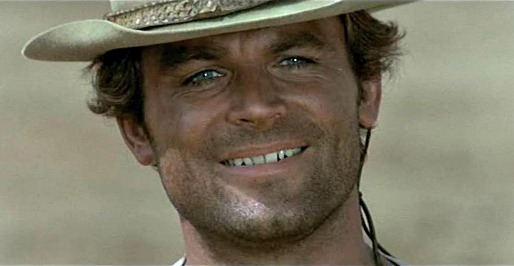
The X factor in all this is Nobody, as he dubs himself, a goofy young admirer of Beauregard who wants to take his place -- but only after seeing his hero go out in a blaze of glory. Terence Hill, an Italian who adopted an American-sounding name as a publicity stunt, plays Nobody.

Hill has an offbeat but undeniable screen presence. With his perfect bone structure, lagoon-blue eyes and cleft chin, he's almost too pretty to convincingly play a Western protagonist. But he sells the idea of a roving prankster, who's honed his own skills with a revolver (and other forms of combat) to a surpassing edge. He's like a reverse Don Quixote, whose mission is just while his methods are comical ... but deadly.

The "Nobody" moniker is employed for some pretty obvious jokes -- the most notable being for Beauregard's epitaph, after they stage a fake duel in which the old gunslinger is "killed" so he can slip off for his quiet retirement, his reputation assured. "Nobody was faster on the draw," it reads.

Director Tonino Valerii was a Leone protege, an assistant director who soon stepped behind the camera himself. Leone actually directed the opening and closing gunfights himself, according to legend.

It's an interesting and entertaining film, if somewhat baffling. The motivations of Nobody are never really clear. He just sort of sidles around, acting innocent and making strange non sequitur comments, in almost a Buster Keaton-esque fashion. Then it comes time to demonstrate his awesome speed and accuracy.

The stunts and gags used in the movie's many fights are as impressive as they are impossible. For instance, that Nobody could down several large glasses of whiskey, flip the empty mugs over his shoulder and shoot them before they hit the ground. (What would that blood-alcohol level be? Like 3.0?) Or that he can reach into an opposing gunfighter's holsters, pull out his weapons and slap them in the head with them before the man can reach them himself.

Beauregard displays similar skills, despite the suggestion that his vision is failing. (He wears glasses in several scenes, and one shot of Nobody from his viewpoint is deliberately blurry.) At one point, Beauregard shoots Nobody's hat of his head four times in a row -- each time, passing through the exact same hole. I can't imagine what sort of robotic-type calculations would be necessary to make a bullet pass through the exact same millimeters of a hat atop the head of a moving man at about 50 feet. But if one actually could do that, then what makes the hat fly off?

The showdown with the Wild Bunch carries no narrative or emotional weight, since it happens for no reason at all. Beauregard has no beef with the Bunch, other than their association with Sullivan. But Beauregard chooses to take a payoff in gold dust rather than risk raising the ire of the Bunch. Only Nobody's misplaced hero worship, plus the sheer challenge of one man taking on 150, convinces Beauregard to try. Of course, all he has to do is shoot those bags of dynamite to make the whole gang -- or at least a goodly percentage of them -- go kablooey.

(Also, since no one is around except Nobody, Beauregard and the Wild Bunch, who exactly is it that's going to relate this tale for the history books? One doubts the gang would freely share the story of how they were defeated by one near-sighted old man. And Nobody's grasp on coherent facts is somewhat in doubt.)

"My Name is Nobody" is notable for being one of those manly movies in which no significant female characters exist. A woman cook gives Nobody a skillet of beans and bacon, but other than that no female has any lines of dialogue, or are even glimpsed until that final showdown in the street.

The last thing I'd like to talk about for this film is the musical score by Ennio Morricone, a longtime Leone collaborator and one of my personal favorites. It's a bouncy, comic theme with his usual mix of orchestral instruments and non-traditional noisemakers -- including what sounds like drops of water run through a synthesizer. He also borrows strains from Wagner's "Ride of the Valkyries" for the Wild Bunch sequences, with the notes bent and flattened to make it a mocking tribute.

It's silly, touching and exciting simultaneously -- much like the film it serves to enhance.

3 stars out of four


Monday, May 28, 2012

Reeling Backward: "The Ox-Bow Incident" (1943)

"The law is slow and careless around here sometimes. And we're here to see it speeded up."
Thus speaks the central villain in "The Ox-Bow Incident," a 1943 prairie morality tale that, in truth, contains no real bad guy. That's because virtually everyone in it is morally compromised in some way. The speaker, a vengeful cowpuncher named Farnley (Marc Lawrence), is simply the most overt about it.

This film is from director William A. Wellman; the more I see his movies, the more I become convinced this largely unheralded figure is one of Hollywood's greatest filmmakers. The screenplay is by Lamar Trotti, whose credits include "Young Mr. Lincoln" and "Drums Along the Mohawk," from Walter Van Tilburg Clark's novel.

It reminded me very much of "12 Angry Men," also starring Henry Fonda, in that it's about the pitfalls of the group mentality applied to a law-and-justice scenario. A bunch of men who are convinced they are doing right eventually come to see that they've been woefully misguided all along. With "Men" it happens before the verdict is rendered, but in "Ox-Bow" the realization doesn't occur until after three men have been wrongly hanged for crimes they did not commit.

The movie is also notable in that the story unspools in more or less real time -- Wellman includes a single fade-out/fade-in to indicate the passage of time. The film essentially only has three scenes: the first where the townsfolk learn of the murder of a local rancher and form a posse; a brief (and mostly unnecessary) interlude where they erroneously chase down a stagecoach; and the confrontation with the accused trio.

At a spare 75 minutes, "The Ox-Bow Incident" has a stripped-down feel, like the narrative has been boiled down to its barest essence.

Interestingly, Fonda is not the central character, nor is there really any protagonist in the story. Fonda plays Carter, a rather surly and hot-tempered local cowboy who gets caught up in the posse mostly out of fear -- he and his partner Art (Harry Morgan) take part because if they did not, they might be suspected of being involved in the cattle rustling and killing of an upstanding rancher named Kincaid.

Carter acts as sort of the nexus of the plot, whose own story is not central to the narrative but a figure around whom all the other characters travel in close orbit.

Carter and Art ride into town, dusty and thirsty, and find not much going on. They sidle up to the bar for some rotgut whiskey, and Carter learns that Rose has suddenly left town. She was perhaps the only unmarried woman in town under the age of 80, and if she was not exactly Carter's betrothed, then certainly he felt promises had been exchanged between them.

Agitated over stories of cattle rustling, Carter starts a fight with Farnley, getting the best of it but then getting knocked out by a bottle over the head from the bartender. Art revives him with a splash of water, explaining that Carter always feels better after a fight, win or lose. Carter grows ill and stumbles into the street to retch his guts out.

Still bent over, he complains to Art: "Holy cow, now I'm gonna have to start all over again!"

Instead, everyone is riled up by the news of the murder of Kincaid and the theft of his cattle. The sheriff is out of town, but the lackadaisical deputy Mapes (Dick Rich) decides to commission a posse. From the beginning it is clear that they're looking for a purpose, a cure for their idleness, more than justice -- that, and the thrill of seeing somebody swing.

The town drunk (Paul Smith) uses a rope to act out a googly-eyed, tongue-lolling imitation of a man being hanged. It's funny the first time he does it, less so the second, and positively chilling when he does it in front of the accused to taunt them.

Perhaps the film's one major flaw is a chance encounter with a stagecoach along the trail. Stupidly, the posse gives pursuit, instigating the stagecoach hands into shooting Art in the arm. After running them down they learn the coach contains Rose and her new husband, a rich and snooty type from San Francisco. It seems like this sequence is setting up the narrative for more developments, but we never see the newlyweds again.

While the scene has its own momentum, plot-wise it's dead weight.

The most enthralling section is the quick capture and long "trial" of the three men, including Dana Andrews as Martin, the leader, and Anthony Quinn as Juan Martinez. Martin insists they bought the 50 head of cattle from Kincaid wish cash, although they lack a bill of sale. After trying to escape, Juan is also found to be carrying Kincaid's fancy engraved pistol. The third member of the accused is a feeble-minded old man.

The posse includes a large cast of characters. Beyond Farnley, the self-appointed leader is Tetley (Frank Conroy), a former Confederate major who still wears his gray battle uniform 20 years after the end of the war. Tetley is imperious, with a thick veneer of polite gentility masking his harsh, uncompromising ways. He mostly comes along as a way to instill some manhood in his gentle-minded son (William Eythe).

Jane Darwell, forever Mrs. Joad from "The Grapes of Wrath," has a disturbing turn as a hard-bitten woman who's as bloodthirsty as any of the men. She has several scenes where she cackles with glee at the plight of the three accused men, and it's positively vile.

The group also includes Davies (Harry Davenport), an elderly store owner who tries unsuccessfully to have the men brought back to town for a trial, and Sparks (Leigh Whipper), a negro preacher who acts as the moral conscience of the group.

Once the interrogation gets underway, there's a doomed, haunting feel to the movie, as the audience surely knows how things will end. Martin tries to reason with his captors, then pleads with them, and finally begs them. This draws a sharp retort from Darwell's character to "take it like a man."

The film ends on a bit of a false note, as Carter reads the letter Martin has written to his wife and children, asking them to forgive the men who murdered him in the name of justice. The language is rather highfalutin for a humble farmer, and it's doubtful any man not a living saint could summon that sort of big-hearted perspective a few minutes before is to die for a crime he had nothing to do with.

Still, "The Ox-Bow Incident" is a riveting story about how right and wrong are sometimes hard to distinguish, and why laws are necessary to keep justice out of the eager hands of the unruly mob.

3 stars out of four

Monday, May 7, 2012

Reeling Backward: "Warlock" (1959)


"Warlock" exists in that nether region between classic Westerns and revisionist ones, the period where the idea of two men staring each other down in the street with six-guns was beginning to seem less like grand adventure and more like a morally ambiguous bloodbath.

It's an ambitious film, lacking a clearly heroic figure -- and even the would-be villains have more than a single dimension, more than simplistic motivations.

It reminds me very much of "Unforgiven," Clint Eastwood's late-era masterpiece, so much so that I wonder if this movie played any role in inspiring it.

Henry Fonda is ostensibly the star, playing Clay Blaisedell, a notorious gunman who makes a living going from town to town. Officially he's a rent-a-marshall, but his real job is to kill outlaws ... or whoever it is that's currently stirring up trouble in the area. As he patiently explains to the town council of Warlock, eventually they'll grow fearful and resentful of him, at which point they'll have had full satisfaction from each other, and it will be time for him to leave.

He actually makes most of his money as a gambler, bringing games of chance and an entire saloon operation to town. Blaisedell even travels with a sign for "The French Palace," a bit of self-appointed royalty that he takes wherever he goes.

"The 400 dollars a month I get from you would hardly pay for the ammunition I use up in practice. Fortunately, as a faro dealer I'm an attraction. Things work out very well," Blaisedell intones.

Blaisedell is accompanied by his best friend and right-hand man, Tom Morgan, who runs the saloon and watches out behind Clay for "back shooters" sneaking up on him. Tom, who has a club foot and is nicknamed the Black Rattlesnake of Fort James, is a real piece of work. He loves Blaisedell fervently, seeing himself as his protector -- not just his life, but his reputation. Anthony Quinn plays Morgan with a slithery sort of braggadocio, and carefully hides the deep-seated resentment Morgan has toward Blaisedell.

The real protagonist, in my view, is Johnny Gannon, a member of the local gang of troublemakers, known simply as the San Pablo cowboys. Johnny only throws in with them to protect his headstrong 19-year-old brother, Billy. In an unlikely turn of events, Johnny takes up the empty job of the local deputy sheriff, which ends up putting him in between Blaisedell and Abe McQuown, the powerful cattle baron who leads the cowboys.

Johnny, if not exactly a lowlife, hasn't led a very respectable life, at one point admitting that he participated in the cold-blooded murder of 37 Mexicans who trailed McQuown's gang after they had rustled their cattle. But he takes his job as deputy seriously, even if it means sacrificing his life.

Director Edward Dmytryk makes a deliberate contrast in appearance between the hired gunslingers and Johnny. Blaisedell and Morgan are always dressed in fine waistcoats and ties, with expensive hats and groomed hair. Blaisedell is famous for his pair of gold-handled pistols, though he never actually is seen with them until the final showdown.

Meanwhile, Johnny is scruffy and unkempt, sporting a denim jacket most of the time. He upgrades his wardrobe a bit after donning a badge, but then McQuown nearly cuts off his fingers during a confrontation, so he spends the latter part of the movie looking rather pathetic, holding his bandaged hand in a timid manner.

I think it's an attempt to mix up the conception of heroes and villains, of the brave and the craven, with Johnny mincing up and down the dusty street in an unmanly gate, while Blaisedell strides slowly and purposefully in classic Western fashion. The renowned gunslinger relies more on his reputation, not to mention his back-up man, than his guts. And the reformed thug-turned-lawman is willing to stand up to 20 armed men while barely being able to hold his gun.

"When you stand to win, you gotta stand to lose, too," Johnny says.

Things inevitably build to a showdown between Blaisedell and Billy, who asks Johnny to stand with him. "I ain't backin' him, because you're my brother, and I ain't backin' you, because you're wrong," he responds.

I'm quoting so much of the dialogue from "Warlock" because it's so consistently good, screenplay by Robert Alan Aurthur, adapted from the novel by Oakley Hall. It's not the naturalistic sort of exchanges you see in later films like "Barbarosa." But it's not the dull claptrap you often found in Westerns prior to this film.

Here's one terrific piece in the only significant exchange between Blaisedell and Johnny, and probably the most words Blaisedell has ever spoken in an unbroken string in his entire life:

I remember when I first killed a man. It was clear and had to be done. Well, I went home afterward and puked my insides out. I remember how clear it was. Afterwards, nothing was ever clear again. Except for one thing. That's to hold strictly to the rules. It's only the rules that matter. Hold onto 'em like you were walking on eggs. So you know yourself you've played it as fair and as best you could. But there are things to watch for ... in yourself. Don't be too fast. When there are people after you, you know it and you worry it. Then you think, "If I don't get drawn first and then kill first--. You know what I mean?"

Here, the icy Blaisedell allows a bit of self-doubt that he never shows to the public. What if he twitched during a gunfight and actually drew a split-second earlier? Then he would have shot first, and found himself bereft of the rules he clings to as both cloak and shield for his killing.

It's a tiny sliver between murder and upholding the law, it would seem.

I should also mention that DeForest Kelley, forever Bones from Star Trek, has a delightful role as a Southern-drawling member of the cowboy gang whose loyalties are constantly in flux.

"Warlock" isn't a perfect movie. There's a pair of female complications that seem completely unnecessary to the plot. Dorothy Malone plays Lily Dollar, an old girlfriend of Morgan's who bears a death wish against Blaisedell for one of his previous exploits. And Dolores Michaels is Jessie, a pure-hearted townswoman who finds herself attracted to Blaisedell's dark sense of honor.

Both women's mushy scenes have enough momentum on their own, but in context with the story's high-minded themes, taking continual breaks for some kissy time just saps the movie of some of its narrative strength.

Still, "Warlock" is a minor masterpiece, a forgotten relic that doesn't fit easily into notions of the Western.

3.5 stars out of four


Monday, May 10, 2010

Reeling Backward: "My Darling Clementine" (1946)


"My Darling Clementine" is almost an art-house version of a Western, long before anyone thought to divide films into mainstream ones and "serious" ones.

Director John Ford lets his camera linger over the expanses of arid ground and the yawning openness of the Arizona sky. It's like a banner of freedom, possibility -- and threat. The Tombstone of 1882 was little more than a stopover for miners, lacking even a church or a school. Ford really makes the audience feel the lawlessness, and the possibility for to introduce some structure with the arrival of Wyatt Earp.

Earp, played by Henry Fonda, was one of the first cinematic good guys to wear black. Tall, lean and stern, he and his three brothers are just driving their cattle through the countryside when their herd is rustled and the 18-year-old brother murdered. Earp, who had just been offered the job of marshal for corralling an drunk Indian and turned it down, returns to take up the badge.

It's clear from the beginning that the Earps are not in it for the long haul. Wyatt already knows the Clantons are responsible for the crime; he just wants to hang around long enough to get his revenge. If it can have a patina of legitimacy through law enforcement, so much the better.

Wyatt spends most of the movie tangling not with the Clantons but with Doc Holliday (Victor Mature), a self-loathing gambler and proprietor of the town's biggest saloon. There's something terrible in his past, which is never revealed, and he seems to delight in gunning down any man who dares challenge him.

The Clementine of the title (Cathy Downs) doesn't show up until nearly halfway through the movie, and is really a tertiary character. I'm not sure if she has more than a couple paragraphs of lines. She used to be Doc's girl before he ran off, and has spent years tracking him down. He abruptly orders her to leave town, though Wyatt intervenes to prevent this, taking a shine to Clementine himself.

Eventually, the conflict that led to the shootout at the O.K. Corral heats up again. This famous piece of history had been depicted on film many times before, and would be again several times after. Ford shoots it not as a cliched quick-draw standoff, but a nasty little business of hit-and-run tactics.

As was usually the case with Ford's Westerns, the supporting cast adds a lot of color and texture to the tale. The great character actor Walter Brennan, who usually played world-weary cynics with a heart of gold, is chilling as Old Man Clanton.

In one amazing scene, Clanton sits mournfully in a chair next to the bed containing the body of his youngest son, who has been gunned down by the Earps (after fatally shooting Chiuauha, Doc's Mexican saloon girl). Morgan Earp (Tim Holt), who chased the fugitive back to his home, tells Old Man Clanton he's sorry it turned out this way, and turns to leave. Without even getting up from his chair, the old man triggers the shotgun in his lap, shooting Morgan in the back. It's a moment of startling violence and contempt for human, and must have been shocking to audiences in 1946.

Ford mainstay Ward Bond plays Morgan Earp, Wyatt's well-fed brother who eats more for breakfast than most people do in a weekend.

History, of course, was very different from the movie. The instigating cause of the gunfight was all about some cowboys who refused to give up their weapons, and the shootout led to a series of reprisals and assassination attempts. The Earps were eventually run out of town, never to return to Tombstone.

But as they said in another great John Ford Western, "When legend becomes fact, print the legend."

4 stars out of four


Monday, October 19, 2009

Reeling Backward: "Once Upon A Time in the West"


Over the years, I have heard several people point to the moment near the beginning of "Once Upon a Time in the West" where Henry Fonda guns down a small boy as one of the watershed moments in their cinematic lives.

Here was an actor who had played presidents, generals, fathers, everyday decent men. If there was anything close to a movie star who personified everything that was good and true about American circa 1968, Fonda was it.

And then he shows up dressed all in black and blows away a kid -- and smiles leeringly while he's doing it, too.

Sergio Leone had wanted to make a movie with Fonda for years, and by '68 his "spaghetti Westerns" -- Italian in origin, shot largely in Spain -- had gained enough international respect and box office clout to finally interest Fonda. The actor was getting older (63), his star was fading, so it must have seemed like a good time to flip his career on its head by tackling a sinister, even vile character.

I've also read that Charles Bronson was Leone's first choice to play the "Man with No Name" role in his "Fistful" trilogy that made Clint Eastwood a star. Bronson and Eastwood have much the same onscreen persona in the Leone films -- taciturn, hard-hearted but basically good men who say very little, and let their six-shooters do most of the talking.

Ennio Morricone was, in my opinion, one of the greatest film composers of all time. (I say "was," incorrectly -- in his early 80s, he's still going strong with TV and film scores, including 2007's wonderful and underrated "The Weatherman.") He used all sorts of props and human voices in his scores in addition to orchestral instruments -- think of the signature "ayi-ayi-yah" singing that opens the iconic theme for "The Good, the Bad and the Ugly."

In "Once Upon a Time in the West," each of the four main characters has their own musical cue. For Cheyenne, the cagey bandit played by Jason Robards, it's a sad and sweet ditty with banjos and the sound of horse clops. The melody is done sometimes with a whistle, sometimes a banjo, and sometimes a banjo combined with a tinny piano. I just love how that sound captures the essence of the character. Cheyenne is a hard man who's very protective of his badass image -- mainly so people stay out of the way of his robbing and pillaging. But, as he says himself, even he wouldn't shoot a 6-year-old boy.

For Jill McBain (Claudia Cardinale), the New Orleans prostitute who arrives in the dusty town of Flagstone to join her new husband, only to find him and his three children shot dead, the music takes on a syrupy tone with lots of strings. Jill is acknowledged by all three of the men whose stories revolve around her to be an extraordinary woman -- in some ways, she's tougher than all of them. But still, as in many Westerns the female characters represent society, stability and comfort, and Jill's musical theme reflects that.

The last two characters' music overlaps to a certain extent, and the reason becomes apparent at the very end when their story arcs converge in their quickdraw showdown in the sun.

Bronson's character is called simply Harmonica, and I don't think I have to explain what instrument dominates his music cue. It's not really a melody, though, but a plaintive wail consisting of just a few repeated notes. They echo across the plains in the film's opening scene, where three assassins await his arrival at a train station. We hear Harmonica's theme before we see him, playing the tiny instrument that is his name, his signature expression, his history and his inevitable destiny.

Morricone's score uses mostly just a few chords underneath the harmonica notes to give it some depth and a haunting lingering aspect. But when combined with some harsh electric guitar chords, later dissolving into swelling strings, the harmonica becomes a part of Frank's (Fonda) theme.

Frank is perhaps the most black-hearted villain ever to appear in a Western. With him, there's no prevarication or facade of civilization. He is a killer, who does what he does not only because there's money to be made at it, but because he genuinely enjoys it. Frank is not bothered by his nature; from Fonda's steely-eyed performance, I doubt he even gives it much thought.

Frank despises weakness, which is why he never shows any himself, and immediately preys upon others who do. Frank has spent the last few years working for Morton, a train magnate who dreams of completing the great East-West railroad line, even as his body is crippled by disease.

Morton hobbles around with crutches and a back brace, and uses a special drop-down set of hand bars to navigate the custom train car that serves as his mobile home and office. Frank calls Morton's condition "dry rot," and says any reasonable man would've put a bullet in his own brain long ago. For now, Frank is content to rub out any homesteaders who get in the way of Morton's railroad -- such as the McBains -- but it's clear he has ambitions to push the boss aside.

The story is an interesting and convoluted mix of divergent motivations and alliances. Jill believes Cheyenne and his men were responsible for killing her husband, since the murderers wore the long dusters that are his gang's trademark. But it actually was Frank and his men, looking to throw suspicion off themselves.

Cheyenne visits Jill to try to convince her he had nothing to do with it. Harmonica, seeming to have no allies or motivation, shows up and inserts himself into this vortex, protecting Jill when some of Frank's men return to finish the job. Harmonica and Cheyenne end up helping each other out of convenience, and at one point Harmonica actually protects Frank from his own men, who have been bribed by Barton to turn traitor.

Frank, meanwhile, is irritated by Harmonica's repeated intrusions, and his refusal to give his real name -- only reeling off names of men Frank has killed.

One could write a whole treatise about the sexual politics of this movie. In this worldview, men are all rapacious opportunists who revel in using their physical power to subjugate women. Harmonica, despite being the ostensible hero of the film, holds Jill down and rips her dress. Frank takes her prisoner and forcibly has sex with her. She goes along with it, but Frank correctly surmises that she'd do anything to save her own skin, even accept on her body the hands of the man who killed her spouse. Only Cheyenne maintains something resembling a respectful difference.

"Once Upon a Time in the West" is a great and strange Western, the apex of Sergio Leone's spaghetti movies.

3.5 stars


Monday, August 10, 2009

Reeling Backward: "The Grapes of Wrath"

"The Grapes of Wrath" is about the exploitation of people by other people. Since that's unfortunately a perpetual blight on the face of mankind, it's also part of the reason why the great 1940 film version of John Steinbeck's novel remains so timeless.

The film, directed by John Ford and starring Henry Fonda, feels relevant to current times in myriad ways. The economy isn't as much of a mess now as it was during the Depression of the 1930s. But there's the same sense of our fundamental values having gone out of whack. Corporations that are making healthy profits lay off workers as executives enjoy seven-figure bonuses. People are losing their homes for reasons they often can't even understand, to faceless entities they couldn't name. Whole families are forced to uproot, and like the iconic Joads travel an arduous journey to a destination that may hold no better promise for them.

In Steinbeck's novel, the regular farmers and folks are the sainted salt of the earth, at the mercy of bankers, powerful agricultural consortiums and the roughneck hooligans they hire to keep the workers in line. Although the film is more vague in its presentation of the moneymen, the enforcers are vivid and villainous. The fact that they wear badges and are called "deputy sheriffs" makes them even more contemptible, since their vocation is not upholding the law but preventing its just application.

Another way in which "The Grapes of Wrath" has resonance today is in comparing the Okie farmers' reception to that of illegal immigrants. There's an amazing scene where the Joads stop at a modern gas station to fuel up, and after they've gone the attendants describe them as less than human, even swine, because of their shambling appearance and rickety old truck piled high with belongs and human detritus.

In another scene, the Joads encounter a roadblock. A mob carrying torches and weapons stops them and surrounds the truck, ordering them to turn around. 'We don't want any more Okies like you coming in into our town and taking jobs away from those who already live here,' is the gist of their feeling.

Whatever one thinks about the flood of people crossing our borders (mostly the Mexican one) to find jobs -- I consider myself fairly moderate on this issue, though I'm probably closer to the Minutemen than La Raza -- the treating of other humans as chattel must infuriate anyone with an ounce of empathy.

It seems that wherever they go, the Joads are viewed as undesirable, even dangerous, simply because they are poor and have few prospects.

This was perhaps the greatest performance of Henry Fonda's career, though he would have to wait another 40 years to receive the Best Actor Oscar. As Tom Joad, the eldest son recently paroled from prison for manslaughter, Fonda has a harsher, more defiant aura than we're used to. In his many roles Fonda was usually a reassuring figure, the loyalist and company man, so to see him so convincing in this role as an agitator -- even if a reluctant one -- is striking.

A couple more points. The cinematography is by Gregg Tolland, who would go on to deliver his masterwork, "Citizen Kane," the following year, and in "The Grapes of Wrath" one can see him warming up. The play of darkness and light is hauntingly beautiful, and characters will often move in and out of the light in the midst of a piece of dialogue. John Ford often uses low angles to make certain moments more portentous.

Jane Darwell, as Ma Joad, won the Best Supporting Actress Academy Award, and deservedly so. Most people remember the rousing speech she gives right before the end credits roll, with the oft-cited line, "We're the people." But she has many other great moments throughout the movie, such as the scene where she burns mementos in the wood stove before they're forced to vacate their home. It's a wordless scene, ripe with power and glory.

4 stars