Delivering immeasurable volumes of snark about movies and anything else that pops into my head
Tuesday, August 14, 2012
Video review: "The Hunger Games"
"The Hunger Games" is officially a global phenomenon, racking up enough ticket sales to make even the "Twilight" franchise take notice. Both are based on young adult novels, but rather than just vampires and werewolves competing to see who can out-smolder the other, "The Hunger Games" actually has a story to tell.
In a dystopian future where the North American population is divided into a dozen districts, a male and female youngster from each are selected every year to compete in the Games, a brutal modern form of gladiator fighting. The games are televised, with the audience able to send assistance to their favorites.
Katniss Everdeen (Jennifer Lawrence) is a proud girl from a poor district who volunteered to protect her younger sister from being conscripted. The story follows her as she and Peeta (Josh Hutcherson), the boy selected from her district, go through the training and initiation process, which combines the pageantry of the Olympics with the pop culture crassness of a reality TV show.
Eventually, of course, they're dropped into the wilderness and the bloodletting begins. "The Hunger Games" has some great action scenes, but also some brains and storytelling ambition. I'm actually looking forward to the sequel.
Video extras are rather good, and you don't have to shell out top dollar to get some worthy goodies. The DVD comes with a making-of documentary, and a featurette about the books by Suzanne Collins.
Other features include "Letters from the Rose Garden," "Controlling the Games" and a conversation between director Gary Ross and film critic Elvis Mitchell. There's also a faux "propaganda" film ostensibly from the nefarious forces organizing the Games.
Upgrade to the Blu-ray edition, and you add an interactive feature, " Preparing for the Games: A Director's Process."
Movie: 3 stars
Extras: 3.5 stars
Monday, August 13, 2012
Reeling Backward: "The Gallant Hours" (1960)
"The Gallant Hours" is a war movie with no depiction of war. Other than a few far-away sounds of cannon fire or pinging submarine sonar, there is nothing in the film that even alludes to combat. Rather, the action takes place in cramped shipboard offices, inside jungle tents or the back of a jeep. It's not about the bond that forms between foot soldiers during a war, but the loneliness of command of the admirals and generals sending them into the fray.
"Gallant" is a biopic of Admiral William F. "Bull" Halsey, but rather than attempting a sprawling narrative of his entire life, it focuses entirely on the five-week period leading up to the naval battle of Guadalcanal, a key turning point in World War II. Halsey made some bold decisions to take the fight to the Japanese despite having an inferior fleet, and the movie depicts these choices as making the difference in the Pacific campaign.
It's unabashed hagiography, but done well and with a minimum of historical chicanery.
James Cagney, outfitted with some caterpillar eyebrows, zestfully tackles the role of the larger-than-life Halsey. If anything, they tone him down quite a bit, since Halsey was known for his salty language and quicksilver temperament. This was one of Cagney's final starring roles, and he made the most of it.
Director Frank Montgomery made his own bold choice in how the story would play out. He alternates between scenes of the American and Japanese commanders conferring and planning (though obviously more time is spent on the Yanks). It would seem to be rather dull stuff -- pulling papers out of attache cases, pointing at maps, etc. But Montgomery makes it engaging and often even compelling.
Usually in war movies the focus is on the "man on the ground" perspective, amidst the mud and blood, often with dismissive references to the generals issuing deadly orders while safely ensconced in the rear. "Gallant" shows that, even if the fellows with all the brass weighing down their collars have much cushier accommodations, the burden they bear can be crushing.
Montgomery and his screenwriters (Bernie Lay Jr. and Frank D. Gilroy) make the interesting choice to provide a lot of narration (by Montgomery himself) about what we're seeing, and about virtually every individual we encounter. So when we first meet a character -- even one who might disappear in a couple of minutes -- there will be some newsreel-ish exposition saying who he is, where he came from, his personality and combat experience, etc. Sometimes it will even reveal that he will die later in the war.
Again, this has the potential to become repetitive and even comical if overdone ("Arthur Jones, ship's cook, from Baton Rougie, a miller's son, quick with a smile and quicker with a spatula..."). But somehow the tactic works, and we feel like we're getting a more complete picture of the men surrounding Halsey.
Only two really stand out as personalities. Harry Black (Ward Costello) is the by-the-book man who's initially affronted by Halsey's seat-of-his-pants style of command, but ends up fiercely loyal. Dennis Weaver plays Andy Lowe, a pilot from the South with a thing for the ladies. His laconic, slightly mocking manner and molasses-slow line delivery act to lighten things up whenever it gets too intense.
"The Gallant Hours" is also notable for its remarkably even-handed depiction of the Japanese commanders, who are shown as honorable, diligent and resolute. Perhaps by the time this film came out, a decade and a half after the war's end, audiences were ready to accept a portrayal of their former enemies in a way that was not single-mindedly jingoistic.
Overall, the historical accuracy of the film is pretty scrupulous, with one glaring exception: the interception and destruction of the aircraft carrying Admiral Yamamoto, the revered Japanese naval commander. "Gallant" shows this happening extemporaneously with the big final battle, and suggesting it was a ballsy call by Halsey that allowed him to take out his counterpart.
In fact, Yamamoto's death occurred months later, and according to Yamamoto's Wikipedia page Halsey was consulted on the operation to dispatch the plane, but did not conceive of the plan.
I can see why the filmmakers inserted this bit of flimflam. The back-and-forth nature of the opposing commanders' schemes plays out like something of a chess match -- which, the film reminds us several times, was a personal passion of Yamamoto. Including his death acts as the knocking over of the king piece, the final victory in their battle of wits.
3 stars out of four
Thursday, August 9, 2012
Review: "The Bourne Legacy"
At 2¼ hours, "The Bourne Legacy" is essentially one big long chase scene that never wants to stop, and with good reason. Because whenever it does, the audience starts thinking about the characters and the plot -- how thinly-drawn the former are, and how the story structure crumbles to ashes with even a cursory examination.
As you probably know, this is the fourth movie in the Bourne super-spy franchise, and it's missing one notable quantity: Jason Bourne. Matt Damon is out, and Jeremy Renner is in, but it's not just a cynical recasting of the same character by a different actor. Instead, it's an entirely different guy, but set in the same universe and caught in the same situation.
Jason Bourne is apparently still around -- at one point, we hear he's spotted in Manhattan. But the CIA spooks cooped up in their now-ubiquitous high-tech control rooms are instead focused on Aaron Cross (Renner) instead. They peer at computer screens, which seem to be wired into every video camera on the planet, plus satellites up above, and shout urgent orders at each other that seem to have no real-world effects whatsoever.
One wonders if across town, another group of spymasters are jammed into another room barking their own orders in pursuit of Bourne.
No matter. Director Tony Gilroy, who co-wrote the screenplay with brother Dan, is less concerned with the whys and wherefores of the story than just keeping the action moving.
Cross first appears in a snowy mountain range, stalked by wolves and other dangers. Why is he stranded out there? Neither he, or we, are ever really sure. But it seems that Outcome, the ultra-secret program of which he was an agent, has been deemed too dangerous to continue to exist. To wit: the CIA is busy killing all the spies, and Cross is the last one left.
It's a bit of a cheap ploy that all the Bourne movies have recycled. Bourne was in a program called Treadstone, but when its cover was blown they initiated another program, Briarpatch, to clean up the mess of Treadstone. Now it's Outcome that is the target and -- yes, you guessed, there's another program beyond that one that's supposed to be even more extreme.
Based on these movies, it seems the CIA doesn't do anything but create and then shut down super-soldier operations, and all of its agents die trying to kill the "dangerous" agents.
The control method the spies have over the Outcome recruits is that they're genetically enhanced, and must continually take drugs to maintain their physical and intellectual boost. Thus Cross and his fellows can jump across mountain ravines, take out drone airplanes with a hunting rifle, and be shot, stabbed and pummeled and keep on going. But only if they keep taking their little blue and green pills.
Rachel Weisz plays Marta Shearing, a doctor who administers the drugs to the agents, but is willfully ignorant of what they do. Until, of course, she becomes a target herself. Cross rides to her rescue, and they're on the run across the Eastern seaboard, and then the action jumps to Manila in the Philippines.
With the original Bourne movies, there at least was the conceit of Jason's amnesia to keep the narrative momentum rolling, as he labored to find out who he was, why people were trying to kill him, and who was behind it all. Here, the chase is the first, and only thing.
The action is engaging and daring, including a motorcycle chase that's positively rousing, as the two-wheeler carrying our heroes skitters and screeches all around the mayhem.
Gilroy, though, has a tendency to place his camera too close to the action, especially the hand-to-hand fight scenes, so we're never quite aware of exactly what's happening. Gilroy's previous credits behind the camera were "Michael Clayton" and "Duplicity," and his lack of action-movie experience is glaring.
"The Bourne Legacy" isn't a bad movie, and those just wanting a couple hours of mindless diversion may find it suits the bill. As spy thrillers go, this one's dumber than the average bear.
2 stars out of four
Wednesday, August 8, 2012
Review: "The Campaign"
"The Candidate" really slows down in its last half-hour or so, as this raunchy, no-holds-barred take on modern politics pulls up its pants, gets a little serious and tries to say Something Important. But the first hour or so is loose and carefree, and is as gut-bustingly funny as anything I've seen in awhile.
Call it two-thirds of the funniest movie of the year.
There's one scene that nearly made me cough up a lung. Marty Huggins, the prissy Christian family man played by Zach Galifianakis, is telling his clan the sort of scrutiny they can expect now that he's running for Congress. He asks them to lay any embarrassing secrets out on the dinner table so they can confront them. The two cherubic young boys and his prim wife proceed to lay out a litany of scatological transgressions that would have Dante warming up his inferno.
His opponent, four-term incumbent Cam Brady (Will Ferrell), gets into plenty of his own hilarious escapades. One involves babies, and in his zeal to beat out Marty to lay some kisses on them in the time-honored political tradition, he ends up ... well, kind of the opposite of kissing the baby.
Much of the humor is over-the-top and zany, and bears no relation to even the worst antics we've seen in this or any election cycle. (Thought Senate Majority Leader Harry Reid got pretty close with his line, "He didn’t pay taxes for 10 years! Now, do I know that that’s true? Well, I’m not certain.")
Later on, though, things go from crazy-funny to crazy-implausible -- such as when one candidate shoots another during a hunting "accident," or another seduces his opponent's wife, tapes it, and uses the footage as the basis for a campaign ad. In both instances, their poll numbers go up.
These moments pierce the bubble of carefully cultivated disbelief, and the movie just becomes one big goof job.
Finally, there's the schmaltzy finale, in which we're asked to believe that one candidate would take an action that has never been performed in the history of politics, and probably isn't even legal. Also, oddly, that both campaigns would share the same hall for their victory parties. All to set up a big moment where things get tender and teary.
You can practically hear the windbag gas escaping.
Director Jay Roach and screenwriters Chris Hency and Shawn Harwell are careful to keep the political barbs nonpartisan, or more accurately multi-partisan: everybody comes off looking bad.
In a bit of a switch, it's the Democrat Brady who's a boozing, corrupt tool of the big corporations, represented by the not-even-slightly subtle duo of super-rich brothers named Motch. They're played by John Lithgow and Dan Aykroyd, and their presence mostly serves to remind us that Aykroyd is now old enough to play the aged evil tycoons he battled in "Trading Places."
Huggins, meanwhile, is the humble do-gooder who's chosen to run as a patsy, and even has to take lessons on how to appear more manly from his appointed svengali, played by Dylan McDermott. With his Cheetos mustache and slightly swishy manner, Galifianakis paints a complex comedic portrait of a man who doesn't really fit into any neat box.
Ferrell, meanwhile, is mostly doing a takeoff on his caricature of George W. Bush, with a thick coating of North Carolina molasses. Think of a DNA splicing of John Edwards and Sean Hannity. (His motto: "America. Jesus. Freedom.")
"The Campaign" is definitely worth a ticket, though be forewarned the language and sexual terminology is about as nasty as you can get without an NC-17 rating. Keep the little ones at home, and keep your expectations low for the last act, and you'll have a good time.
3 stars out of four
Tuesday, August 7, 2012
Video review: "The Lorax"
Subtle as a buzz saw mowing down those cotton-candy-colored Truffula Trees, “The Lorax” (PG, 86 min.) fitfully combines a heavy-handed environmental message with bright, shiny animation for little kiddies.
Adapted from one of the lesser-known books by Dr. Seuss, this story has as its hero a grumpy little yellow furball who acts as the protector of the forest. His nemesis is the Once-ler (voice of Ed Helms), an amiable young man who wants to use the Truffulas to make his Thneed, a mysterious product (even to him) that will make him rich.
The Lorax (voiced well by Danny DeVito) possesses magical powers, but he never actually uses them to put a stop to the Once-ler’s nefarious antics. Instead, he waits until the devastation is complete and then tries to make people feel bad about it.
As eye candy goes, “The Lorax” is a treat, with wonderfully crisp images and fanciful critters who feel like they jumped right off Dr. Seuss’ pages. Even the supposedly sterile city that sprung up in the Once-ler’s path is fun to spend time in, with its gravity-defying buildings and one-wheeled vehicles.
“The Lorax” will likely keep tots engaged, but this one’s meant for the adult to hit “play” and go read a book.
Like a lot of fare aimed at younger audiences, “The Lorax” is being given a strong video release with lots of extras.
Both the DVD and standalone Blu-ray editions come with a feature-length commentary track, plus three featurettes: “Seuss to Screen,” “Seuss It Up” and “Once-ler’s Wagon.”
Upgrade to the Blu-ray/DVD combo pack, and you get three new mini-movies, plus a making-of featurette about them. There’s also a deleted scene, sing-a-long song, a game and a digital copy of the film for taking with you on the road.
Movie: 2 stars out of four
Extras: 3 stars
Monday, August 6, 2012
Reeling Backward: "My Name is Nobody" (1973)
By 1973, spaghetti Westerns had descended into comedy, and sometimes even self-parody. There was always an element of laughs and leers in the kitschy Italian/American fusion, but by the time "My Name is Nobody" rolled around, the clown princes with six-shooters were riding tall in the saddle.
The plot of this comedy Western, produced and partially directed by Sergio Leone, is quite spare. An aging gunman, Jack Beauregard (Henry Fonda), wants to make one last big score before hanging up his spurs and retiring to Europe. Sullivan (Jean Martin), the front man for a failed gold mine, has a history with Beauregard and is looking to rub him out with the help of his partners, the 150-man-strong Wild Bunch, who launder their stolen gold through him.
(As near as I can figure, all the Wild Bunch -- an obvious nod to Sam Peckinpah, who also has his name on a tombstone -- do nothing but ride around en masse with dynamite in their gaudy studded saddlebags, which eventually proves their undoing.)
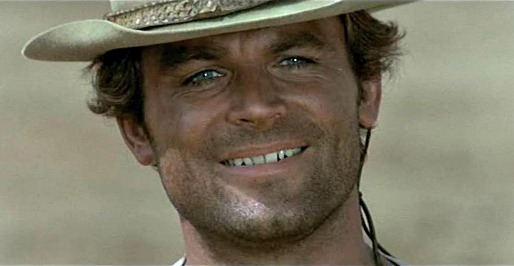
The X factor in all this is Nobody, as he dubs himself, a goofy young admirer of Beauregard who wants to take his place -- but only after seeing his hero go out in a blaze of glory. Terence Hill, an Italian who adopted an American-sounding name as a publicity stunt, plays Nobody.
Hill has an offbeat but undeniable screen presence. With his perfect bone structure, lagoon-blue eyes and cleft chin, he's almost too pretty to convincingly play a Western protagonist. But he sells the idea of a roving prankster, who's honed his own skills with a revolver (and other forms of combat) to a surpassing edge. He's like a reverse Don Quixote, whose mission is just while his methods are comical ... but deadly.
The "Nobody" moniker is employed for some pretty obvious jokes -- the most notable being for Beauregard's epitaph, after they stage a fake duel in which the old gunslinger is "killed" so he can slip off for his quiet retirement, his reputation assured. "Nobody was faster on the draw," it reads.
Director Tonino Valerii was a Leone protege, an assistant director who soon stepped behind the camera himself. Leone actually directed the opening and closing gunfights himself, according to legend.
It's an interesting and entertaining film, if somewhat baffling. The motivations of Nobody are never really clear. He just sort of sidles around, acting innocent and making strange non sequitur comments, in almost a Buster Keaton-esque fashion. Then it comes time to demonstrate his awesome speed and accuracy.
The stunts and gags used in the movie's many fights are as impressive as they are impossible. For instance, that Nobody could down several large glasses of whiskey, flip the empty mugs over his shoulder and shoot them before they hit the ground. (What would that blood-alcohol level be? Like 3.0?) Or that he can reach into an opposing gunfighter's holsters, pull out his weapons and slap them in the head with them before the man can reach them himself.
Beauregard displays similar skills, despite the suggestion that his vision is failing. (He wears glasses in several scenes, and one shot of Nobody from his viewpoint is deliberately blurry.) At one point, Beauregard shoots Nobody's hat of his head four times in a row -- each time, passing through the exact same hole. I can't imagine what sort of robotic-type calculations would be necessary to make a bullet pass through the exact same millimeters of a hat atop the head of a moving man at about 50 feet. But if one actually could do that, then what makes the hat fly off?
The showdown with the Wild Bunch carries no narrative or emotional weight, since it happens for no reason at all. Beauregard has no beef with the Bunch, other than their association with Sullivan. But Beauregard chooses to take a payoff in gold dust rather than risk raising the ire of the Bunch. Only Nobody's misplaced hero worship, plus the sheer challenge of one man taking on 150, convinces Beauregard to try. Of course, all he has to do is shoot those bags of dynamite to make the whole gang -- or at least a goodly percentage of them -- go kablooey.
(Also, since no one is around except Nobody, Beauregard and the Wild Bunch, who exactly is it that's going to relate this tale for the history books? One doubts the gang would freely share the story of how they were defeated by one near-sighted old man. And Nobody's grasp on coherent facts is somewhat in doubt.)
"My Name is Nobody" is notable for being one of those manly movies in which no significant female characters exist. A woman cook gives Nobody a skillet of beans and bacon, but other than that no female has any lines of dialogue, or are even glimpsed until that final showdown in the street.
The last thing I'd like to talk about for this film is the musical score by Ennio Morricone, a longtime Leone collaborator and one of my personal favorites. It's a bouncy, comic theme with his usual mix of orchestral instruments and non-traditional noisemakers -- including what sounds like drops of water run through a synthesizer. He also borrows strains from Wagner's "Ride of the Valkyries" for the Wild Bunch sequences, with the notes bent and flattened to make it a mocking tribute.
It's silly, touching and exciting simultaneously -- much like the film it serves to enhance.
3 stars out of four
Friday, August 3, 2012
Review: "Total Recall"
I didn't think it was possible, but they've actually done a remake of "Total Recall" that is a less contemplative movie than the 1990 one starring Arnold Schwarzenegger.
This is not an insult.
This redo starring Colin Farrell is a slick and expensive-looking chase movie that never really lets up. It doesn't amount to anything more than one big long chase, so if you're looking for freaky-deaky ruminations about the metaphysics of implanted memories, you'd best move along.
But the actions scenes are crisply staged, Kate Beckinsale makes for one of the best female cinematic villains we've seen in a while, and the visual backdrop of the cramped, dystopian future is pretty ambitious -- even if director Len Wiseman did crib at least 75 percent of it from "Blade Runner."
The new "Recall"and the old are both based on Philip K. Dick's "We Can Remember It For You Wholesale," with both movies taking extreme liberties with that short story. Dick was a fecund talent who wrote about the intersection of technology and alienation, and his characters fretted constantly about whether their own thoughts were falsified or compromised by scientific "progress."
The first movie version, directed by Paul Verhoeven, was horrifically violent R-rated action/adventure built around the star persona of Schwarzenegger. The Austrian ironman had done a couple of comedies by then poking fun at (or making use of) his mechanical acting abilities and warped pronunciations, and that smirky tilt got folded into the mix. The film generated several of the most memorable "Arnie-isms" -- "See you at the party, Richter!" and "Consider that a divorce" being the most often quoted.
The remake diverges in many ways from the 1990 version -- no doubt you've heard about the most noticeable way, in that the action never takes our hero to the planet of Mars, his lifelong wish. But Wiseman and screenwriters Kurt Wimmer and Mark Bomback take pains to offer up several visual and dialogue cues as a nod to the first film.
The infamous three-breasted prostitute is here, and a certain big-boned woman with red hair is conspicuous at a security checkpoint. (I remember how strange and unlikely that idea seemed two decades ago -- being scanned and prodded and questioned, just to travel from point A to B. Now we accept it as a matter of course.)
Farrell also utters another Arnie line verbatim -- "If I'm not me, then who the hell am I?"
The basic setup is the same. Doug Quaid is a shmo blue-collar worker who dreams of traveling to Mars, but lacks the dough. He goes to a dream factory to have some memories of adventures as a secret agent implanted -- but something goes awry when their scans reveal he actually is a secret agent. Doug takes out an entire squad of police, then returns home to find his loving wife Lori (Beckinsale) is a plant tasked with watching over him.
Doug killed Lori in the first movie pretty quickly, but here she's turned into his tireless nemesis. Despite her willowy physique, Beckinsale is convincing as an acrobatic ass-kicker, and the relentless nature of her pursuit gives her an almost supernatural aura.
Instead of mutants on Mars, Doug fights for the rebels in The Colony -- once the nation of Australia but now once again a vassal of the English empire, reborn as the United Federation of Brittania. Most of the world is a toxic wasteland, the Brits need some elbow room, and the Colony has it.
Perhaps the most amazing feature of this world is The Fall, the only mode of transport between Europe and Australia. It's a massive elevator that passes right through the core of the Earth, with the gravity reversing itself halfway through. The first time we see this, we know it will be a plot point later on.
Also cool are the synthetic policemen, who sort of resemble Robocop if he'd become a dancer in "The Black Swan" and gone on a starvation diet. There's some subplot about a "kill code" that will instantly shut down all the robots at once, but we're not sure if that's a ruse or a part of Doug's false memories.
Jessica Biel plays Melina, a rebel girl who has a thing for Doug. Her character doesn't make as much of an impact as Beckinsale, but it does give an excuse for several girl-on-girl fight scenes, which the filmmakers happily obliging.
Bryan Cranston plays the head poo-bah of the Federation, and he cackles and snarls and taunts with obvious relish. This is the second movie this summer in which Cranston, who's become something of an acting demigod for his work on that TV show "Breaking Bad," plays a tawdry villain, and both are pretty one-note performances with a heavy pinch of schmaltz. Someone, please find this man better film roles, now!
Bill Nighy appears as the head of the resistance, and I'll save you the trouble of wondering by stating that he does not emerge from some other guy's potbelly.
The violence in this "Total Recall" is rather aesthetically pure in a decidedly PG-13-rated way. Both Farrell and Biel get kicked and punched in the face so much their heads should've swelled up to the size of watermelons, but instead they get a bunch of small facial cuts that bleed profusely and then disappear two scenes later. (Except for one on Doug's right ear that appears to be "sticky.")
Is this "Total Recall" decidedly better or worse than the other one? Not really. And I'll cop to missing Schwarzenegger's dominating, grinning, vowel-strangling presence.
But it's a fun, fast-moving story that will entertain and occasionally amaze you. That already puts it into the "save" pile, ahead of many other movies I'd like to be able to hit a button to forget.
3 stars out of four
Subscribe to:
Posts (Atom)