Showing posts with label hans christian blech. Show all posts

Monday, December 16, 2013

Reeling Backward: "Battle of the Bulge" (1965)


All movies are on some level flimflam, even the ones that purport to be based on "true events." This is doubly so for war pictures, which must take the chaotic and bloody gruel of combat and some turn it into a digestible cinematic meal. If an obvious narrative doesn't present itself in the historical record, Hollywood will bend over backward to impose one -- never mind how much the made-up characters and plot diverge from reality.

You know you've got a problem with historical accuracy, though, when Dwight D. Eisenhower emerges from his post-presidency blanket of privacy to hold a press conference denouncing your movie. Such was the fate of 1965's "Battle of the Bulge."

This borderline awful war drama is like a Tinseltown Cliff's Notes version of one of World War II's most decisive battles. The real Battle of the Bulge lasted nearly a month, stretched over a huge chunk of Western Europe and involved hundreds of thousands of soldiers and pieces of equipment. The movie version, however, focuses on the plight of a handful of American soldiers at various levels of command, ranging from sergeant up to general.

Not only is the role of the British downplayed in the Hollywood version, I'm not sure if an English soldier even shows up once during the movie's 170 minutes. That's ironic, considering director Ken Annakin is an Englander who directed the British scenes in the far superior "The Longest Day."

Astonishingly, despite being one of the most famous winter military deployments since Valley Forge, there's barely a hint of snow in the film, which looks like it was shot during the full bloom of summer.

My biggest complaint is that all the American soldiers are not individuals but character "types" -- usually ones that synch up nicely with the star persona of the actor playing him. So Henry Fonda is Kiley, a careful and reasonable man whose warnings about a German offensive go unheeded. And Charles Bronson is Wolenski, a tough no-nonsense major who leads a group of hardcase dogfaces.

James MacArthur plays Weaver, an untested young lieutenant who quickly gets wised up by the German Panzer incursion and the tutelage of his wiser sergeant. Robert Ryan is the determined, methodical good general and Telly Savalas is Guffy, a tank sergeant who runs a black market racket on the side and operates as the movie's Bronx-accented comic relief.

None of these actors makes much of an impression, with the exception of Fonda, who could play a telephone switch operator and make it snap.

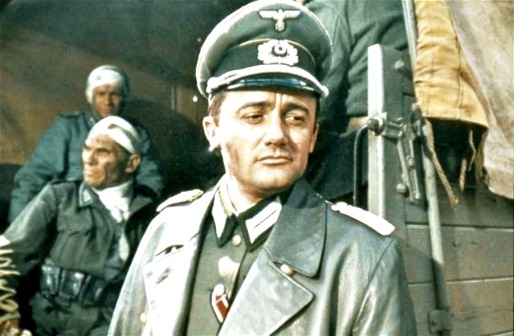
The real star of the show is Robert Shaw as Hessler, the ambitious, take-no-prisoners German tank commander given a prime spot in the counteroffensive of the Third Reich. Hessler is loosely based on the real-life Panzer commander known for his aggressive tactics that resulted in high casualties among his own forces, while also crushing the enemy.

Outfitted with the platinum blond hairdo he wore in "From Russia with Love" and a few other films, Shaw is the model of the icy Aryan Nazi, who would rather the war go in forever in stalemate than lose his status as a military hero. Hans Christian Blech plays Conrad, his right-hand man and conscious, who whispers in his ear not to be so cruel. In the end, they break ways and Conrad is assigned to tote fuel drums. The final shot of the film is Conrad tossing away his rifle and ammunition belt as the defeated Germans march away home.

Hessler is also implied to order the execution of captured American POWs at Malmedy, an actual war crime that is depicted briefly in the film without a lot of emotional power. Mostly it's used as the turning point of the Weaver character when he stops being callow and learns to accept the consequences of command decisions.

Weaver survives the massacre to, in the movie's depiction, nearly single-handedly stop the German tank advance by rolling some cans of fuel at Hessler's column, blowing them up. Neat trick, that.

Shaw is a real treat as a hiss-able screen villain, but in terms of nuance "Battle of the Bulge" is severely lacking. It's a dumbed-down cut-up of a movie about a great, tragic event. I don't think Ike was the only one who thought it was a serious disservice to the men who fought and died.


Monday, November 25, 2013

Reeling Backward: "Morituri" (1965)


"Morituri" wasn't very commercially or critically successful. If it wasn't done in by its title -- Latin for "those who are about to die" -- then the clunky plotting in the film's second half did the trick. It starts out as an interesting and cerebral WWII espionage thriller, with Marlon Brando playing a charming scoundrel, and devolves into a confusing tale of mutiny and sexual intrigue aboard a German cargo ship carrying 7,000 tons of rubber.

Why rubber? According to the haughty British colonel played by Trevor Howard -- aren't all cinematic English military men puffed-up prigs? -- that much rubber will keep German army vehicles rolling across Europe for several more months. Without it, their control over Europe slips, so the fate of the entire war rests upon the decks of the aged ship Ingo.

(Have you ever noticed that in most war flicks, "the fate of the entire war" often rests on the people and events depicted in the movie?)

The Allies don't just want to sink the ship as it makes its way from Tokyo to occupied France, but capture it for themselves. To this end they recruit Robert Crain (Brando), a wealthy German military deserter living in luxury in Australia. He's blackmailed into posing as a Gestapo officer ("standard leader") and placed aboard the ship as a passenger. His mission is to disable the explosive charges used to scuttle the ship, so when the Ingo enters into an Allied trap in the middle of the Pacific, the precious cargo won't be lost.

The best and most interesting sequence of the movie is when Crain, now redubbed as Mr. Kyle, first boards the ship and must navigate the various personalities and power intrigues going on. Brando is a treat, playing a sly man of refined manners who must pretend there is a great, evil resolve underneath. Of course, he really is highly motivated, but not to the end anyone thinks.

The captain, Mueller, is played by Yul Brynner, who isn't too keen about having an SS man spying on his operations. Mueller's last cruise ended with his ship getting torpedoed while he was inebriated (medical treatment for an infected jaw, according to the official report). The Ingo represents his last chance to get back in the Third Reich's good graces -- something he desires mostly for the benefit of his family, especially his son, the commander of a destroyer operating in the Atlantic.

Mueller and "Kyle" clash immediately, with the captain restricting the Gestapo man's movements around the ship -- sure to put a crimp in his sabotaging style. So he enlists the aid of the first mate, Kruse (Martin Benrath), a fervid ideologist who believes he should've been given command of the ship anyway.

Things get shakier the further we go. Turns out there are plenty of political prisoners and criminals amongst the crew, who are being shipped back to the Fatherland to face their fate in one of those "all the rotten apples in a single barrel" strategies that only exist in the movies, and always seem to backfire. Soon Kyle is recruiting support from them for a mutiny, including Monkeyman (Hans Christian Blech), a blond tough who has a pet bird.

And then it just gets weird. Just as Kyle has managed to alert a British destroyer to the fact that the Ingo has been disguised to look like one of their own, a German submarine blows it out of the water. The U-boat is commanded by an admiral for some reason -- fleet officers don't generally limit themselves to a single vessel -- who is immediately suspicious of the purported SS agent aboard.

Meanwhile, they drop off the survivors of a passenger ship they previously torpedoed -- which is pretty unlikely; as we know from "Das Boot," there's barely enough room on a WWII submarine for the crew, let alone prisoners -- aboard the Ingo. Among them is a Esther (Janet Margolin), a Jewess and self-described "anti-German" who is none too pleased about her fate.

Captain Mueller offers to help the girl and advises her to hide her Jewish heritage, but instead she throws it in the face of Kyle (thinking him a loyal Gestapo man), Kruse and everyone else. She also offers to sleep with Mueller, tells her loutish fellow Americans she's open to a gang rape, and relates a tale to Kyle about being forced to have sex with her brother while others watch. I have no idea what this material is doing in the movie, but it brings the proceedings to a cold stop.

Director  Bernhard Wicki and screenwriter Daniel Taradash were somewhat limited in adapting the novel by Werner Jörg Lüddecke, which contains this and many other ludicrous elements. (For starters -- why disguise Crain as a high-profile SS agent, instead of just a meathead member of the regular crew?) After the film performed poorly, the studio tried to re-title it as "The Saboteur," but it didn't help things.

When the ship gets to sinking, Wicki -- perhaps limited by his production budget? -- doesn't bother with special effects. He simply tilts his camera so it looks as if the Ingo is listing. But you can clearly see that the waterline of the ship hasn't changed. 

Aside from the chintzy camera tricks, "Morituri" is a nice-looking film -- evidenced by its Oscar nominations for black-and-white cinematography and costume design. And Brando is charismatic and compelling as a man stuck in circumstances he doesn't really want trying to do the best he can. But the cranky plot sinks this cinematic ship.


Monday, October 22, 2012

Reeling Backward: "The Bridge at Remagen" (1969)


By 1969 American attitudes about warfare had changed considerably due to our being mired in Vietnam, and it's hard not to miss how this was reflected in war films about previous conflicts.

"The Bridge at Remagen" wears the clothes of a heroic war picture, but it's got a hippie-pacifist bent to it. And it's not just that the soldiers are depicted in a more realistic way, or that the story focuses more on the madness of war rather than the "band of brothers" ethos that had ruled heretofore.

What's most notable is the way the soldiers, both American and German, talk back to their superiors and defy orders that they consider inhumane or illogical. At one point, a surly sergeant belts a major after he's ordered them to undertake a dangerous mission that will cost many of them their lives. The major lies on the ground sputtering ineffectually about a court-martial, while his attacker ignores him and turns away to go about his duty.

I.e., in these sorts of pictures the soldiers do what's expected of them, but not before letting everyone know how they really feel.

In a John Wayne picture, this would be played out as the cowardly youngster cracking under pressure and taking a swing at the officer bearing the lonely burden of command. (The Duke probably also would've blocked the punch or decked the kid in retaliation.) In "Remagen," it's a rah-rah moment where the righteous upstart gives it to The Man.

George Segal plays Lieutenant Hartman, a young and effective platoon leader who's sick to death of the war. He and his men have been the bleeding edge of the Allied advance for awhile now, and they're bone-tired and fed up. When they get picked to lead the assault on the Remagen Bridge, Hartman can barely contain his anger.

Hartman is respected by his men because he's a cautious leader who strives to keep casualties to a minimum, but is not well-liked. And that's because he does little to curry their favor or loyalty. When one of his underlings calls him a cold bastard, he wheels on him and demands to know how much the man owes him in gambling debts. "$78.50 ... that's all you're worth to me," he sneers.

Of course, in the end Hartman manages to start behaving more in the mold of a kindler, gentler commander. As they take the bridge inch by bloody inch, the pain of every man who falls is etched on his face. In the end he "captures" the bridge head by wandering in a daze toward the German line, and is greeted by the enemy commander waving a white flag.

It's an act of resignation, not heroism, but the result is the same.

His right-hand man and antagonist is that surly sergeant, Angelo, played by Ben Gazzara. Angelo has a habit of raiding all the dead corpses for loot which he then sells to his fellow soldiers, bragging that he intends to come out of the war a rich man. Hartman expresses his disgust, but doesn't lift a finger to stop him. He also stops Angelo and the other men from raping a French woman they stumble across, and in return she offers herself to him as a reward -- which he refuses. He's just too exhausted to summon up even lust. Then comes the order to take the bridge.

Speaking of that bridge. Remagen was notable because it was the last intact bridge over the Rhine River, with the German fatherland lying upon the other side. A later, superior WWII movie, "A Bridge Too Far," would chronicle a failed plan by the Allies to capture other bridges leading into Germany in 1944. By the spring of 1945 as depicted in "Remagen," the Germans had destroyed all the other bridges and were waiting to blow up this one only because a large part of their army was still trapped on the wrong side.

Robert Vaughn plays Kruger, the German major who's tasked with destroying the bridge. His commanding general, a friend, secretly gives him an order to hold the bridge for as long as possible so the retreating German forces and civilians can get across. Kruger is promised 1,600 men and prime weapons and explosives to do his job, but upon arrival finds only 200 soldiers, most of them wounded or reserves who are green boys or old men, and weak industrial explosives.

This was another reflection of the times in which the movie was made. Rather than portraying the Germans as all vicious Nazis, or even as noble enemies, "Regmagen" shows the Germans as being a reflection of the Americans. Though the footmen don't give lip to their officers quite like the Americans do, the officers do question and twist their orders if they deem them inappropriate. Vaughn plays Kruger as a man of steely conviction whose resolve is drained by the ordeal.

Director John Guillermin stages some well-crafted battle scenes, including complex sequences involving tanks, mortars and artillery. It was interesting to me in that it actually showed how the foot soldiers interacted with the heavier arsenal. Usually we just see things from the perspective of the dogfaces on the ground. The tanks also move incredibly fast -- I'm not sure if I've ever seen another film where the steel beasts are shown rumbling along at breakneck speed like that.

The screenplay by Richard Yates and William Roberts is pretty much all Hollywood hooey, with the exception of what happened to Kruger and his superior officers -- they were executed for allowing the bridge to be taken by the Americans. Their intentions were good, trying to save countless thousands of German lives, but they still failed in their mission, though largely through no fault of their own.

As Kruger is about to be shot, he hears planes flying overhead and asks, "ours or theirs?" Told they are those of the enemy, he ponders, "But who is the enemy?" It's a heavy-handed moment, where one of the characters essentially blurts out the entire theme of the movie. Always better to show, not tell.

2.5 stars out of four