Showing posts with label Dennis Quaid. Show all posts

Wednesday, November 6, 2019

Review: "Midway"


What a good old-fashioned rip-roarer war picture. “Midway” is the sort of movie they made 40 to 60 years ago starring John Wayne or Henry Fonda and a bunch of other guys, but with modern CGI effects for the extravaganza air-and-sea battles.

I went in skeptical that famously schmaltzy conductor of disaster flicks, director Roland Emmerich (“Independence Day”), would deliver anything more than another soulless special effects showcase. But paired with screenwriter Wes Tooke, a rookie to feature film scripts, and a solid cast of square-jawed actors of varying fame, I left amazed and more than a little shook.

The aerial combat scenes are just flabbergastingly good. The pilots careen and yaw all over the screen, a concerto of impacts and explosions sounding all around them. There are plenty of dogfights with Japanese Zeroes, with cutaways to how it all looks from the ground.

Best of all are the bombing runs, as the Americans tip tail over nose and dive seemingly straight down vertically, the Japanese aircraft carriers blasting a storm cloud of flak into their faces, pulling up at only the very last moment. Their wingtips kiss the ocean surface before climbing again.

It’s like taking a ride on the world’s longest, deepest roller coaster ridden by yowling demons bound straight for the fiery furnaces of hell.

The story actually sets up the war in the Pacific beginning at Pearl Harbor and all through the important military developments before Midway, including the battle at Marshall Islands and the James Doolittle (Aaron Eckhart) raid on Tokyo. The last hour or so of the movie is the titular battle, which is generally regarded as the turning point of the war.

Like a lot of old-school war flicks, the action flips back and forth between the pilots and ship captains on the front lines with the commanders and intelligence boys back at HQ, and does a good job of seeing how one group played off the other.

Patrick Wilson is Edwin Layton, a dweeby intelligence officer who predicted the attack on Pearl, and now has to pluck up the courage to convince the top brass to rely on the info from his team, which includes military band members turned into codebreakers. Woody Harrelson (!) plays Admiral Chester Nimitz, put in charge of the Pacific effort while most of the fleet was sunken or smoking.

Ed Skrein is terrific as Dick Best, the prototypical hotshot cowboy pilot who flies like he doesn’t care about coming back. Then he’s placed in command and has to become the shepherd to a flock of green newbies. He’s got a sort of hunched-over, laconic rascal charm. Think Han Solo by way of Jersey.

Luke Evans is Wade McClusky, the by-the-book commander who clashes with Best, and Luke Kleintank is Best’s buddy, Clarence Dickinson, another crackerjack pilot. Dennis Quaid plays Vice Admiral William Halsey, Mandy Moore is Best’s wife, Anne, and Nick Jonas plays a puckish machinist who gets into the action.

Surprisingly, nearly all of the characters are actual historical figures. The Japanese commanders are even given plenty of scenes so we can size up the strategy from their side. Though this isn’t an “equal sides” type of film production along the lines of “Tora! Tora! Tora!”.

There's even a little ode to filmmaker John Ford, who happened to be on hand at Midway the day of attack, producing some seminal documentary footage.

The film’s a bit long at 138 minutes -- so many are these days, it seems. I long for a time when editors were powers in Hollywood and had agency to tighten, tighten, tighten. Today’s movies are like Robert De Niro’s out-of-shape scenes in “Raging Bull.” They still can pack a punch, but the flab is distracting.

Still, a few talkie scenes that run long and some clanky dialogue aside, “Midway” is a terrific piece of throwback entertainment that actually gets the history right.


Thursday, January 26, 2017

Review: "A Dog's Purpose"


“A Dog’s Purpose” is an unrepentant tearjerker, as movies about dogs often are.

There’s just an indescribable purity about a dog. Treat it well, and it will return that to you in the form of boundless love. A dog will wait hours in your office while you do stuff they consider dreadfully boring (like writing a movie review), hoping for a chance at five minutes of playtime.

They may not be great for the pocketbook -- how much for flea medicine again?? -- but when it comes to spiritual replenishment, the ROI on dogs cannot be beaten.

Director Lasse Hallström, who made the seminal “My Life As a Dog” 30-odd years ago, gives us a fanciful tale of a super canine, a red retriever named Bailey who lives out several lives during the course of the movie, always being resurrected as a puppy with a new chance at finding its reason for existing.

Josh Gad, with that incredibly flexible voice of his, narrates Bailey as he morphs into Ellie, a German Shepherd police dog, a Corgi named Tito with a tremendous appetite, and a big hound named Buddy. He retains his memories as Bailey, and strives to do good by the humans in his life, despite some of them not being very caring owners.

The strongest relationship is with Ethan, a boy growing up in the 1950s and ‘60s. He’s played by Bryce Gheisar as a kid and K.J. Apa as a teen. They’re inseparable buds, even when Ethan becomes the star quarterback on the high school football team and starts dating Hannah (Britt Robertson), who’s clearly The One.

But dark stuff in Ethan’s family and circumstances push things in a darker direction, with Bailey trying to make sense of it all from his perspective underneath the kitchen table. In his simplistic paradigm where sniffing, eating, playing and licking are the sum total secrets to happiness, humans are a tremendous conundrum.

Let’s talk about controversy. Or rather, nontroversy. There’s a video floating around of one of the dog actors for the film being pushed into water by its trainer during production. It got scared but was not hurt or ever in any danger. Some activist types are pushing a boycott of the movie as a result. Please. People who call that animal abuse have obviously never seen real animal abuse. I did worse than that to my pooch last weekend when she stole a piece of pizza.

It does appear to have had an effect, which it is my duty to report. For starters, the movie is a lot shorter than the 120-minute running time that’s been published. It appears something like 20 minutes have been hastily cut out. The credits also list a bunch more people as screenwriters besides Cathryn Michon, who adapted the novel by W. Bruce Cameron. And the Hollywood premier was scrapped.

OK? Got all that? Let’s get back to reviewing the movie.

This is not an especially clever or sophisticated film. Dogs do things to make us happy, dogs do things to make us sad. Life (or rather, lives) unfold with the requisite mix of joy, betrayal, tragedy and pathos.

I’m not giving anything away in saying that the story eventually returns to Ethan and Hannah, a half-century later, now played by Dennis Quaid and Peggy Lipton. We know what’s going to happen, the dog knows what’s going to happen, and it’s just a matter of waiting until the people catch up.

But doggarnit, if you don’t shed a few tears and crack a few smiles during “A Dog’s Purpose,” then there’s no hope for you.


Monday, March 10, 2014

Reeling Backward: "Dreamscape" (1984)


"So Jane, what you do here in effect is count boners?"
If there was any better indication that a new Rubicon of filmmaking had been crossed, it was this quote from 1984's "Dreamscape," which was the second movie to be released with a PG-13 rating ("Red Dawn" being the first). It boasted enough gory violence, f-words and sex to earn it an R rating, but slide down to the next category with a few modest trims.

The new rating from the MPAA was designed to address a wave of films in the early 1980s -- "Poltergeist" and "Indiana Jones and the Temple of Doom" among them -- that stretched the limits of the amount of blood and violence allowable in a PG movie. Steven Spielberg was actually among those who suggested an intermediate rating between PG and R.

But the studios soon realized the potential to nudge a host of other adult-oriented material into popular mainstream movies, while still selling tickets to kiddies. A new paradigm was established, and since then most big blockbuster films have carried the PG-13 classification.

The 13 part of the rating is simply a guide for parents. As a former assistant manager of a movie theater, I can tell you there was no actual restriction on under-age children buying their way into the movie, despite outraged assertions from any number of grown-ups.

As an almost-15-year-old when "Dreamscape" came out, I can also authoritatively declare that this fantasy/sci-fi/horror hybrid touched a whole lot of erogenous zones for people in my demographic. The story is about the ability of psychics to enter into the dreams of other people, and help or hurt them depending upon their motivations.

As was the case with the "Nightmare on Elm Street" and other cinema of the era, we were made to understand that if you die in your dream, you die in real life, too. Utter hooey, of course, and we all knew it back then, but it's one of those conceits you swallow in the course of a life of mainstream movie-going.

Dennis Quaid was the star, but the person most people remember from the movie is David Patrick Kelly, who steals the entire second half as "dream assassin" Tommy Ray Glatman. (As he also did in the latter portion of "The Warriors," plus other films.)

So intense in his portrayal of the psychopathic psychic, Kelly seems to be practically shivering out of his skin -- something he actually does later, turning into a snake-man for dream combat against his arch-foe, Alex Gardner (Quaid). He also conjures up fingernail blades to tear out the beating heart of a man, a scene that surely would not have passed muster under the banner of a PG film.

Directed by Joseph Ruben, who co-wrote the screenplay with David Loughery and Chuck Russell, "Dreamscape" was reputedly based on a short novel by Roger Zelazny, who sold a story outline to 20th Century Fox but did not receive a screen credit.

The tale is brimming with all sorts of Cold War anxiety about nuclear annihilation, coupled with paranoia that the government is invading our lives and shredding our freedoms. Generally I'm not one to go in much for political interpretations of movies, but the Reaganesque subtext is pretty hard to ignore here.

Eddie Albert plays the President, who is having bad dreams about nuclear war, including being attacked by radiation mutants, and resolves to pursue disarmament talks with the Soviet Union. Bob Blair (Christopher Plummer), an old friend of his who runs a shadowy covert arm of the government -- "They're the guys the CIA is afraid of" -- opposes this, claiming the POTUS wants to "emasculate our nuclear deterrent."

He resolves to nip the problem in the bud by having Tommy Ray enter his mind as part of a secretive "dreamlink" research project housed at a fictitious college. Max von Sydow plays Dr. Novotny, head of the project and an old friend to Alex, whom he recruits to join the mission. Kate Capshaw is Jane, a fellow researcher who takes great pains to keep her relationship with Alex on a professional level.

Quaid, at the height of his brief initial stardom, is a smirky, charismatic presence, playing a guy with the soul of a con artist but who dresses like a preppy (Easter egg-colored cardigan vests aplenty).

George Wendt (Norm!) shows up briefly as Charlie Prince, a best-selling horror author whose vocation somehow gives him insight into the most secretive workings of the U.S. government. He's the one who clues in Alex that Blair is planning to use Tommy Ray to assassinate the president. How the hell does he know this? Unless he's a psychic, too?

The film's lowish-budget roots shine through during the dream sequences, which involve a lot of bad blue screen effects and herky claymation for the snake man sequences. The conception of Alex and Tommy Ray's psychic abilities is rather spotty, granting them the ability to predict the future -- Alex picks winning horses at the track -- but not much insight into other people's non-dreaming state of mind.

I don't think I had seen "Dreamscape" since its initial theater run 30 years ago (gulp!), but I was surprised at how well the movie remained fixed in my mind. I was struck by how much imagery of trains there is in the movie: Alex and Tommy Ray fight aboard a train, and then chase each other through a bombed-out underground station -- all of it bathed in a harsh red filter.

Alex also enters Jane's mind while she is dreaming and seduces her on board a train -- something they act out in real life in the movie's closing shot. Though it's a little creepy when you consider the act in its full context; it's basically psychic rape.

"Dreamscape" holds up well because it boasts a lot of imagination for what is essentially a summer action flick. And it's got a great villain who used the new MPAA rating to get exponentially more dastardly in his deeds.


Monday, October 8, 2012

Reeling Backward: "The Long Riders" (1980)


I had always taken "The Long Riders" to be an overstuffed bit of Hollywood hooey, a sensationalized account of outlaw Jesse James and his gang that, in terms of historical fidelity, landed just this side of "Young Guns."

Turns out it's actually truer to the facts than most Western tales of its ilk.

It certainly has a gimmicky feel, what with the unprecedented in Hollywood history casting of three sets of real-life brothers to play siblings and members of the James-Younger Gang -- the Keaches (James and Stacy) as the Jameses, the Carradines (David, Keith and Robert) as the Youngers and the Quaids (Randy and Dennis) as the Millers.

Actually, four: Christopher Guest and Nicholas Guest have small turns (basically three scenes) as Charlie and Bob Ford, wannabe members of the gang who eventually were allowed by Jesse to join -- after everyone else had quit, been killed or imprisoned.

The Fords, of course, were the ones who betrayed and murdered Jesse James, with Bob shooting him in the back of the head while James was unarmed and had his back turned. This scene is depicted in "The Long Riders" in a curiously flat way, with little visceral impact. It feels more like a tacked-on coda than an essential part of the story.

Narratively, the film seems smaller than its story. At a mere 99 minutes, the movie has to cover a lot of plot spread out over a number of years, with various members of the gangs romancing and marrying women in between robbing banks and trains. Each romantic relationship is essentially given one or two scenes in a fleeting attempt to lend them weight.

The only pairing of any impact is between Cole Younger (David Carradine), who puts on an air of studied nonchalance, and Belle (Pamela Reed), a worldly prostitute who wants him to make an honest woman of her. He's content to let them have their fun whenever their paths cross, and have nothing tying him down. He tells Belle he loves her specifically because she's a whore.

In one of the film's most memorable scenes, she marries a half-Indian named Sam Starr and forces the men to fight over her with cruel-looking oversized knives. Cole wins the duel but abandons Belle in disgust at having to prove himself to her.

This story thread is notable in that, as near as I can determine, it is the only part of "The Long Riders" that is a pure Hollywood concoction. Despite its highly stylized texture, the movie is actually pretty faithful to the  historical facts.

I should amend that to say it is faithful to the general narrative of recorded history, though it alters or muddies some details. For example, an 18-year-old brother of the Youngers, John, is killed in a chance meeting with some agents, and it's depicted as a terrible crime because Jim (Keith Carradine) asserts that his kid brother never rode with the gang or committed any crime. In fact, John did do some robbing with them.

Similarly, the battle with the Pinkerton National Detective Agency, which has been hired to track them down, escalates to tragic heights when the lawmen throw a smoke bomb into the Younger matron's house and it explodes, killing their 15-year-old half-brother. The boy was killed, but he was really only nine years old. Not depicted is that the Youngers' mother was also injured in the attack and had to have her arm amputated.

In that age, I would think that chivalrous Southern gentlemen (at least in their minds) would be more riled about their mother being attacked and maimed than anything else. These changes actually serve to make the assault seem less outrageous than it really was.

Stacy and James Keach made this film as a labor of love, producing and co-writing the screenplay along with Bill Bryden and Steven Smith. James has an intriguing take on Jesse James, playing him as a preternaturally serene leader who sees himself as smarter and more important than the members of his gang.

James Keach later segued away from acting and turned more to directing and producing. Johnny Cash and his wife June were so taken with "The Long Riders" that they befriended Keach, and asked him to produce their biopic "Walk the Line."

I hadn't seen "The Long Riders" in at least 20 years. Despite the film's storytelling flaws, I found myself still admiring it on several levels.

The performances throughout have a terse, organic authenticity -- we never feel like the actors are trying to impersonate a historical identity, but use it as a springboard to draw their own characters. For example, I enjoyed the simmering tension that exists between the Jameses and Youngers, erupting at the worst of times.

"The Jameses ride with the Youngers," one of the latter insists, annoyed by references to the Youngers being part of the Jesse James outfit.

There's also a nice quiet scene aboard a train -- for once, they are traveling inside as passengers rather than riding up on horses outside to rob it -- where Cole confides to Frank that he hopes one day to write a book about his memoirs. Frank scoffs at this idea. This is a nod to Cole's actual later life, where he spent more than 20 years in prison and started a respected newspaper for the inmates. He eventually won parole and spent his final days starring in a wild west show with Frank.

The James-Younger Gang effectively met its end with an ill-advised raid on a bank on Northfield, Minn. Why the former Civil War bushwackers, who confined nearly all their felonious activity to Missouri and surrounding states, decided to travel hundreds of miles north to knock over a bank is unclear.

Things go awry -- the film implies the townsfolk knew they were coming and set a trap for them -- and the outlaws are caught in the street and torn to pieces. Though none of the Jameses or Youngers are actually killed in the conflict, their wounds are missive. I vividly remember Keith Carrradine getting shot through the face, a bullet going in one cheek and exploding out the other. Cole famously was shot 11 times, which the prison doctor dubs a record, but one of dubious distinction.

The town of Northfield still celebrates the bloody event with an annual reenactment -- much the same way my former home of Ocklawaha, Fla., reenacts the Ma Barker shootout every year.

I think three things make "The Long Riders" a noteworthy film, or rather three people: director Walter Hill, cinematographer Ric Waite and composer Ry Cooder.

Hill's staging of the violence has a horrifying sort of loveliness. He often resorts to fetishistic slo-mo to capture the impact of bullets ripping through the characters' flesh, or bodies hurtling through the air after impact. The excellent action scenes are aided by Waite's elegiac camera work, which juxtaposes moments of cringe-inducing violence with poetic compositions.

Both filmmakers seem enraptured by the long gray duster coats the gang always wear. This, along with their lack of masks and penchant for calling each other by their real names, often and loudly, makes one wonder why it took the Pinkertons so long to find them.

Cooder's old-timey musical score, mixed with actual songs from the era performed at weddings and saloons, is positively a delight to listen to. It's more at the forefront than most music in movies.

"The Long Riders" is more or less a forgotten Western, made during the artistic valley of the genre between 1969 and 1991, when "Butch Cassidy and Sundance Kid" and "The Wild Bunch" made the format seem anachronistic, and Clint Eastwood breathed it back to life with "Unforgiven."

Though hardly deserving to be counted among those films' numbers, it's certainly more memorable than its non-existent reputation suggests.

3 stars out of four


Wednesday, May 16, 2012

Review: "What to Expect When You're Expecting"


Unless you're pretty slow on the uptake, you already know that "What to Expect When You're Expecting" bears little relation to the self-help book aimed at educating pregnant women about the little darlings growing in their bellies.

In fact, it's such a deliberate departure, one wonders why the producers insisted on keeping the title, other than nefarious purposes to lure in millions of moms and mama wannabes, who don't really require much luring for bubbly romantic comedies. Of course, this is the same industry that is also this week releasing a movie based on a board game about sinking military naval vessels, so starting off assuming the worst is probably going to work out pretty well.

There is no advice to be contained in the movie version of "WTEWYE," which is what I will call it henceforth, since I don't feel like typing it all, plus it seems like that would come out "wha-TOO-wee," which is good aural representation of how I felt about it.

Directed by Kirk Jones from a script by Shauna Cross and Heather Hache, "WTEWYE" feels like it was cooked up in a Hollywood laboratory ruled by poll-testing tubes and focus group beakers. Despite this, there actually are a few moments that shine.

The story takes a disparate group of five women, loosely interconnected and located mostly in Atlanta, who learn they're to become mothers right around the same time. There are also their male counterparts, plus friends, relatives, various hangers-on and a walk-on by some unrelated fathers known simply as The Dudes Group (more on them in a bit).

Now, that is a whole heapin' lot of characters to keep straight, let alone make them believable and identifiable. The result is that one couple's story works so well that I was annoyed whenever the movie focuses elsewhere, two other orbits of pregnancy feel forced and faked, another is really just a secondary story to the first one, and the last one has no purpose for even existing.

A quick run-down:

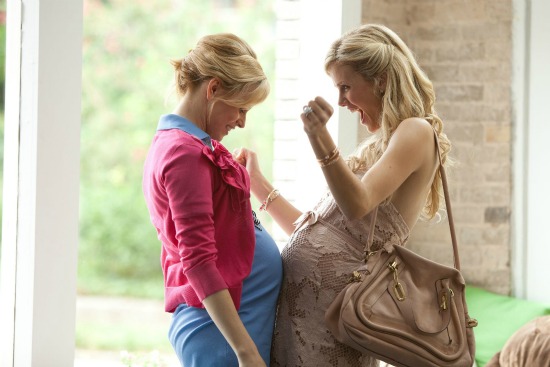
 Jules (Cameron Diaz) is a celebrity fitness trainer who just won a "Dancing with the Stars"-type reality show and fell in love with her gorgeous dancer to boot. They're rich, famous and busy, and find there's not much they truly agree upon.

Wendy (Elizabeth Banks) runs a store called The Breast Choice devoted to everything about having a baby, but she and her hubby Gary (Ben Falcone) have had trouble conceiving on their own.

Gary's dad Ramsey (Dennis Quaid), a retired race car driver, knocks up his second wife with twins. She's younger than Gary, a plastic-y Barbie type who makes pregnancy look like a breeze.

Holly (Jennifer Lopez) and Alex (Rodrigo Santoro) can't get pregnant, so they look to adopt a baby from Ethiopia. Alex is getting cold feet, which gives Holly the jitters.

The last couple is Rosie (Anna Kendrick) and Marco (Chace Crawford), early-20s owners of competing food trucks and recovering from a high-school split. They get back together for a one-nighter, she gets knocked up, and then they have a lot of Very Important discussions to share.

I genuinely enjoyed the Wendy/Gary storyline, with Banks getting some of the best lines and scenes as a woman who's spent her adult life pushing the motherhood-is-magic theme, only to find it's more about cankles and hemorrhoids. "I didn't get 'The Glow,' I just got bacne."

The one with the young kids is given the shortest shrift, which is OK since it feels like it was only included to rope in a certain demographic.

The Dudes, a club for dads to hang out with their kids, are also worth a laugh or two, with their mantra of total acceptance of each other's substandard parenting. But their sequences bring the movie to a dead stop.

I wasn't expecting much from "WTEWYE," but audiences certainly deserved more than this.
1.5 stars out of four