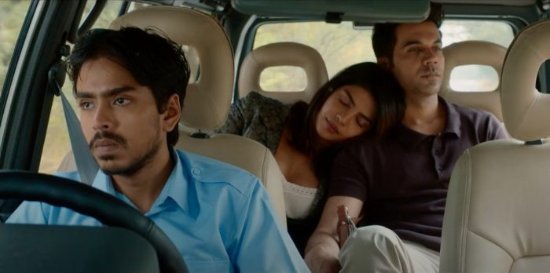
"The White Tiger" stands as something of a self-conscious counterpoint to "Slumdog Millionaire," the Oscar-winning drama set in India that told the story of the chasm between the prospering new elite and the tradition-bound culture mired in poverty and class divisions. Though thematically similar, they couldn't be further apart in tone.
In fact, there's even a moment where it takes a swipe at the earlier film, snidely saying your problems aren't going to be solved by a million-dollar game show. Snort.
Whereas "Slumdog" was hopeful and humanistic, this new piece from writer/director Ramin Bahrani, based on the book by Aravind Adiga, is a slow descent into, if not cynicism, then at least grim-eyed realism.
We identify with our propagandist, Balram, an ambitious young man from a squalid village who charms his way into being the driver for a wealthy family. And yet, over time, even as he morphs from bright-eyed striver into disillusioned businessman and palm-greaser, our understanding for why he does what he does never diminishes.
If it's possible to make a movie where the main character loses in the audience's admiration but gains in our estimation, then this is it.
It's a revelatory performance by Adarsh Gourav, who should get as much notice in Hollywood as Dev Patel did. His Balram is utterly subservient to his masters -- a word he openly uses to address them -- and yet understands resentment in his bones. A bright child on the way to a scholarship, he was forced to leave school and break charcoal for a living after his father, a rickshaw cyclist, died of tuberculosis.
Bahrani employs the parable of the roosters who are kept in pens, watching as one after another of their fellows are beheaded and torn into pieces of meat, knowing their turn will come. This is likened to the lower caste members like Balram, instilled at birth with the understanding they must not rise up against their landlords and betters.
Only once in a great while does a "white tiger" come along, one who can break out of poverty and become a rich person with a fat belly. Balram is determined that he is to be one of these tigers.
The story starts with the ending, in which Balram is already a well-to-do entrepreneur of some sort, narrating his tale as an email to a Chinese consul who is coming to India to promote business between the nations. It almost gives the narrative a fable-like quality.
Balram convinces his strict grandmother to pay for driving lessons so he can become a driver to the family of The Stork (Mahesh Manjrekar), the landlord of their village who collects one-third of every rupee made.
He fears the elder son, known as The Mongoose (Vijay Maurya), who cuffs him like an errant slave, but manages to worm his way into the service of the younger son, Ashok (Rajkummar Rao), who is progressive after having lived in New York City, advocating for investments in technology rather than coal and graft of government officials.
(The story is set in the early Aughts, before smartphones and apps were ubiquitous.)
Balram is thrilled to move to the bright lights of New Delhi with Ashok and his similarly minded wife, Pinky (Priyanka Chopra), even if it means sleeping in the garage of their high-rise luxury condo building.
Pinky and Ashok are emblematic of the new Indian generation, wishing for a more egalitarian system but unwilling to give up any of their inherited luxury to make it happen. Like Balram, we're charmed by them but come to see they're much like Ashok's brother and father, who are at least open about keeping their thumb on the poor.
Things go on, with Balram genuinely happy to be of the most service to his employers. Until a terrible deed occurs, and his faith in a flawed but reliable system is shattered.
Is "The White Tiger" a depressing movie? I don't think so. It takes a young man who is trod upon by virtually everyone in his life and evolves him into an anti-hero eager to turn the tables.
It's a harsh but penetrating look at how people in Indian, or any, culture line themselves up into predetermined strata they're not supposed to try break out of. Even when someone does so in a less than moral way, it's still an audacious and compelling journey.


