At first, "Together" has an undeniably sitcom-y feel. James McAvoy and Sharon Horgan play a couple who experience the COVID pandemic over the course of a year, addressing the camera directly a la Ferris Bueller.
The first interlude, days after the March 2020 shutdown, is ferocious and funny. They talk, laughingly but seriously, about how much they hate each other. They're PO'd that the coronavirus has pushed back their plans to split up. I was thinking, are director Stephen Daldry ("Billy Elliott") and screenwriter Dennis Kelly really going to use the worldwide devastation of COVID for snickering laughs?
But, no. The film soon grows deeper, more serious and richer.
We visit them again in late spring, then summer, then winter, finally arriving full circle in March of this year. Things change, outwardly and inwardly. His hair grows longer and a bit grayer, finally ending up in a manbun. She cycles through waves of emotion, actually reaching a place of calmness and relative happiness before anger rolls in like an inevitable tide.
"Cryptozoo" feels like a throwback to the late 1970s or early '80s -- an animated movie that is very much adult in tone and content, presenting a story that is both fanciful and cutting. There's lots of violence and nudity, though leavened with an environmental/moral message, making the whole enterprise seem like a more enlightened version of "Heavy Metal."
The story, set in the late 1960s, is about the world hiding multitudes of cryptids, or mythological creatures, that various factions of humanity want to exploit or help. Some of the cryptids are dangerous and beastly, others very human-like and intelligent. They're constantly in danger of being discovered, captured and sold into servitude.
There are mammoth scorpions, tiny imp-like critters, a South American snake as big as a skyscraper, figures with no head but a face on their torso, unicorns, pegasi, dragons and cryptids that are just dancing balls of light.
The film features voices by some name actors including Lake Bell, Michael Cera, Zoe Kazan and Peter Stormare. Written and directed by Dash Shaw, it features an animation team led by Jane Samborski. At first glance, the animation (largely hand-drawn, I believe) may seem to lack the sharpness and polish of what we've become used to, possibly even bordering an amateurish.
"Queen of the Beach" is the story of Shilpa Poojar, a poor girl who peddles her trinkets, clothes and other wares at Anjuna Beach, an out-of-the-way tourist locale on the west coast of India. The documentary follows her progress over the course of nearly a decade, starting at age 8, though she has worked there since she was 5.
There are millions of child laborers just like her. Though we talk about India as a growing economic powerhouse (or polluter), the truth is much of it still exists as a third-world country. At Shilpa's home village there is only intermittent electricity and they fetch water from the central fountain.
If Shilpa were a Golden Age Hollywood starlet, a producer would describe her as having "presence." Even meeting her as a skinny tyke, she is a bouncing ball of energy and charisma. She speaks English quite well -- along with smatterings of Russian, German, Japanese and other languages used by her customers. She has never been to school, and dreams of learning to read and write.
Over the years we watch her accomplishments and setbacks, see how she is held down by having to support her family -- even as her father and brother (the only child who was schooled) do not work. Her dream of an education seems to fly further and further away.
I don’t mind saying that I prefer American films to those from overseas. Saying this risks one being labeled a philistine, but the truth is that you can appreciate foreign cinema while syncing most closely with films that originate from your own culture.
But I’m also not afraid to say that there are certain things other nations’ filmmakers seem to be better at than us. The British do period costume dramas best. Ditto for martial arts films from Japan, Korea and China. And nobody consistently makes such unabashedly erotic movies as France.
(Though the Spaniards have spent the last quarter-century trying to catch up.)
“Curiosa” seems almost an oddity in our increasingly repressed age. Though it’s told from a feminine perspective, and directed and co-written by a woman, Lou Jeunet, it takes unapologetic pleasure in gazing at beautiful female bodies (with not a little male parts too). It’s a story about love and sex, how they intertwine and how they sometimes do not, and the pain and enjoy that derive from them.
"Summer of 85" is a rapturously joyful and sad movie that gets right at the heart of what it's like to fall in love for the first time and be vulnerable, with the added twist of being gay. There's been a spate of terrific queer romance films over the last few years, and here's another one.
Directed by François Ozon, who also adapted the novel by Aidan Chambers, the story is set in a French coastal town in the middle of the greatest decade ever to grow up, and no, this is not subject to debate. Things don't look terribly different from their American cinematic counterparts of that time: feathered hair, stone-washed jeans, wearing a jacket when you go out on the town even though it's July.
(I admit, my inner copyeditor glanced at the title and screamed silently, "Where's the apostrophe???" I'm glad I didn't leave it there, though, or I would've missed one of the best coming-of-age romances I've seen in a good while.)
Félix Lefebvre plays Alexis, a shy, intellectually bent 16-year-old on the verge of exploring life. He has to decide if he's going to stay in school to study literature at the behest of his teacher, Lefèvre (Melvil Poupaud), who thinks he holds promise as a writer, or get a job and consign himself to a life of drudgery like his dock worker father, (Laurent Fernandez).
His mother (Isabelle Nanty) is vaguely supportive and wants Alexis -- he prefers Alex -- to do whatever makes him happy. Though as a working class woman who's never known anything outside of kitchen toil, she's often mystified by her son's modern, peculiar ways.
While borrowing a friend's sailboat, Alex capsizes as a storm approaches and is rescued by David (Benjamin Voisin), a free-spirited 18-year-old who seems afraid of nothing in this life. He brings the sopping Alex to his home, where his mother (Valeria Bruni Tedeschi) undresses and bathes him. She lost her husband the year before, and she and David run a small marine shop in town, and instantly embraces Alexis as part of the family.
It's clear from the start that Alex and David are completely smitten with each other, though they take some time dancing through the steps of a typical straight friendship before taking to bed. They ride around on David's motorcycle, boat and swim, hit the carnival and get into a fight, go dancing and other stuff that wouldn't be out of place in an '80s teen comedy.
The film is sun-dappled and gorgeously shot (cinematography by Hichame Alaouié), especially our beautiful couple. The physical contrast between them is startling, and deliberately accentuated by Ozon.
Alex is diminutive, lithe, with feathery blond waves and soft feminine features -- David and his mom take to calling him "little bunny." Whereas David is tall, strapping, with a slight snarl to his lip to go with his shark's tooth necklace and wavy dark locks. Together, they look like a rock star (I was reminded of Michael Paré in "Eddie and the Cruisers") dating the girl next door.
The story is told from Alex's perspective, so there's a feeling of being swept up and away by someone older and much more experienced than us. He's fumbling and awkward at emotional intimacy, protesting reticently at first but soon eager to leap into the fire.
David registers as a rebel but also an old soul, the sort of naturally gregarious person who can become friends with someone minutes after meeting them. He makes Alex promise that whoever dies first, the other will dance on their grave.
We know from the start that this tragedy will come to pass, as a framing story has Alex morose and barely able to rise from his bed after David's death. He is also being investigated by the authorities for unnamed crimes related to the death, and Alex is unable or incapable of defending himself.
Eventually his teacher advises Alex to write out his and David's story as a sort of confession/catharsis, so the romance is colored by the act of remembrance. This is interesting in the context of Alex's later discussion with a mutual friend, a British au pair named Kate (Philippine Velge), that young love is often a deceptive illusion, in that we fall in love with the idea of being in love as much as the actual person.
Was David really this way, or is it just how Alex saw him? It's a hypnotizing question to ponder, especially after their relationship starts to suffer inevitable bumps. Underlying all this is an undertone of fear of being exposed, at a time when being gay made you a target for ostracism, or worse.
"Summer of 85" is a wondrously beautiful movie, but also one that isn't afraid to stare at the ugly parts of what being in love is really like. The best onscreen portrait of two men in love I've seen since "Brokeback Mountain," this film feels both timeless and immediate.
At just 81 minutes, this horror film unfolds in a single, cramped apartment. A mute boy of about age 11 has just moved in with his single dad. He discovers an old book of spells in the closet that belonged to the previous resident, an elderly man who died there, including one to grant one's "wish of desire."
Dylan's (Ezra Dewey) wish is the most obvious choice: he would like to have a voice of his own. It's never explicitly stated how he lost the one he had, as his hearing is fine and he only uses American Sign Language to speak. We are shown a large, off-putting Y-shaped scare on his chest, and are left to infer the rest ourselves.
The spell in the "Book of Shadows" seems easy enough: light a candle an hour before midnight, put three drops of blood into it and speak an incantation. A djinn, or immortal spirit of the shadow world, will manifest and attempt to claim your soul. If you can make it to the stroke of the witching hour, the wish will be granted... one way or another.
The movie spends about 20 minutes setting up this little world, and then the hour in question plays out in real time. It is one of the most terrifying I can remember in a long while.
Rob Brownstein plays Dylan's dad, Michael, and what a perfect combination of casting and performance. He is middle-aged, calm and gentle, and the love for his son is at the center of his universe. With his deep, reassuring voice -- Michael is a radio DJ working the grave shift -- he lets Dylan know that he is perfect just as he is.
Dylan has a lot of nerves and trauma surrounding his mother. At one point he asks his father if she would still have "gone away" if he wasn't different from other kids. Later he has visions of her standing in the kitchen of their old place wearing a nightgown, an indelible image we'll not soon forget.
The djinn is more heard and felt than seen, at least for awhile. It takes corporeal form in an interesting way, which I'll leave to you to find out. Its spirit leaves its mark through black swirls of smoke that snake around objects in an almost seductive way. When Dylan manages to inflict harm on the djinn, its physical shell wants to return to that state, almost like chalk dissolving in liquid.
Dylan's apartment is practically another character in the movie, one of those typical low-end stacked boxes with just a couple of common rooms, a bath and two cramped bedrooms. The boy smartly uses every nook and cranny to his advantage, hiding here, trapping the djinn there.
It's nice to experience a scary movie --featuring a kid, at that -- where you're not constantly yelling at the characters to stop doing the stupidest, most obvious thing.
This is the second feature film for the directing/screenwriting team of David Charbonier and Justin Powell after their somewhat similarly-themed "The Boy Behind the Door" last year. As young filmmakers they've already got a masterly sense of how to use confined space and time to ratchet up the tension and fear.
They're carefully building the suspense puzzle piece by painstaking piece, not relying on cheap "boo gotcha" scares -- the commonest of crutches for untalented or lazy storytellers.
For example, Dylan has asthma, and one of the ongoing trigger points is that his breathing will start to lock up and he has to figure a way to get past the creature and find his inhaler.
The filmmakers make very good use of the music by Matthew James and photography by Julián Estrada, adding to the pervading mood of claustrophobia. I especially liked how different light sources and reflections shift and play out around the spaces, making us feel like we're comfortable with the layout and then tricking us into doubting our own perceptions.
Dewey is flat-out terrific as Dylan, especially when you consider it's a wordless performance that requires just the emotions that play out on his face to convey to the audience what he's thinking. The character has no narration or inner voice to communicate with us -- just a fabulous young actor.
"The Djinn" is a very tight piece of filmmaking, every little piece contributing to the greater sum with zero superfluous elements to distract or degrade the experience. As movies seem to have gotten longer and fatter in recent years, how I've wished for something leaner like this.
"The Killing of Two Lovers" teases you with its title. Does it refer to an actual murder that takes place, or two? Or do the people who we think are in danger of being killed the wrong two? Or maybe it's metaphorical, alluding to the death of love between a married couple?
This is a contemplative, observational drama from writer/director Robert Machoian. It stars Clayne Crawford as David, a father and husband we're not sure how we feel about.
He is currently estranged from his wife, Nikki (Sepideh Moafi), living just down the street with his elderly, wisecracking dad. They all reside in a run-down rural town, a flat expanse between mountains that seem to loom in the background menacingly rather than beatifically.
Things start with a scene, which I'll not describe in detail, which make us immediately fear and loathe David. He contemplates something cowardly and hateful, and we feel like he would have gone through with it if circumstances didn't intervene. Shortly thereafter he tries something similar, behaving like a first-rate stalker and creep.
But then we see him looking after his ailing father, and walking his kids to school in a quietly protective way, and maybe we think we don't know all there is to him.
He and Nikki are taking break, at her urging, to "work on things" with the understanding they will see other people during this time. It soon becomes clear this means Nikki is seeing another man, Derek (Chris Coy), while David does little else but pine for her and think about how to fix their fractured family.
Machoian shoots many scenes from middle distance or even further away, so we feel like we're observers who happened upon this scene rather than seeking it out voyeuristically. In watching Crawford I'm reminded of Robert Duvall in "Tender Mercies," acting even with his back to the camera.
We follow David around on his daily routine. He's an overalls-and-pickup kind of guy, doing whatever hard work needs done, like cleaning up a field of junk for a hundred bucks a day. He noodled around with being a singer/songwriter back in the day, but he and Nikki got hitched straight out of high school and started having kids, so their young dreams have been back-burnered, possibly permanently.
It's a strange journey because David will seem so even-keeled and mature one moment, like insisting to his troubled teen daughter, Jess (Avery Pizzut), that she shouldn't make Nikki out to be the villain because she wanted the separation and now has a stranger sleeping over. Then a few hours later he'll be following people around in his truck or losing his cool.
Relationships and marital stress are not fun, and can feel like we're being physically pulled out of the body of the person we want to be and into a limbo wandering of dread and self-hate. This film shows all of that in a stark, realistic way that melts into your bones.
One scene really resonated with me where David knows he is in the right about something Nikki has done regarding Jess, through carelessness rather than spite, and we see him use that fleeting power to manipulate the situation and compel an apology that he lavishes in.
It becomes about point-keeping and one-upping, even (especially?) with the ones we love.
I also admired that way sound is used in the movie. There is no musical score and the background wind of the prairie lurks around us constantly like a ghost in the shadows. Sudden concussive, almost metallic sounds will suddenly punctuate the soundscape, suggesting the cocking of a pistol or scraping of a knife.
It's a powerful, subtle way of making the audience feel like we're always balancing on the border of uncertainty and violence.
At 84 minutes, "The Killing of Two Lovers" is just long enough to fill us with a pervading sense of fear and tension, but also hope and empathy. We feel badly for this couple, even as they don't always act in the most compassionate way or try to be their best selves. David does some terrible things, or at least contemplates them, and we wish for him to pull back from the edge.
I'm not sure what to call this movie. Is it a crime thriller? A family drama? A revenge Western? Elements of all are in its DNA. I think it's one of those movies that actively resists categorization.
The strange association that comes to mind is "Bonnie & Clyde." They were regular people who became outlaws, and David and Nikki often teeter on the edge between normalcy and depravity. It's a narrower line than we like to think.
Some movies are good, some are bad, a whole bunch are somewhere in the middle. Then there are those films you watch and someone asks you afterward, "What's it about?", and you honestly don't know how to answer.
"Transference: A Love Story," is helpful enough to give us a big clue right in the title. It is indeed a romance about two nurses working in a London palliative care hospital, both of them immigrants: Katerina (Emilie Sofie Johannese) from Norway and Nik (Raffaello Degruttola). They have a torrid affair, then things go shaky, then splitsville, then... well, you'll see.
Really, what the movie is about is lots of leisurely shots of the stars looking forlorn, often against a cityscape backdrop, possibly with some odd narration by Katerina that somehow uses physics and other scientific principles to comment upon their relationship.
It's weird. It doesn't work. Even slightly. IMDb.com lists its running time as 90 minutes, but the version I watched was closer to two hours. It should be an18-minute short film. Certainly you could communicate everything meaningful in the story in that amount of time.
Nik and Katerina do not seem like a good fit. Everyone tells them so, from her roommate, Camilla (Pernille Broch), to their workmates to... anyone with eyes.
She is 25; he seems close to double that. She is fetching, with long, dark hair and mysterious eyes; he looks like the guy who serves you soup. Katerina has animated facial expressions and seems full of inner turmoil; Nik barely hasn't any animation in his face at all. He's closer to scary than smoldering.
I do not know if Degruttola is a terrible actor or if this was a deliberate choice he made. Probably the latter. He is also the writer/director of the film, and the press notes highlight the fact the story is inspired by his own complicated, real-life relationship with his father, who struggled with bipolar disorder his whole life.
The movie takes until about the halfway point to suggest outright that Nik may have mental health issues. Katerina is the one who comes on to him, which he initially resists since they work in the same place. Soon they plunge full into a passionate (though coyly scanty on skin) affair, including rendezvous at the hospital where people are literally dying in the next room, which is just... ick.
Later on we meet Marieka (Lotte Verbeek), who is Nik's ex. He wants to share news of his new relationship with her, almost as if asking her permission, and she has her own news to relate. A few other characters flit in and out of the background without much impact: another Italian coworker (Iggy Blanco), much younger and better-looking than Nik; the supervising nurse (Bea Watson), who appears even younger than Katerina and is astonishingly clueless about their affair.
Not a lot happens in this movie, and when they do events don't seem to fit with the rest of the story. Nik has an encounter in a bar that turns violent for reasons no one, including him, can figure out. And then, more staring off into space while the music plays.
So... much... staring...
I still scratch my head thinking about "Transference." It's supposed to be a love story but it's more about mental health challenges. Really, it's about how hard it can be to love someone struggling with a mental health diagnosis. Watching this movie doesn't help anyone.
"Two Distant Strangers" is an incredibly compelling film on a familiar, harrowing topic that manages to keep surprising us. Carter (Joey Bada$$) is a young black artist waking up from a one-night stand with Perri (Zaria), a lovely young woman. He's really into her but is also in a rush to get back to tend to his dog. He runs into a white cop, Sergeant Merk (Andrew Howard), who racially profiles him and instantly escalates a harmless encounter into a deadly one. Worse yet, Carter awakes the next morning to find himself back in the same situation. Over and over again, he tries to replay the encounter, but it always ends in his death. Stuck in a mirthless "Groundhog Day" scenario, Carter finally takes a tack of engaging with the police officer as a person, leading to an enlightening conversation on how they see each other across a huge societal divide. A stunning look at a right-now issue that makes us feel and think. Directed by Travon Free and Martin Desmond Roe from a screenplay by Free.
Feeling Through
18 minutes
A beautiful, simple story from writer/director Doug Roland. A young man, Tareek (Steven Prescod), has no place to go. He hangs out on the street with some buddies, while texting others for a place to crash. Finally getting lucky, he runs into a strange man standing on the street corner. This is Artie (Robert Tarango). It turns out he is deaf and blind. He communicates by writing on a notepad, and asks Tereek for help getting to the bus. It's late, but he agrees, taking Artie by the hand. A stop at a bodega -- where Tereek pockets $10 from Artie's wallet while buying an iced tea -- makes them miss the bus. Again and again, Tereek has an opportunity to dump this fellow and ease his own path. But he chooses to stay. A little grace inside all of us.
The Present
23 minutes
In this tense Palestinian short, a father named Yusef (Saleh Bakri), must travel each day through an Israeli checkpoint to get to his home. It's a humiliating experience, but one he endures stoically. On his wedding anniversary, he takes his young daughter, Yasmine (Mariam Kanji), through to buy groceries. Yusef suffers further humiliation at the hands of the smirking young soldiers, who single him out for for hours of meaningless detention. Eventually they make their way through, and Yusef reveals the surprise of buying a new refrigerator to replace their failing one for his wife, Noor (Mariam Basha). Of course, this means getting through the checkpoint again, and tempers flare to a dangerous point. A poignant and telling tale about human dignity, and what happens when it is trod upon.
White Eye
21 minutes
An Israeli man (Daniel Gad) who had his expensive white bike stolen last month finds it locked up on the street in a rough part of town. He's sure it's his because of a dent and purple sticker. He calls the police but they say they can't let him take it without filing a complaint or identifying the thief. He's ready to pay a workman 250 shekels to cut the lock when an immigrant from the meat-packing shop next door steps out, claiming the bike is his and he bought it a week earlier. Things escalate, and the Israeli is on the right side of the law for demanding his rights -- but is he on the right side of humanity? A probing look at otherism and alienation.
The Letter Room
32 minutes
No often you see a star of Oscar Isaac's caliber in a short film. He plays Richard, a middle-aged guard at a prison who is reassigned to Director of Prisoner Communications, which is a fancy way of saying he reads their mail for any dangerous material. He helps out Jackson (John Douglas Thompson), an older inmate on death row he gets on with, to see about any missing letters from his daughter. Richard becomes entranced with the sensual, moving letters from Rosita to her boyfriend, Cris (Brian Petsos), another man on death row who never talks -- or reads the letters. A surprisingly expansive portrait of one man, as we wade into Richard's own loneliness, with lots of imagery of him eating and drinking by writer/director Elvira Lind, as if he craves sustenance as a replacement for human contact.
I'm a sucker for World War II movies, especially based-on-true ones like "Six Minutes to Midnight." It was arguably the single most important event in human history, and even today there are still endless tales of unheralded heroism, sacrifice, debasement and tragedy to be told.
Strangely, this spy drama starring Eddie Izzard is curiously flat and lacking emotional appeal. It has an interesting premise: a British school for German girl that becomes a locus of intrigue that could alter the fate of the war. It's got secret agents posing as teachers, double-crosses, intimidating brutes and Dame Judi Dench as the noble but self-deluding head mistress.
Yet I found the movie, directed by Andy Goddard from a screenplay he wrote with Izzard and Celyn Jones, to be predictable and even a tad dull. Izzard's character isn't very well fleshed out, existing as a sort of do-gooding everyman without any history of distinctive personality traits.
He fills out a suit marvelously, but the role is thin as tissue.
(I should mention Dench and fellow Brit acting legend Jim Broadbent receive top billing, though Izzard's the star and main character, as well as serving as executive producer. This film is clearly his baby, yet he takes a lesser credit. Though I suppose just being in the same movie with those two stalwarts must be reward enough.)
As the story opens in summer of 1939, the English teacher at the Augusta Victoria College for Girls at Bexhill-on-Sea on the southern coast of England goes mysteriously missing. We see him being nervously chased about the boardwalk, so we know it's not just the jitters. Thomas Miller (Izzard), a middle-aged widower with a journeyman's history of going from school to school, is hired on a trial basis as replacement by Miss Rocholl (Dench), who runs the college.
Roscholl is a strong adovcate of Anglo-Saxon cultural alliance, and is aware how this looks in the days before the outbreak of a war that seems certain. She informs Miller that a number of the students are daughters of Nazi high command, so discretion is key.
It turns out Miller is a Brit agent who's been sent to ferret out what's going on at the school. He's disturbed to find the young women listening to Hitler broadcasts and even giving the Nazi salute -- with Rocholl and the young teacher, Ilsa (Carla Juri), joining in.
Broadbent turns up, all too briefly, as Charlie, the local bus driver who seems to know more than he ought. James D'Arcy plays the police captain looking into the matter who's unreasonably snotty about it. Jones, the co-screenwriter, plays his brutish corporal, one eyebrow melted in a permanent sneer. David Schofield plays Miller's huffy superior who meets him for clandestine hand-offs of secrets.
One of the film's weaknesses is that the students are never really given strong identities, just acting as a sort of greek's chorus of blonde, apple-cheeked emotional windsock. The only two that really stand out are Maria Dragus as Astrid, the headstrong one even Miller confesses he's a little scared of, and Tijan Marei as Gretel, the smart, timid girl the others pick on.
The movie starts to explore Gretel's relationship with Miller a little bit, with him trying to support her against the bullying. There's even a brief suggestion she might be Jewish, or passing as gentile, though it's soon swept aside for more spy vs. spy stuff.
If the intrigue were more exciting, we might forgive the lack of character development. As it is there's just a vague description of there being a list of British undercover agents being circulated through the school, and that the Nazi commanders intend to bring the girls home before declaring war. I never could quite figure out why the MacGuffin has to be tied to the school -- aren't there hundreds of other ways to transmit the secret list?
Izzard isn't terribly convincing as a secret agent, shortish and stocky with floppy blond locks. Miller does a lot of running in the movie, on the lam from both German and British authorities at different points, though there is one clever bit where he impersonantes a marching band musician.
"Six Minutes to Midnight" doesn't work very well either as a human story or as a spy thriller. It seems like the start of something very good, but a lot of ingredients were left on the counter.
I confess I went into “The Father” without much enthusiasm. Dementia is a subject that’s been pretty well explored in cinema -- “Supernova” is just one recent example -- and I wondered how much familiar ground this film would tread all over again, even with Oscar winners Anthony Hopkins and Olivia Colman leading the way.
It took but a few minutes to replace my anxiety with astonishment. Director Florian Zeller, who adapted the screenplay (along with Christopher Hampton) from his own play, gives us a gripping tale that puts us right inside the mind of Anthony (Hopkins), an 83-year-old Londoner.
I don’t think I’ve seen a better cinematic depiction of mental illness since “A Beautiful Mind.”
The trick here is that we’re not witnessing Anthony from without, but seeing things through his eyes. To him, everyday life is a confusing journey in which strangers suddenly appear in your apartment, claiming to have known you for years, or strangers seem as old friends.
He also experiences agonizing time slips, so he’ll think it’s still morning when it’s suppertime -- or even that he believes an hour has gone by when it’s been more than a month.
Colman plays his daughter, Anna, who has come to live with Anthony in his marvelous flat… or he has moved into her place, depending on his current mindset. Shockingly, Anna is sometimes played by another actress, Olivia Williams, and the pain on both their faces when he angrily denies her identity is a sight to behold.
This is a masterwork in acting by Hopkins, playing a proud man who’s desperately trying to put up a front of still being in charge of his own life. He’ll make a joke of his forgetfulness, charm the pants off whoever he’s talking to, then teeter off into a canyon of anger and despair the next moment. It’s an incredibly vulnerable performance.
Colman is solid too, playing a woman of middle years who has watched her own life flash by as she’s tended to her father in his decline. She lets us feel the mixture of shame, guilt, resentment and affection when she sees her father. Part of her knows a time is coming when he’ll need more care than she can give, but she’s not yet ready to let go of the responsibility.
At various times (from Anthony’s perspective) Anna is currently married, or divorced, or recently met someone and decided to move away to Paris. Rufus Sewell and Mark Gatiss play her lover alternately, whose patience for Anthony varies quite a deal, from kindly tolerance to outright abuse.
Imogen Poots turns up as Laura, a young caregiver who Anna has hired to look after Anthony while she goes away. He’s gone through a slew of such women who couldn’t take his abuse -- for example, he’s constantly misplacing his watch but accuses his caregivers of stealing it. He’s immediately taken with Laura, who reminds him of his younger, favorite daughter: another reservoir of pain for Anna.
“The Father” falls into that small category films that can be painful to watch, but is extraordinarily rewarding for those that do. Such a beautiful, and very human, story.
Writer/director Nicholas Jarecki had the idea to make his drama “Crisis” about the opioid epidemic as three parallel storylines. It’s not a new concept, but it can be an effective one when woven together artfully. Instead, the movie feels like three different tales rather than a gripping whole.
Individually, the pieces work. But two of them only intersect very late in the story and the third one… never does.
Armie Hammer plays Jake Kelly, a gruff, hard-charging DEA agent on the verge of a huge bust after spending a year infiltrating himself into the pill-mill trade. Evangeline Lilly is Claire Reimann, a suburban mom distraught over her teenage son’s death from overdose who decides to take matters into her own hands. Gary Oldman plays Tyrone Power, a scientist who’s been signing off on the big pharma’s studies in exchange for funding but undergoes an attack of conscience.
All three of these have enough narrative momentum, not to mention compelling performances, to merit an entire feature film. Together they are less than the sum of their parts.
It’s part cops-and-robbers, part revenge cycle and part corporate intrigue. I’m guessing the notion was to take a look at the opioid crisis from a variety of angles, but we actually see very little of the end effects on the users. Jake’s sister (Lily-Rose Depp) is an addict, which works to stoke his passions, but she only gets a couple of substantive scenes.
Tyrone is a chemistry professor at a small college that relies upon donations from a huge pharmaceutical company to fund his research, with Luke Evans playing the heavy. They believe they’ve stumbled upon a new form of painkiller that isn’t addictive, which will revolutionize the use of opioids -- not to mention rake in billions. But some lab technicians discover that the drug, Klaralon, is killing off their mice test subjects and needs to be pulled for more study.
He decides to go up against the big powers -- including his friend, the college president played by Greg Kinnear -- and progressively gets chewed up.
Claire insists that her son was not actually a drug user, and with a little digging and the help of a private investigator, she believes he was actually murdered rather than overdosed. She travels to Canada to look into the big pill operation behind it, which has recently moved into the even more deadly trade of fentanyl. It’s mentioned, but only lightly explored, that she used to be a user herself.
Meanwhile, Jake has set up his own front clinics where shady doctors dispense prescriptions to dangerous narcotics like candy (they hire homeless to obtain the pills, then immediately buy them back so they’re not putting more drugs on the street). With his new boss (Michelle Rodriguez) putting the pressure on, he has to set up a multimillion-dollar deal between his operation, the Canadian manufacturers and the Armenian distributors.
If that sounds like a lot of characters, that’s because it is. And I haven’t even mentioned the various supporting characters, spouses, friends, henchmen and so on.
I liked all three main actors in their roles. Claire is fragile but determined, Jake glowers so much he seems to positively steam, and Tyrone’s keening, high-minded oratories about doing the right thing pluck the heartstrings. It’s not enough, though.
“Crisis” is an ambitious movie that I think fails because of a lack of bigger ambition. I can imagine this as a trilogy or limited series that gradually sucks us deeper into an international epidemic, with each story showing the full breadth of every side. What we get feels like a CliffsNotes version of something bigger and better.
Imagine coming home one day to have your entire life ripped away from you. And nobody even knows about it.
You're barred from entering the place where you've lived for years, consigned to the shed in the back which was just used to keep your stuff. The person you've loved for decades is struck ill and kept from you, other than a few uncommunicative moments. Your long-held plans to move away together are dashed, instantly and maybe irrevocably.
Effectively, you've been robbed of everything that defined your existence.
That's the story of "Two of Us," the affecting romantic drama from France that is that nation's official entry for the Oscars. (Under the Academy's arcane rules, only one film from each country can be considered for Best International Feature.)
This is a quiet, intimate, and yet emotionally powerhouse movie anchored by two splendid performances by Barbara Sukowa and Martine Chevallier. It's not often you get to see a passionate romance between two older women portrayed so unflinchingly, both emotionally and physically.
Madeleine (Chevallier) is perhaps in her early 70s, a French widow who raised her family in quiet anguish, married to a man she didn't love. That was reserved for Nina Dorn (Sukowa), a slightly younger German expat and retired teacher. They've carried on an affair for decades, first hidden from Madeleine's marriage and now from her two grown children. Today they live across from each other in opposite apartments, though Madeleine's is the real home and Nina's just a nearly furniture-less depository.
Nina is frustrated that they've had to hide their love so many years, and is pushing to sell their places and move to Rome, where they first met. But Madeleine, still feeling tied to this place and her family, is not ready to admit her sexuality to the world, and hesitates.
Disaster befalls when Madeleine experiences a stroke after the couple have a huge argument. After she returns home from the hospital, unable to speak or walk, Nina finds herself in an impossible situation and crushed with guilt. Although she has a key to the apartment, she can't come and go because a live-in caretaker, Muriel (Muriel Bénazéra), is always there.
Nina offers to watch over Madeleine but is rebuffed. Madeleine's daughter, Anne (Léa Drucker), is completely unaware of the relationship and subtly pushes away the woman she thinks is merely a friendly neighbor. Her brother, Frédéric (Muriel Bénazéraf), bears resentment for his mother's soured relationship with their father and remains physically and emotionally checked out.
Things go on. There is unavoidable conflict with Muriel and later his son, Theo (Augustin Reynes). Nina responds with less than stellar behavior herself, though we identify with her utter anguish at being locked out of her own life.
Meanwhile Madeleine, who has been as still as a mannequin, begins to show signs of recognition and consciousness. But circumstances transpire to keep her and Nina apart.
I was surprised how the film played out almost like a crime procedural, with Nina having to act as the thief, gradually stealing back pieces of her own identity. Filippo Meneghetti, a first-time narrative feature director, wrote the screenplay with Malysone Bovorasm, collaborating with Florence Vignon.
It's a very simple, spare story lacking in big look-at-me moments. And yet by underplaying, it tugs that much harder at your feelings than would something with syrupy string music and showy "Oscar clip" moments.
Sukowa, with her fierce lion's mane and proud features, gradually reveals herself as a formidable adversary to anyone who would try to deny her love for Madeleine. Chevallier obviously gets less to do, spending much of the movie sitting expressionless, but manages to give us little hints and winks about what's really going on beneath that deceptively placid exterior.
Taking place almost entirely inside just the two apartments, "Two of Us" is a film of interiors -- those we show to the world, and that which we keep hidden, sometimes against our deepest wishes.
I experienced equal parts fascination and frustration watching “The Wanting Mare.” It’s a film of extraordinary beauty and imagination, and a nigh-incomprehensible approach to the basics of storytelling.
I don’t believe writer/director/star Nicholas Ashe Bateman intended a standard linear narrative. It’s more of a dreamlike dance through wonderment and regret. The actors, almost all of them unknowns, acquit themselves with a level of authenticity and heft you don’t often see in the science fiction genre.
That’s how “Mare” is described in the press notes, though it’s more of a gritty dystopian fantasy. Set in a mythological time, possibly long after this one, it seems to consist of only two places: Whithren, a seaside hellhole in which people scrounge and scrap, and an unnamed northern place that everyone wants to get to.
The only way to escape the heat and rot of Whithren is by catching a cargo ship, which transports the wild horses caught in the south and taken north.
It’s a Casablanca-like scenario, though instead of Captain Renault’s letters of transit the only way out is a ticket aboard the ship. These aren’t things you can just buy, more like physical totems that people are willing to kill for.
Moira (Jordan Monaghan) comes from a line of women who seemingly came from the northern place, and every night they dream of how the world was before… whatever made it like it is now. With her cascading tawny hair, lithe frame and bold gaze, Moira is the picture if strength and independence.
Moira likes to go from her lonely house on the cliffs into the city to listen to music. The whole place is a thicket of buildings that have fallen down, and ones that are about to. There doesn’t appear to be any kind of industry, or trade, or agriculture. Just people killing time until they can get their hands on a ticket, or die.
(There are phones and automobiles of near-past vintage, so it’s hard to fix exactly how this world relates to our own.)
One night she saves Lawrence (Bateman), who has been shot up while attempting a robbery. As he heals, they begin a joyous love affair that is the high point of the film, carried out almost entirely without words.
Lawrence tells Moira that he knows where a ticket is, and promises to get it for her. But things go poorly, and he finds a baby girl abandoned on the shore -- much like Moira’s ancestor long ago -- and brings it to her.
The time shifts forward, inexplicably, and for a time we follow this little girl as an adult (Yasamin Keshtkar). She has somehow come into possession of one of the valuable horses, and forms an alliance with Hadeon (Edmond Cofie), a local crime lord, to keep the animal safe. Like Moira and Lawrence, they begin an affair (which the movie depicts so scantly it’s more implied).
Things go on. We meet more people, and try to puzzle out how they factor into the story. Another young woman (Maxine Muster), an older man and woman (Josh Clark and Christine Kellogg-Darrin), a few others.
How does it all fit together? I’m not entirely sure. A better question is: Was it ever meant to? Or is this film closer to surrealism, relying on imagery and mood to grant us an interesting experience?
Bateman seems to have a bright future as a filmmaker. He’s got an arresting visual style that reminds of a young Ridley Scott. Certainly he comes up with intriguing story concepts. “The Wanting Mare,” though, feels like a half-assembled puzzle that came with many pieces missing.
"The White Tiger" stands as something of a self-conscious counterpoint to "Slumdog Millionaire," the Oscar-winning drama set in India that told the story of the chasm between the prospering new elite and the tradition-bound culture mired in poverty and class divisions. Though thematically similar, they couldn't be further apart in tone.
In fact, there's even a moment where it takes a swipe at the earlier film, snidely saying your problems aren't going to be solved by a million-dollar game show. Snort.
Whereas "Slumdog" was hopeful and humanistic, this new piece from writer/director Ramin Bahrani, based on the book by Aravind Adiga, is a slow descent into, if not cynicism, then at least grim-eyed realism.
We identify with our propagandist, Balram, an ambitious young man from a squalid village who charms his way into being the driver for a wealthy family. And yet, over time, even as he morphs from bright-eyed striver into disillusioned businessman and palm-greaser, our understanding for why he does what he does never diminishes.
If it's possible to make a movie where the main character loses in the audience's admiration but gains in our estimation, then this is it.
It's a revelatory performance by Adarsh Gourav, who should get as much notice in Hollywood as Dev Patel did. His Balram is utterly subservient to his masters -- a word he openly uses to address them -- and yet understands resentment in his bones. A bright child on the way to a scholarship, he was forced to leave school and break charcoal for a living after his father, a rickshaw cyclist, died of tuberculosis.
Bahrani employs the parable of the roosters who are kept in pens, watching as one after another of their fellows are beheaded and torn into pieces of meat, knowing their turn will come. This is likened to the lower caste members like Balram, instilled at birth with the understanding they must not rise up against their landlords and betters.
Only once in a great while does a "white tiger" come along, one who can break out of poverty and become a rich person with a fat belly. Balram is determined that he is to be one of these tigers.
The story starts with the ending, in which Balram is already a well-to-do entrepreneur of some sort, narrating his tale as an email to a Chinese consul who is coming to India to promote business between the nations. It almost gives the narrative a fable-like quality.
Balram convinces his strict grandmother to pay for driving lessons so he can become a driver to the family of The Stork (Mahesh Manjrekar), the landlord of their village who collects one-third of every rupee made.
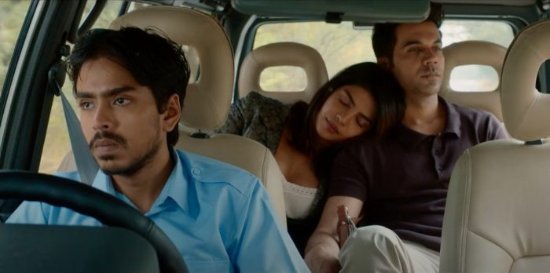
He fears the elder son, known as The Mongoose (Vijay Maurya), who cuffs him like an errant slave, but manages to worm his way into the service of the younger son, Ashok (Rajkummar Rao), who is progressive after having lived in New York City, advocating for investments in technology rather than coal and graft of government officials.
(The story is set in the early Aughts, before smartphones and apps were ubiquitous.)
Balram is thrilled to move to the bright lights of New Delhi with Ashok and his similarly minded wife, Pinky (Priyanka Chopra), even if it means sleeping in the garage of their high-rise luxury condo building.
Pinky and Ashok are emblematic of the new Indian generation, wishing for a more egalitarian system but unwilling to give up any of their inherited luxury to make it happen. Like Balram, we're charmed by them but come to see they're much like Ashok's brother and father, who are at least open about keeping their thumb on the poor.
Things go on, with Balram genuinely happy to be of the most service to his employers. Until a terrible deed occurs, and his faith in a flawed but reliable system is shattered.
Is "The White Tiger" a depressing movie? I don't think so. It takes a young man who is trod upon by virtually everyone in his life and evolves him into an anti-hero eager to turn the tables.
It's a harsh but penetrating look at how people in Indian, or any, culture line themselves up into predetermined strata they're not supposed to try break out of. Even when someone does so in a less than moral way, it's still an audacious and compelling journey.
Hollywood has never had a firm idea exactly what to do with Hilary Swank. After winning two Oscars in her 20s for non-traditional gender roles, she's been constantly busy but rarely found strong parts in big films or a particular niche to fill. She was wonderful in the under-appreciated "The Homesman" a few years back, which almost nobody saw.
As a result, like Ben Kingsley she's an unfortunate contender for the title of "Oscar winner who appears in the most bad movies."
Sadly that's another point on the board for her with "Fatale," an aggressively awful psychological thriller where she plays a dirty cop setting up a sports management mogul played by Michael Ealy. It's one of those movies intended for mostly African-American audiences where she's relegated to the Evil White Person role.
I'm OK with making Caucasians the heavy, but just like it when it's done with something like originality and panache. This is like a grade-Z modern film noir where you can literally see every perambulation of the plot three moves ahead. It's crime story as soap opera.
Swank does get to play something we don't get to see her do a lot, a sexy role as an alluring woman of mystery. Her looks have unfortunately become something of a pop culture meme, including that famous "Is Hilary Swank hot?" episode of "The Office" some years back. To me, the answer is unambiguously "yes," so I don't exactly know why this is a thing or has acted to limit her roles.
Maybe it's because of her strong jaw or roles playing a boxer and transman. We've come so far...
The film is directed by Deon Taylor ("Lakeview Terrace") and scripted by David Loughery, both of whom have a knack for these sorts of slick, multicultural, vaguely exploitative dramas. (They worked together on "The Intruder," another crazy-honky-torments-beautiful-black-folk story, also starring Ealy.)
The end result is something that feels formulaic and unfocused. The filmmakers seem obsessed with bedazzling us with the bling of an affluent L.A. lifestyle -- fancy mansions in the hills, zero-edge pools, cars that cost as much as the average American house -- to the detriment of competent plotting and character development.
Ealy is Derrick Taylor, a rising sports agent who built his company from the ground up with his buddy and partner, Rafe (Mike Colter). They're already rich but about to break into the big time with A-list signees. (This being a low-budget film, Lance Stephenson, formerly of the Pacers and most recently the Liaoning Flying Leopards, is the biggest name they get for a cameo.)
His marriage with beautiful-but-icy Traci (Damaris Lewis) is on the rocks, and he starts to suspect all those late nights celebrating with real estate agents are something else. So when he's in Las Vegas for a friend's bachelor's party, Derrick falls to temptation with Veronica (Swank), a tall brunette who's simultaneously tough but needy in a locks-your-phone-in-her-hotel-room-safe kinda way.
Back in L.A., Derrick is nearly killed by a masked intruder in his home, and who would be assigned to the case but Veronica, who turns out to be a storied police detective. She's got some personal troubles of her own, including a snidely ex (Danny Pino) who's a city councilman keeping their daughter from her.
Somehow, Veronica funnels her hatred for her ex into her contempt for Derrick, because he "used" her back in Las Vegas. Veronica's motivation for her subsequent dastardly actions is the movie's most under-explored territory, which leaves Swank having to stand around spewing a lot ridiculous gun-moll dialogue without any context to ground her character in. I hate to say it, but some of her line readings even come off as amateurish.
As for Ealy, Derrick is built as such a passive, reactive character that he seems like a puppet in his own life. We get lots of scenes of him with brow furrowed and jaw tucked into his chin as he struggles with his fate. I think he's supposed to smolder but largely comes across as an indecisive wimp.
Movies like "Fatale" are made to serve a very specific purpose, and I'm guessing the audience it's intended for will be sated by spoon-feeding them what they want. Personally I hate to see Swank used so poorly once again -- but then again, she signed on for this dreck.
Reviewing movies is a little different these days. It's fair to say we're having to work extra hard. It used to be a relatively simple matter of seeing what new theatrical releases were coming up, scheduling/lobbying for screenings with the regional studios reps, and making a plan of what to cover.
With everything format-neutral now, it's difficult to know what's coming out in theaters, on Video on Demand and the varying streaming services in any kind of strategic way. I kind of have to take an educated guess about what's most important to review, and do that. The end result is that some outlets get more attention than others.
But this week was an easy call: I heard that a movie was coming out on HBO Max starring Meryl Streep, Dianne Wiest and Candice Bergen and said, "I'm there." Throw in Lucas Hedges and director Steven Soderbergh, and that's 29 Oscar nominations and six wins between them.
Talk about pedigree, and the film didn't disappoint.
Consider that over the past four decades, there has never been longer than a five-year period in which Streep was not up for an Academy Award. And she's earned every one of them. Streep continues to show ferocious strength and emotional subtleties in nearly all her roles, and "Let Them All Talk" is no exception.
She plays Alice Hughes, a renowned novelist nearing the end of her career. Alice is one of those smart people who works very hard to let everyone know how smart she is. She's observant, sensitive, and has a generosity of spirit, even if it only goes a certain way. Not a bad person, a little full of herself, though most people agree she has every right to be.
The story (screenplay by rookie screenwriter Deborah Eisenberg) entails a cross-ocean ship voyage Alice is taking with her two oldest friends, Roberta (Bergen) and Susan (Wiest), as well as her nephew, Tyler (Hedges). The purpose is to collect a major literary award in England, and Alice does not fly.
Her agent, Karen (Gemma Chan), also tags along, unbeknownst to Alice. Her latest manuscript is due, and no one in the publishing world even knows what it's about. Karen and her peers hope it is a sequel to Alice's most celebrated novel from 35 years ago about a woman, Rowena, who tanked her marriage horribly. It was a best-seller that was turned into a movie, and the agents and publishers can smell the surefire green of a follow-up.
Several dynamics are happening at once on board the ship. Alice has brought Tyler along to look after her two friends, since she stays in her cabin most of the day working, only emerging for a shared lunch and a solo swim. But Tyler gets recruited by Karen to be her spy to find out more about the new book, and becomes infatuated with her.
Meanwhile, Roberta and Susan are feeling left out and stiffed. Although they were the closest of friends in college, they don't really see each other much and their friendship has evolved to that stage of Christmas cards and occasional phone calls.
Susan, who works with abused families, is fine with this arrangement but Roberta is not. She seethes with resentment toward Alice, believing that the Rowena character was based on her.
Roberta is a real piece of work, toiling at a lowly (to her) job selling lingerie while openly campaigning for a rich man to marry. She's one of those people whose life hasn't worked out the way they hoped and now feel they are owed something -- and Roberta has decided Alice is the one who owes it.
For her part, Alice thinks she's doing her pals a great favor by getting them free passage on a glorious two-week ship cruise. It never occurs to her that spending time with her friends should be part of the bargain.
Left more or less to themselves, Susan and Roberta play loads of board games and natter away about the situation with Alice. They bump into Kelvin Krantz (Dan Algrant), a famous mystery writer -- think John Grisham and Dean Koontz rolled together -- who's also on the cruise. At first heaving-breast fangirls, they are delighted to strike up a chatty friendship.
There's a great juxtaposition of two scenes between Alice and Kelvin. She makes a great show of protesting she's never heard of him, even though it's likely he has sold many times the number of her books. While she's giving a talk, Kelvin gets up and gives a lovely paean to her favorite book (not the Rowena one). Later, she asks him about his own writing process and manages to insult him without seeming aware she's doing so.
(Though I suspect Alice is keenly cognizant of how she comes across.)
"Let Them All Talk" is a gem of a little movie with a half-dozen well-drawn characters, each of whom we feel like we get to know, and would like to do so even further. Even though Roberta and Alice can be rather unpleasant, the feel like full-bodied, authentic women who live in the real world.
I wasn't familiar with Algrant and Chan as actors, and both give very nice supporting performances that are small in screen time but feel big in their impact on the story. In most movies Karen would be depicted as a one-dimensional, conniving character but here we get to see all sorts of shadings we didn't expect. My only regret is she kind of gets pushed to the background in the last act.
And there's Streep, a cinematic giant who, at 71, somehow still seems to be building toward her peak rather than sliding down the back end of it. She's America's greatest living film actress (or actor), and I never get tired of talking about that.
As I've gotten older, I've found myself much more appreciate of slower, languid filmmaking. Movies that would have bored me to death with the lack of a strong narrative thread at age 20 can more easily worm their way into my heart now.
I can't say, though, that "Luxor" was one of those.
Andrea Riseborough plays Hana, a woman at the crossroads of life, figuratively and literally. A surgeon who practices in some of the world's worst hot spots for conflict and economic strife, she has some time off before moving on to her next assignment. She's decided to spend it in and around Luxor, the Egyptian city where she made pleasant memories 20 years earlier.
Much of the movie, written and directed by Zeina Durra, consists of just following Hana around as she travels and looks at things. The wordless stretches are sometimes so long that when a character speaks again, we're momentarily jarred by the relative cacophony.
I guess we would call this movie a romance, since not long into her journeys Hana stumbles across Sultan (Karim Saleh), an archaeologist she knew back in the day. It is soon apparent that they were lovers, and their respective career and personal paths diverged. But now rejoined, they find the mutual longing is still there.
We get the sense that Hana, with her seemingly random day trips to historical spots, was probably searching for Sultan -- even if she didn't know it herself.
Not much really happens after that in the traditional sense of film storytelling. He shows her a "feminist temple" where a pair of lovers of an insignificant king raided his burial place, scattering his remains and replacing his images with their own. They go to his current dig to meet up with some of her other friends from back in the day.
Sultan follows Hana around like a presumptuous puppy, constantly with an arm on her or just encircling her body without touching, as if declaring ownership of her space. She is less receptive to a reunion than he is, but it feels like she's arguing with her own heart against the direction it's pulling.
With her omnipresent pulled-back blonde waves, thin face and shapeless clothes, Hana is playing the role of tourist in her own life rather than living it. She does cast sidelong glances at children playing nearby, and mentions to Sultan that she doesn't look at his Facebook page because it would be hurtful to see him happy on a beach with a wife and children.
I was never truly bored watching "Luxor," though I'll add I wasn't happy when its brief 85-minute runtime came to a close. I formed a pretty good idea of where the movie would end up, which it did exactly, and that's always a trifle disappointing.
"Luxor" is essentially the visualization of one woman wrestling with the first half of her life, which will end up deciding how the second one unfolds. That's ripe material for a really compelling story, but instead we just get the contemplation.
"Uncle Frank" is one of those movies that is heartfelt, splendidly acted and as predictable as a sunset.
It's written and directed by Alan Ball, who won an Oscar for the screenplay for "American Beauty," which was something truly original and even subversive. In "Uncle Frank" he has created something utterly maudlin that wraps itself in a blanket of self-regard.
Paul Bettany plays the titular character, a man from South Carolina who moved to New York City because he was smart and gay. The smart part we figure out pretty quickly, and soon thereafter the gay smart. We can tell this from the very first scene because while home for his father's birthday he gives thoughtful gifts, doesn't yell at the children or watch football. Gay!
I just hate, hate, hate these movies that present everyone from the South as walking caricatures. Stephen Root plays the dad, whose contempt for his own child is so palpable it practically manifests into physical form. It's never explored, simply presented for effect.
Steve Zahn plays Frank's brother, Mike, well on his way to following in dad's hateful, hurtful footsteps. Judy Greer is his wife, Kitty, and Jane McNeill plays his sister, Neva, who is the one who "knows" about him. The great Margo Martindale plays his mother, who mostly stays in the kitchen but has a big heart.
Lois Smith turns up as the batty Aunt Butch, and I'll just let that name sit there where it belongs.
The person Frank is Uncle to is Beth, Mike and Kitty's daughter, played by Sophia Lillis, who you may remember from her terrific performance as Beverly in the first "It," the first one that wasn't terrible. It's doubtful you'd remember her if "Uncle Frank" was the first thing you saw her in, because the script gives her almost nothing to do but observe and be present.
When Beth was a mousy kid, Uncle Frank counseled her to get out of Creekville and be whoever she wants to be, rather than what others expect of her. So a few years later she hightails it to New York University, where Frank is an English professor. Of course, he's not taking his own advice, living in the closet even though he's been with his boyfriend, Wally (Peter Macdissi), for a number of years.
The story is set in 1973, which was an interesting time to be gay. After the Stonewall Riots, the LBGTQ community (as we call it now, but not then) was in the pubic conscious for the first time, though usually relegated to cheap jokes in TV and the movies. Down South, though, the movie presents homosexuality as still a fire-and-brimstone offense, worthy of shunning or even stoning.
Of course, once things turn around for Frank and his family -- as we know they must -- the womenfolk will come around with stories about how their hairdresser or friend from school is also "that way" ... and it's really no big deal!
That seems to be the big takeaway of "Uncle Frank": being gay is no big deal!
I liked Bettany, playing a sort of morose man who takes things in stride as best he can. He puts on a serene front of a self-assured intellectual, but deep down his dad's hatred -- along with a teen romance we learn about in flashback -- weighs heavily upon him.
The precipitating event is Frank's father's death, the subsequent road trip home with Beth for the funeral, and the expected revelation of his sexual prefer... orientation! I mean orientation! Because Webster's tells me so, or at least it does now (after some recent, hasty changes).
Wally follows along, and Macdissi is the one breath of fresh air in the movie, playing an Arabic man who is confidently, openly gay. Always with a smile on his face, an open ear and a hug at the ready, Wally is light years ahead of Frank in terms of his personal journey. He's willing to wait around for Frank to catch up, but not forever.
I realize as I'm wrapping up that it sounds like I hated this movie. I didn't. It's a fine effort. The cast is splendid, and I'm a sucker for any movie featuring lots of vintage cars. It never drags and a few sections are genuinely enjoyable.
If it's possible to like everything about a movie except its basic premise, then "Uncle Frank" is it. Maybe this is the sort of visceral disconnect people had with "Green Book" that baffled me. A man coming out to his family in 1973 just doesn't seem like very daring or even interesting subject matter for a film in 2020.
I think maybe if the Frank-Beth relationship was what really drove the story, I'd feel different. But she winds up being a blank slate who's still mostly blank at the end. Though she does get one humdinger of a one-liner while visiting an auto repair shop. If Ball had kept things going with her, or given Beth her own parallel obstacles to overcome, then Frank's anguish would seem more palpable.
Instead, she's pretty much relegated to the background for the back half of "Uncle Frank." Meanwhile, Frank wrestles with his dad's ghost and his own bitter memories, and the end point of his trip might as well be a flashing billboard everyone can see way, way off.