Showing posts with label romantic comedy. Show all posts

Monday, June 14, 2010

Reeling Backward: "Mystic Pizza" (1988)


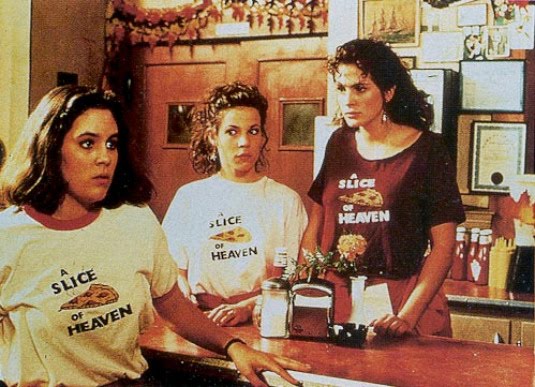
A few weeks ago I featured "Steel Magnolias" in this space as an example of a good chick flick. It made me curious to see another early Julia Roberts movie I'd heard good things about, 1988's "Mystic Pizza." I wouldn't call it a bad chick flick, but it's closer to the cliche of a flick aimed exclusively at a female audience.

To put it bluntly, "Mystic Pizza" is more or less a movie version of a soap opera, layered in with some quirky humor and gigantic '80s hair. Roberts has a couple of moments in the film where her 'do seems as tall as her entire head. There are other moments that distant memories of being stuck home sick as a kid with the warbling music of "Days of Our Lives" in the background were brought to the fore.

Roberts, Lili Taylor and Annabeth Gish were all 20-ish starlets just starting out, and the main enjoyment to be had in the movie is watching them emerge as actresses. Roberts plays Daisy, the bad girl offspring of a family of fisherman in the seaside town of Mystic, Conn. Gish is her goody sister Kat, who's saving money to attend Yale. Taylor is Jojo, the scrappy friend who gets cold feet at her wedding in the film's opening scene -- actually, she gets knocked cold when she passes out on the altar.

All three work at the Mystic Pizza restaurant, a downscale place that just happens to have the best pizza around. The proprietor, Leona (Conchata Ferrell), guards her recipe like nuclear missile codes, and vows to pass it on only after retiring.

This is the sort of movie in which a local dining critic is watched dispensing his views on the restaurant's television, and we just know it's inevitable that he'll show up at the Mystic.

The film's title, by the way, was based on a shop screenwriter Amy Holden Jones saw in the real Mystic, and she made up a story around it. Inevitably, the restaurant has become a tourist attraction -- though who knows if the pizza is as good as Leona's.

Anyway, all three girls juggle relationships during the fateful fall in which the story takes place. Jojo resists her fiance's attempts to get her to go through with the marriage. At one point, Bill even refuses sex until they are married. Bill is played by Vincent D'Onofrio, incredibly lean and in blue-collar hunk mode. Jojo confesses that even the sight of his manly wrists drives her into a sexual frenzy.

Daisy's guy is Charles, scion of a local rich family. He has one of those great introduction scenes where he and his preppy friends waltz into a rough fishermen's bar and start slinging money around for drinks and bets. Daisy catches his eye, and the next day he presumptuously shows up at her house, informing Daisy's mother that they have a date. Beats having to ask.

The fiery Daisy enjoys the attention, but is seasoned enough to know Charles probably just wants a fling with a townie. In one of the big comedic scenes, she spots him at a local restaurant with another woman, and dumps a pickup truck full of bait fish into his red Porsche. Of course, the other woman turns out to be his sister.

Kat's fling is with the father of the little girl she's hired to babysit. Tim's wife is away for a few months. He's an architect, about 30 and a fellow Yaley, and soon the good-hearted Kat is casting moony eyes at him. We know it's doomed before things even start, but in this sort of movie Kat is obliged to find that out for herself.

Matt Damon makes a very brief cameo in a dinner scene as Charles' younger brother. "Hey Mom, do you want my green stuff?" is his only line. It was his first role, and four years later he would make a bigger impression in "School Ties," a film like this one that gathers a lot of undiscovered talent in one place.

"Mystic Pizza" was directed by Donald Petrie, and he's still around making similar middlebrow stuff with a romantic comedy bent -- "How To Lose a Guy in 10 Days," "My Life in Ruins," etc.

2.5 stars out of four


Friday, May 14, 2010

Review: "Just Wright"


"Just Wright" is a love story that's a little bit old-fashioned, a little bit sweet and a little bit bitchy. It actually could have used more bitchiness.

It's sort of a modern take-off on "Cyrano" -- a less than conventionally attractive hero acts as matchmaker for his gorgeous friend to woo the ravishing lady of quality he himself secretly adores. Except the genders are switched around, and there's no feeding of poetry lines.

Queen Latifah plays Leslie Wright, a 35-year-old physical therapist who hasn't found the right guy. Laid back, a rabid sports fan (especially basketball) and self-confident, Leslie is the girl every guy wants to be best friends with -- just not fall in love with.

Her godsister Morgan (Paula Patton) is equally interested in basketball -- not for the game, but for the opportunity to land an NBA player as a husband. One senses that any player would do, so long as his bank account is fat. Morgan has no job and no interest in finding one: Marrying rich is her vocation.

One day after a New Jersey Nets game, Leslie bumps into Scott McNight (Common), the team's star point guard, at a gas station. He can't figure out where the fuel tank lid is on his new Maybach. After she hooks him up, he invites her to his birthday party. (Although I wondered how a gal driving a rusty old Mustang has any expertise about a brand of car that starts around $350,000.)

Morgan insists on tagging along to the party, of course, and the minute Scott lays eyes on her, he's in full pursuit mode. Leslie is clearly disappointed, thinking they had a spark between them, but is big enough of a woman to stay out of the way.

Then Scott blows out his knee, and it appears his season, and maybe his career, are over. Leslie is hired to help him with rehab and Morgan, sensing greener pastures elsewhere, dumps Scott via a note on his bedstand. She even returns her engagement ring, which I thought out of character.

It's not too crazy a guess that Leslie and Scott grow close during his grueling rehabilitation, and he starts to realize that having your best friend for a mate isn't such a bad idea after all.

After Scott is back tearing up the basketball court, Morgan makes an 11th-hour return to claim her man again. I'll leave the outcome to those who buy a ticket. One wonders, though, what Morgan was doing during the intervening months. Certainly not working, so what did she do for money? Was she giving try-outs to other NBA ballers for her one-woman team?

Director Sanaa Hamri and screenwriter Michael Elliot deliver a reasonably entertaining romance, and I certainly enjoyed all the cameos but real NBA players like Dwayne Wade and Dwight Howard. Common, a rapper by trade, looks fairly comfortable in the basketball scenes -- although the moments when he dunks are carefully framed so as not to show where his feet are.

Queen Latifah has a wonderful onscreen presence -- audiences instinctively like her and root for her. Common, however, just doesn't have the acting chops for a romantic comedy. He smiles a lot -- I mean a lot, almost Joker-like -- but the emotion never seems to reach his eyes. His line readings are stiff and clunky. Perhaps he's got a future in the movies, but right now I'm not seeing it.

I wish "Just Wright" could have been more a meditation on attraction versus substance. There are a lot of terrific women out there who are not considered beautiful by society's standards, and spend their days alone when they could make someone very happy. (Vice-versa the other way.) I would have loved to see some scene where Scott has started to act upon his feelings for Leslie, and some of his buddies rag on him for dating someone who's not model-gorgeous.

I suppose it's too much to ask for contemplation of substance-vs.-looks in a movie that just wants to entertain.

By the way, you know "Just Wright" is a work of fiction because it depicts the New Jersey Nets making it to the NBA Finals to compete for a championship. The real-life team flirted with the worst record in league history this past season, and was just sold to a Russian oligarch.

2.5 stars out of four

Thursday, May 13, 2010

Review: "Letters to Juliet"


When you see as many romantic comedies as I do, you practically shiver when you spy one on your calendar. After a thousand Meet Cutes and a thousand 90-minute dances in which the couple pretends to hate each other right up until the moment they realize they're in love, one craves something with a modicum of originality and heartfelt emotion.

Blow some kisses to "Letters to Juliet" for having both, if in modest quantities. The cast is attractive and engaging and we like spending time with them (with one notable exception), and all the gorgeous Tuscan landscapes are almost worth the price of admission by themselves.

Amanda Seyfried is some kind of workaholic, appearing in five movies in the last two years in addition to starring in the HBO series "Big Love." Here she plays Sophie, an ambitious wannabe writer who finds a long-lost love letter while traveling in Tuscany, and resolves to reunite the lovers and rekindle the romance. Of course, she finds some of her own along the way.

That might sound nice, except that she's already engaged to Victor (Gael Garcia Bernal), a chef who's about to open his own restaurant in New York, and seems to view the trip as an opportunity to meet with suppliers and scout out exclusive vineyards.

Bored, Sophie visits the Casa de Giulietta in Verona, supposed home of the family that inspired "Romeo and Juliet." There's a tradition of visitors (read: women) attaching letters about their romantic troubles on the wall, and Sophie stumbles across "Juliet's secretaries" -- women who collect the letters, and answer them.

Beneath a broken brick Sophie finds a worn letter written in 1957 by Claire, an English girl who ran away from Lorenzo, her Italian lover. She writes her back, and to Sophie's surprise Claire herself appears a few days later, with her grandson in tow. Claire resolves to find her soul mate, and Sophie, sensing a good story, tags along.

I'm don't think I'm giving away anything in saying that Claire eventually finds her Lorenzo. The trailer for "Juliet" happily gives away this information, and even if it didn't, the parameters of a film like this demand such a resolution. Vanessa Redgrave -- still a stunner at 73 -- invests the character with a shy sort of determination that's enchanting.

Less interesting is the romance on the main stage. Claire's grandson Charlie is a completely stock character -- the uptight British prig whose fussiness and constant annoyance at the female lead are supposed to mask the passionate heart beneath. Hugh Grant and Colin Firth milked this sort of role for years.

I don't blame actor Christopher Egan, who's just playing the cards screenwriters Jose Rivera and Tim Sullivan dealt him. The trouble is, they spend so much time making Charlie an unlikable twit, that when Sophie starts to fall for him we don't understand what it is she's supposed to be seeing.

Director Gary Winick has a nice eye for capturing the rolling hills and dirt roads of the countryside, the pastoral outdoor feasts, and the colorful Italian folk who all seem to have an instinctive understanding of the emotional logic of Claire's quest for lost love, and never question it.

Except for Romeo being such a star-cussed jerk, "Letters to Juliet" is an agreeable romp. In romcom terms, it may not be a soul mate, but makes for a pleasant enough one-off blind date.

2.5 stars out of four

Monday, February 1, 2010

Reeling Backward: "Ninotchka"

"Ninotchka" may just have been the very first romantic comedy.

Although Hollywood produced many romances around 1939, and many of them were funny, I think "Ninotchka" stood out for several reasons. One is that it was Greta Garbo's second-to-last film. She famously abandoned acting in her mid-thirties, at the height of her fame.

Another is that it was among the first mainstream movies to explicitly criticize the Soviet Union under Joseph Stalin. Don't forget, he was "Uncle Joe" until after the war.

But watching it today, what most jumps out at me is how closely it resembles the structure and form of modern films like "The Proposal," "When Harry Met Sally" or "Leap Year."

The basic formula of the romantic comedy is two very different people meet, hate each other, but eventually come to realize they're in love. External forces conspire to drive them apart, but they subvert them and end up together. The End.

There are obviously a lot of variations, but most films that we dub romantic comedies follow this basic outline. And "Ninotchka" trailblazed the way.

Garbo plays the title character, an envoy from Russia (the movie never refers to the U.S.S.R.) sent to Paris to negotiate a settlement to the jewels belonging to the Grand Duchess Swana, a former member of Russian aristocracy. She lost her family jewels in the Communist takeover, and is trying to prevent three bumbling Russian diplomats from selling them.

The unsmiling, brusque Ninotchka is brought in to iron things out. On the street she runs into a suave gentleman, Leon (Melvyn Douglas), who pitches woo. He's a slick capitalist who prefers not to work, and basically represents everything she reviles. Nevertheless, she's soon smitten.

Soon they realize that Leon is a friend (and perhaps lover) of the duchess. As soon as the business with the jewels is concluded, Ninotchka has to return home and end the romance. Leon attempts to follow her, but is denied as a counter-revolutionary.

In the end, Leon cooks up another diplomatic mess in Constantinople that forces the Russian minister (Bela Lugosi, in a bit part) to send Ninotchka, reuniting them.

The film was directed by Ernst Lubitsch, the German-born master who segued easily from silent to sound pictures. But I think the real triumph of this film is in the screenplay, by Billy Wilder, Charles Brackett and Walter Reisch. It just crackles with great dialogue and humor that bites without ever seeming nasty.

For me the best exchange comes when Ninotchka and the duchess meet at a swank restaurant. Ninotchka is there with Leon, and Swana is none too happy with the presence of the woman who has (from her perspective) stolen her jewels and her man. Ninotchka has just made a pointed reference to the aristocracy using the Cossacks to whip the people into line:

Duchess: "You're quite right about the Cossacks. We made a great mistake when we let them use their whips. They had such reliable guns."

Or this exchange, when Ninotchka steps off the train and refuses to let a porter take her suitcase.

Ninotchka: "Why should you carry other people's bags?"
Porter: "Well, that's my business, ma'am."
Ninotchka: "That's no business. That's social injustice!"
Porter: "That depends on the tip."

I can't say as I was particularly dazzled by the Garbo/Douglas pairing. It's one of those goofy movie romances where the leading man falls in love within minutes of meeting his lady, and he spends the next reel or two convincing her -- and the audience -- it's true love.

If "Ninotchka" were made today, it would come off as a cliched knock-off of the old romantic comedy model. But it endures because it is the mold, not the imitation.

3.5 stars


Tuesday, December 22, 2009

Video review: "(500) Days of Summer"


One of the unexpected delights of the cinematic year, "(500) Days of Summer" was the sleeper hit that reminded us romantic comedies don't have to be formulaic and gooey.

Joseph Gordon-Levitt and Zooey Deschanel play the couple, who, unlike in most films of the genre, don't spend 80 minutes clashing with each other before suddenly realizing they're in love.

They hit it off right from the start -- mostly because Summer is a fearless gal who makes the first move on office drone Tom -- and spend the next 500 days riding the ups and downs of modern romance.

Director Marc Webb and screenwriters Scott Neustadter and Michael H. Weber coyly shift the timeline back and forth, using numbered titles to let us know which day we are in the progression. So we know that Tom and Summer hit a rough patch somewhere around Day 320, while Days 50-100 are that love-stupid phase where everything seems magical.

Extras aren't exactly huge in scope, but are fairly substantive and engaging.

There's a little over 14 minutes of deleted and extended scenes. Most of it is the usual extraneous stuff that deserved to end up on the cutting room floor, except for a hilarious opposite-day version of the musical number set to Hall & Oates' "You Make My Dreams," with this time everything going awry -- the passer-by bumps Tom instead of smiling, the bird poops on his shoulder, etc.

Webb, Neustadter, Weber and Gordon-Levitt team up for a nicely bantering commentary track. Among the revelations is one of the writers confessing that "about 75 percent" of the fracturing relationship depicted in the movie actually happened to him. Talk about suffering for you art.

Told with original verve and hipster irony, "(500) Days of Summer" is funny, charming and smart filmmaking. It's a romantic comedy even the boyfriends will love.

Movie: 3.5 stars
Extras: 3 stars