Showing posts with label julia roberts. Show all posts

Wednesday, December 19, 2018

Review: "Ben Is Back"


A lot of times a movie is disappointing because it wasn’t what you expected. But on occasion you can feel a film tilting off in a direction you don’t anticipate or even initially like, but you come to appreciate the journey it took you on. “Ben is Back” is such a film.

Julia Roberts stars as the mother of a drug-addicted young man played by Lucas Hedges. At first glimpse it seemed a lot to me like the underwhelming “Beautiful Boy” -- a look at a loving parent whose heart is twisted up dealing with a strung-out kid who always seems to fall back into a spiral. And it starts out something like that.

Ben shows up on the doorstep of his mother, Holly, unannounced on Christmas Eve. He’s been in rehab since summer and this is his first time home. Holly is shocked, surprised and delighted, though she’s been through enough ordeals to immediately start stuffing all the prescription pills and jewelry in the house into a pillow case for stashing. There are oblique references to the disastrous previous Christmas.

Ben’s sister, Ivy (Kathryn Newton), is the good kid who resents the prodigal son’s return -- and theft of her spotlight -- and immediately starts casting a cloud of suspicion and derision. Holly remarried Neal (Courtney B. Vance), a successful businessman who has been paying for Ben’s treatment, and they have a pair of adorable moppets.

With this dynamic laid out, I presumed the rest of the movie was going to examine the internal struggles of this blended family. Neal is supportive of Holly’s devotion to Ben, but pragmatic bordering on hostile to the kid himself. I anticipated a portrait of a seemingly placid, well-to-do clan (re)entering a vortex of crisis.

Instead, the story goes off in a very different direction. Their house is broken into while they’re at church and the family dog stolen. Ben, who wasn’t just a user but a dealer of hard drugs, immediately suspects it’s one of his old nemeses. So he and Holly go looking.

At first I thought writer/director Peter Hedges (Lucas’ real-life father) was setting up a small trip to break up the family-at-home dynamic. But then the errand turns into an expansive journey, in which the extent of Ben’s former depravity and dishonesty is played out before Holly’s horrified eyes. Indeed, it takes up the entire rest of the movie.

I first resisted this turn of the tale. I thought of other movies (“Funny People”) that started out great and then systematically flushed themselves down the toilet with an ill-thought excursion, geographically and/or metaphorically.

And yet, I found myself increasing engaged by their trip, which is truly a descent. Holly has always believed that Ben is a good kid who just went awry due to the lure of drugs. She’s a cheery suburban mom with layer of iron hidden underneath. In one arresting scene, she confronts Ben’s pediatric physician whose initial prescription of pain killers first got him hooked.

It’s one of Roberts’ best performances, full of both sympathy and snarl. Her Holly isn’t some innocent dolt who allows her hopes to overcome her grasp of reality. She goes in with eyes wide open… but then they get opened even wider.

I found Lucas Hedges’ work in “Manchester by the Sea” to be overpraised -- I could easily come up with the names of a half-dozen other actors more deserving of his Oscar nomination -- but he earns the attention he’s getting here. His Ben is a liar who will tell you he’s a liar as a disarming tactic in order to ease more deception. He’s a lost soul but not an unredeemable one.

I went into “Ben Is Back” thinking I had it all pegged, and then it turned me around and left me utterly surprised, sobered and delighted.


Sunday, February 11, 2018

Video review: "Wonder"


“Wonder” is a tender-hearted flick that makes no bones about being a tearjerker. Julia Roberts and Owen Wilson star as the parents of Auggie, a 10-year-old boy played by Jacob Tremblay who was born with severe facial defects.

He’s been more or less hiding out his whole life, being home-schooled by his mom or wearing an astronaut’s helmet in public to ward off stares and comments. But now he’s attending school for the first time, and this is the story of his entering a broader, scarier world.

The screenplay by Steve Conrad, Jack Thorne and Stephen Chbosky, who also directed, is a straightforward string of encounters. We know the teasing and taunting is going to come, but it’s no less painful when it does. Auggie soon finds a friend in a scholarship student (Noah Jupe), but the inevitable setback is just around the corner. Mandy Patinkin plays the wise and helpful school headmaster.

The movie, based on the best-selling novel by R.J. Palacio, also follows around Auggie’s older sister, Via (Izabela Vidovic), for a bit, and we get to see the family dynamic from her perspective. She loves her little brother, but it’s hard to be teenager when your sibling soaks up all of the grownups’ attention.

It may not be the most original movie to come down the pike, but “Wonder” is decorated with nice, crisp performances and an authentic human story that’s hard to resist. Three hankies, at least.

Bonus features are quite good. The DVD edition has a feature-length commentary track by Chbosky and Palacio, music video for “Brand New Eyes” and a featurette on the soundtrack.

Upgrade to the Blu-ray version, and you add two more featurettes, “A Child’s Sense of Wonder” and “What a Wonderful World,” plus a five-part making of documentary titled, “Summer of Fun.”

Movie:


Extras:


Thursday, November 16, 2017

Review: "Wonder"


"Wonder" is an old-fashioned, straight up weepie. Tears will be jerked, you can be sure. I liked the fact that the movie is unambiguous about its intentions, and carries them through effectively without irony or coyness.

Jacob Tremblay, who was so amazing in "Room," plays Auggie Pullman, a boy of 10 born with severe facial defects. He's been through 27 surgeries -- his family displays the hospital wristbands as a collage -- and has been home-schooled all his life by his ferocious devoted mom, played by Julia Roberts. Now, as he enters 5th grade, it has been decided it's time for him to integrate into a regular school with other kids.

Well, sort of. In Hollywood parlance, a "regular school" is an exclusive New York City private institution, Beecher Prep, where families that live in multi-million-dollar brownstones pay something like the U.S. median household income to send their kids to rub elbows with the best of the best. But for the purposes of the story, which is based on the best-selling by R.J. Palacio, what's important is that he's around other children consistently for the first time in his life.

The underlying themes of the movie are bullying and otherness. Mom and dad (Owen Wilson) send Auggie to school with the full knowledge that he will be stared at and picked on. They figure it's something he's going to have to deal with sooner or later, and calculate he's reached a level of emotional stability to deal with it.

Also, there's a subplot about the mom wanting to complete her master's thesis that was put on hold a decade ago to be his full-time guardian and tutor. And, frankly, she rightly wants to reclaim a little piece of her own life. I admired that the filmmakers -- director Stephen Chbosky, who co-wrote the script with Steve Conrad and Jack Thorne -- included this dynamic.

I know it runs counter to commonly accepted precepts and hagiography about mothers, but I personally think it's unhealthy for parents to let their kids think they have nothing going in their lives beyond raising them. Part of being a role model is not being afraid to display ambition and individuality.

The makeup effects on Tremblay are very good, to the point I didn't recognize him until I read the credits afterward. Auggie is a smart, sensitive kid who likes science and Minecraft, and has adapted pretty well to life inside his family unit. He tends to wear an oversized astronaut's helmet in public to avoid stares; it's his armor, really. So he has a tough time when his parents ask him to relinquish it.

Auggie does face teasing and isolation, but also picks up a friend in Jack Will (Noah Jupe), a poor scholarship kid with a nice streak. The joy on mom's face when he brings home a pal to play is worth the price of admission alone. Still, old troubles soon follow and Auggie finds himself estranged again.

He's got an older teen sister, Via (Izabela Vidovic), and I was impressed the film devotes a significant amount of screen time following her life and seeing how it's impacted by having a brother who soaks up every ounce of attention from their parents. She's quiet and shy, and dealing with an unexpected fallout with her own best friend, Miranda (Danielle Rose Russell).

She starts to blossom when she joins the school theater club, and meets a cute, funny boy named Justin (Nadji Jeter) who takes a fancy to her.

I also greatly enjoyed Mandy Patinkin as Mr. Tushman, the headmaster of the school who understands the way kids actually think and behave, rather than the idealized regard in which their parents hold them. He is infinitely patient and kind, makes jokes about his name before the students have a chance to, and even manages to treat the bullies in a way that lets them know they are not irredeemable. He's basically the Santa Claus of educators.

"Wonder" plays out exactly the way we expect. Given the premise, we could practically write the ending ourselves. But it's still a touching movie that celebrates the weak and the meek, and shows there different kinds of strength.


Thursday, April 6, 2017

Review: "Smurfs: The Lost Village"


Last week I reviewed “The Boss Baby” and said it’s one of those movies parents struggle to get through, but you do so because little kids will love it. Normally there are only a handful of those films per year to endure, but this time we didn’t even make it seven days before encountering another one.

I’ll say this: I enjoyed “Smurfs: The Lost Village” a lot more more than that weird live action/animated hybrid from 2011 and its 2013 sequel. If there’s one thing that can make cutesy blue gnomes who substitute the word “smurf” for most every verb even more grating, it’s a heaping helping of Neil Patrick Harris.

This computer-animated version has no real humans clomping around, thank goodness. It’s a complete reboot with no relation to the NPH films. Under director Kelly Asbury’s hands, the look and feel is more of a throwback to the purity of the Peyo comics where the Smurfs originated, while giving them more texture and snark.

It manages to entertain in a simplistic way, featuring straightforward physical humor and zippy action scenes. It even manages to explore the reason why there are only boy Smurfs, except of course for Smurfette, who was actually created out of clay by the evil bumpkin wizard Gargamel before Papa Smith used some of his own magic to turn her good.

(And from brunette to blonde in the process, about which I’ll say no more.)

The story (screenplay by Stacey Harman and Pamela Ribon) reintroduces us to the Smurfs, who each have a one-word first name that defines their personality: Grouchy Smurf, Jokey Smurf, etc. But then we pick three main Smurfs – Brainy (Danny Pudi), Hefty (Joe Manganiello) and Clumsy (Jack McBrayer) -- to accompany Smurfette (Demi Lovato) on her quest.

Mandy Patinkin provides the voice of Papa Smurf, who shows up at the beginning and again at the end to provide some sage wisdom. He’s essentially the Santa Claus of Smurfs, along with a little Father Knows Best.

If you’ll remember, Gargamel (Rainn Wilson) is continually hatching plans to steal the Smurfs’ magical blue essence to grow his powers. He learns of a new source hidden deep inside the Forbidden Forest that lies behind a great wall, thanks to the unwitting help of Smurfette. She’s been feeling down in the dumps lately because she doesn’t have a preassigned role like all the boys do.

Spoiler alert: after many adventures, the foursome encounters a lost tribe of all-girl Smurfs. I don’t feel like I’m really giving all that much away, because the title does warn you about a lost Smurf village. Of course, the female Smurfs don’t consider themselves lost, and to them the forbidden part of the forest is the other side from theirs.

Sometimes you just have to Smurf yourself up some perspective.

In the lost village, the Smurfs put their identifying name after instead of before Smurf; so the tough one is Smurfstorm (Michelle Rodriguez), the overly friendly one is Smurfblossom (Ellie Kemper) and Julia Roberts is the wise old leader, Smurfwillow.

(I know, I know, using the words “old” and “Julia Roberts” anywhere near each other feels like an insult to the natural order, but she’s 50 later this year. She seems a lot cooler about it than I am.)

I enjoyed the look of this movie, such as the way the Smurfs’ eyebrows hover in thin air above their faces, or the curious nature of Brainy’s forever-falling-off glasses, which don’t connect in the middle or appear to contain any actual glass.

I don’t laugh all that much, but then the humor is pitched a few decades south of me. All I know is my boys giggled like crazy and had a blast. Fingers crossed we’ll Smurf us an animated film this year we all can appreciate.


Thursday, May 12, 2016

Review: "Money Monster"


Just a few thoughts, as our newest talent, Aly Caviness, is handling the main review over at The Film Yap. Make sure to head there to read in its entirety.

"Money Monster" is a well-executed cinematic effort with tightly bookended ambitions. Unlike "The Big Short," it's not trying -- or, if it is, not trying very hard -- to be an all-encompassing indictment of Wall Street and the corruption of modern digitized market trading. It aims for small observations and dramatic tension.

It gives lip service to The System and how bad it is, but then leans on a narrative that makes clear it's a rotten apple or two who are actually mucking things up.

George Clooney plays Lee Gates, the host of the titular television show in which the smart, smarmy personality gives stock tips and ass-kisses the financial masters of the universe, in between embarrassing hip-hop dance moves and weirdo costumes. It's a slight exaggeration of Jim Cramer and his ilk, but only slight.

It's a hostage story in which some dumb mook off the street took Lee's stock advice and lost his entire inheritance from his mother, and now wants revenge, an explanation or an apology.

Directed by Jodie Foster from a screenplay by Jamie Linden, Alan DiFiore and Jim Kouf, "Monster" provides a couple of terrific moments that I appreciated.

The first is when Lee, after first having got over the shock of having his show interrupted by a gunman who straps him into a bomb vest, finally gets around to engaging the guy, a truck driver named Kyle (Jack O'Connell). He's a talker, so he figures he'll talk to the young man. That's when he learns how much Kyle lost: $60,000.

Sixty grand? Lee asks, shocked. You're gonna kill me, maybe die yourself, over chump change like that?

Lee is a man who brags about sharing dinner at an expensive restaurant with at least one other person every night since the 1990s. He's got his millions, three ex-wives, thousand-dollar suits, etc. He's lived at the top so long, he can't even conceive of a working schmoe having to slave away at $14/hour, taking a year to save up the money he'll spend on a weekend getaway.

The second moment is when, trying to verify something allegedly said on his show a few weeks ago, Lee is forced to watch tape of himself played back on the screen. All this is happening, I should mention, on live TV, with Julia Roberts as Patty Fenn, the director in the control booth trying to keep things calm.

Lee watches the playback of himself in some ridiculous outfit, doing a dance a man of his years should not be attempting, saying stuff because it makes for good TV and not because it adds up to an ounce of fiscal sense. Clooney, who shines playing flawed men, gives a little dip of the head, his gaze faltering downward, and we bathe in his confrontation with his own meager worth.

He's a clown who revels at playing the clown, until he's forced to breathe dip the smell of the face paint, and is sickened.

Alas, the rest of the movie falls into predictable patterns. The cops come to take out Kyle, a negotiator is brought in, the action eventually leaves the studio, a weird sort of alliance forms between Lee and his captor, etc. Patty is the level-headed island of calm trying to keep all these vying forces in balance. Roberts is solid, but it's the kind of role any number of actresses could do just as well.

There is a good surprise or two. My favorite is when someone close to Kyle is located and brought in to talk him down, something we've seen many times before, and events do not transpire in any way we expected. For a brief moment, the movie pushes us out on a limb. We're delighted by the feeling of an abyss yawning; but then our steps are nudged back to the safe and dull path.

Dominic West plays the CEO of IBIS, the big corporation whose stock tanked despite Lee's reassurances to his viewers; Caitriona Balfe is the PR chief who goes rogue for reasons unexplored; Giancarlo Esposito is the head of the police force, uttering urgent things we can safely ignore; Lenny Venito is the podunk cameraman who keeps on shooting despite the danger to himself; and Christopher Denham is Lee's flunky producer tasked with anything the boss wants, including trying out an erectile claim before it goes on the market.

"Money Monster" plays out in live time, and Foster is adroit at balancing the tension and danger, stirring the pot when needed and backing off the heat when the audience needs to absorb information or take a breath. The movie also has a pleasing streak of dark humor to it, much of it deriving from Lee's feckless charm.

All the stuff about trading algorithms and international hackers being brought in to help is distracting or strains credulity. But this is the sort of movie where you have to just go along with the ride. It's a day trade of a film, serving its purpose but soon left behind.


Thursday, January 9, 2014

Review: "August: Osage County"


Based on the Pulitzer Prize-winning play by Tracy Letts, who also penned the screenplay, “August: Osage County” is the sort of movie that shows its stage roots.

The action -- and by “action,” I mean people talking -- takes place in more or less a single location. There’s a certain showiness to the dialogue and performances, as if broadcasting to the back of the room. And it relies on two or three big, booming plot twists to carry the narrative, which by itself is rather meager.

This is the sort of movie that has close on to a dozen important characters, and every single one of them has at least one look-at-me moment where they get to have a big speech to deliver or an emotional crisis in which to wallow. For the minor characters, it practically feels like a checklist: “OK, here’s the timid son’s time in the spotlight.” The major players enjoy several of these.

All this isn’t to say “August” isn’t a thoroughly enjoyable cinematic experience. It is. It just doesn’t hold a grand sense of newness about itself. It feels like latter-day William Faulkner with a wink.

The film skates by on some pretty tremendous performances by some pretty amazing actors, starting with Meryl Streep. As family matriarch Violet Weston, Streep is like an Oklahoma tornado sweeping through her own house, hurling things this way and that. Suffering from mouth cancer and constantly addled by the many drugs she takes to address it, Violet feels no compunction about saying perfectly horrible things to anyone and everyone around here.

She saves her most venomous bile for her own clan. As the story opens her husband, Beverly (Sam Shepard), a noted poet, has died under mysterious circumstances, probably a suicide. As the family gathers to lay him to rest, it’s also an occasion to hash any number of squabbles, secrets and recriminations.

Oldest daughter Barbara (Julia Roberts) loathes the vindictive creature her mother has become, and fears she’s treading down the same path. Separated from her husband (Ewan McGregor) and estranged from their teen daughter (Abigail Breslin), she’s not spoiling for a fight with Violet, but she’s not about to back down from one, either.

The other two daughters are Karen (Juliette Lewis) and Ivy (Julianne Nicholson), both sporting man problems. Karen, brittle and self-deluded, has shown up with her latest beau, a glib sports car-driving business type (Dermot Mulroney). Ivy, the lonely child who stuck around to care for their parents, is resentful and reticent to share news about a new love.

I really enjoyed Margo Martindale as Violet’s sister, Mattie Fae, who has fewer sharp edges but hides a steely, mean streak underneath, and Chris Cooper as her husband Charles, a man with a tendency to smile through the pain. Their son Little Charles is played by Benedict Cumberbatch, a grown man with a childlike disposition and challenges.

Director John Wells is a TV guy whose only previous stint helming a feature film, “The Company Men,” was seen and appreciated by myself, and few others. He more or less hangs back and lets the actors rip, shrewing and harping and haranguing.

“August: Osage County” is a perfectly serviceable drama that’s worth a ticket, if only to see Meryl Streep’s latest masterwork. Even if she’s not always in the best movies, it’s hard to debate her status as the best film actor working today. She racks up Oscar nominations with astonishing regularity, and there’s a reason why.


Thursday, March 29, 2012

Review: "Mirror, Mirror"


There was nothing about "Mirror, Mirror" that I hated, but there was also nothing that I really loved. I like the idea behind this movie, but am largely indifferent to the movie they did make.

Director Tarsem Singh Dhandwar and screenwriters Melissa Wallack and Jason Keller seemed to have set out to make a dizzyingly funny, satirical take on the classic "Snow White" fable by the Brothers Grimm. But the film repeatedly steps back from pure comedy and goes for amusing and charming. You can almost hear the studio honchos whispering in their ear, "Remember the 18-35 female demographic."

The tone is less "Monty Python and the Holy Grail" and more "Ella Enchanted." I think they should have given up on the sweet, mushy parts and gone for the Full Gilliam. Actually, I'm sort of piqued to see what Terry Gilliam could have done with this material and budget.

As you probably know, this is the first of two Snow White adaptations arriving in theaters this year. Later we get the dark-and-scary version, "Snow White and the Huntsman," where Snow gets into knife fights and wears more grime than ball gowns. Personally, I was much more looking forward to this one.

Julia Roberts plays the evil queen and serves as narrator, telling us right from the start that this is her story, not Snow's. That's not really true, but it should have been -- Roberts is easily the best thing about the movie. Instead of the whole cruel-and-evil stepmother gig, Roberts plays the queen as an over-spoiled movie star, toying with her vassals and using her vast powers to keep herself sitting pretty. She doesn't so much like ruling the kingdom as being the center of attention.

By contrast, Snow is a drab and flat character. As played by Lilly Collins, she's a castle shut-in who years for her long-lost father, who married the queen and then disappeared chasing a mythical beast in the forest. For a post-feminist princess, she's rather passive, only taking action after various male figures urge her to take up arms.

The prince here is Alcott, played by Armie Hammer as a vainglorious but good-hearted guy who gets caught between Snow and the queen. The queen wants to marry him and claim his vast wealth to refill her kingdom's empty coffers, but Alcott seems totally unaware of her erstwhile ardor. He's smitten by Snow instead, but then she disappears and takes up with the Dwarves.

The minimalist seven are a hoot, and the filmmakers actually manage to imbue each of them with some distinct personality. Danny Woodburn plays Grimm, the world-weary leader. Martin Klebba is Butcher, who's hardcore and wears a cowboy hat. Grub (Joe Gnoffo) is a big eater, Chuckles (Ronald Lee Clark) is a giggler and Wolf (Sebastian Saraceno) is the bruiser. Jordan Prentice adds a little soul as Napoleon, and Half Pint (Mark Povinelli) has an amusing, unrequited crush on Snow.

The dwarves in this iteration are itinerant highwaymen who live in the forest and rob travelers. They wear funky stilts that can expand and retract like accordions, turning them into giants who leap and twist about like Cirque du Soleil performers gone medieval.

The movie's version of the magic mirror is strange, and a little confusing. Instead of it being a mirror in her castle with a face that the queen converses with, she steps through a mirror into another dimension. She surfaces on a giant lake or ocean where some wooden huts have been built. Inside is the mirror with the magical spirit who is her servant, but looks like her own reflection -- though without any wrinkles, it wryly notes.

"They're not wrinkles! They're ... crinkles," the queen pouts adorably. One of the running jokes is that the queen is in denial about her own aging -- she insistently tells the prince that he and she are "about the same age" -- and kudos to Roberts for bravely tweaking her fading ingenue status.

So Snow joins up with the dwarves, becoming a thief, though a good-hearted one who returns the people's taxes to them. As is the staple in these sorts of movies, she also manages to become an expert swordsman over the course of a single musical interlude and montage.

My biggest problem with "Mirror, Mirror" is that it contained no surprises for me. Once you've established the slightly fractured take on the fairy tale -- which one can get just from watching the trailer -- all the story elements and character arcs fall neatly and predictably into place. Even the oft-referenced Beast in the forest contained no secrets, as I guessed his final disposition before we ever even see him.

"Mirror, Mirror" certainly isn't a bad movie, and there are a few wickedly funny moments and some glimpses of inspired characterizations. Alas, this spell only works sporadically.

2.5 stars out of four

Thursday, June 30, 2011

Review: "Larry Crowne"


Here's a movie for adults that's warm and enjoyable, but has brains and ambition. Because it stars two immensely likeable actors, Tom Hanks and Julia Roberts, you might think it's about two middle-aged people falling for each other. You'd be wrong.

Although "Larry Crowne" takes the form of a romantic comedy-drama, it is less about the intersection of these two characters than the people they discover themselves to be at this moment in their life's trajectory. Their coupling is a byproduct of their respective journeys, not the purpose behind it.

Hanks directs (and produces, and co-wrote with Nia Vardalos) with a soft touch but not a soft head. "Larry Crowne" is full of life lessons, but is clever about it, and flouts its characters' sense of shared community without going all it-takes-a-village muddle-headed.

It's like fancy French toast -- comfort food with a dollop of aspiration.

Hanks plays the title character, a fortysomething guy happily working as a low-level manager at Umart, meaning he wears a bright red T-shirt with his name on it and is called a "team leader." Unfortunately, Larry does not have a college degree -- he joined the Navy out of high school and retired after 20 years as a cook -- so his bosses decide that since he cannot advance any further, they have to let him go. The fact that Larry is a tireless worker who attacks his job with zeal does not matter. Somehow, the Umart folks think they are doing him a favor.

This may sound unbelievably absurd, but the capacity for ridiculousness of group decisions knows no bounds. I know a guy who got a job at a non-profit straight out of college, loved working there and over the course of 20 years earned his way up to the number two position. During some nasty political squabbles, the board approached him about jettisoning the executive director and moving this fellow up to the top spot. Taking a principled stand, he refused the promotion, saying it was not fair to accept a post currently occupied by someone else. After more deliberations, the board decided to keep the person they'd just  been trying to give the boot, and fired him instead. The nature of the collective mind is inherently schizophrenic.

Larry takes it hard, especially when he finds the job market unwelcoming in the extreme. He's divorced but not bitter about it, and owes the bank a pocketful after buying out his ex-wife's half of the house.

So he decides to enroll at East Valley Community College. At the urging of the dean of students, who has more than a little huckster in him, Larry signs up for classes in speech, economics and composition. Master these three skills, he is told, and he can write his ticket.

The econ class is taught by a comically haughty professor (George Takei) who recites the same dry lessons year in and year out, and smiles because each student crammed into his massive classroom are required to buy his book. We never hear about the writing class, so all hope rests with the speech course.

The professor of Speech 217: The Art of Informal Remarks is one Mercedes Tainot (Roberts), who began bordering on burnout a few years ago, and is medium-crispy now. Her greatest hope is that the minimum 10 students will not show up, and she can cancel the class -- which Larry dashes by showing up late. Mercy's first instruction to her students is to care, but she obviously stopped awhile ago.

Mercy takes an anti-shine to Larry at first, thinking he's an old letch using the mid-life college shtick to hit on impressionable young things like Talia, an effervescent lass played by Gugu Mbatha-Raw in one of those performances that grab you and make you go, "More, please."

Truth is, Talia is more of a teacher to Larry than Mercy is, fixing the feng shui at his crowded home and giving his hair and clothes some zip. Mercy is perhaps biased because her husband (Bryan Cranston) really is an old letch, who gave up writing books to blog but really looks at porn all the time.

I have on occasion been accused of being too much of a literalist as a critic, and I will now demonstrate why.

Larry is very specific about being a 20-year military man, meaning he retired in his late 30s, presumably with a pension. Anyone remotely familiar with a career in the armed forces knows about the 20-years-and-out routine. Having known or read about people in this situation, and with a little research and conjecture, I determined Larry's payments from the Navy would be around 30 grand a year, plus free medical. That's not a ton, but should be enough for him to get by in the short run.

It's persnickety, I know, but I needed a line where Larry says something like, "And my Navy pension will barely cover the mortgage." Otherwise, don't introduce the 20-year thing without acknowledging the reality of it.

And on the question of Mercy's horndog husband, it is not really possible for any man to watch porn literally all day long. He could certainly see a lot of it, maybe even have a psychological addiction to it, but there would be spaces where, shall we say, his desires are at least temporarily diminished. It's just the way things work.

Things go on with Larry and Mercy, but I'll leave that for you to discover. They rotate in each others' orbits, with that gravitational pull always there but not shifting the heavens.

"Larry Crowne" is a romantic movie, but it's less about the familiar, tired tropes of cinematic love than the serendipitous passion we find in our lives when our plans end up in pieces on aisle 12.

3.5 stars out of four

Tuesday, November 23, 2010

Video review: "Eat Pray Love"


It's good to see Julia Roberts back in serious-actress mode a decade after "Erin Brockovich." But "Eat Pray Love" was not the right movie to cement her comeback.

Based on the best-selling memoir by Elizabeth Gilbert, it's the story of an early-middle-aged woman who goes through a nasty divorce and decides to spend a year traveling the world. She spends time in Italy searching for the perfect pizza, in India getting in touch with her new-found spiritual roots, and finally in Indonesia where she falls in love with a Brazilian businessman played by Javier Bardem.

It's all a little too rote, and no wonder: Gilbert came up with the idea for the book beforehand, and used the advance money to finance her trip.

Those who've read it (unlike me) say the author is very upfront about the calculated nature of the whole enterprise, but the movie doesn't offer a peep. She's supposed to just leave her home in a whirlwind of passion and soulful discombobulation.

She meets a variety of characters, including a toad-like little holy man, a drawling Texas who shares her faith in Hinduism, and the aforementioned Latin lover.

It's a beautiful-looking movie without much really going on in its head, or its heart.
Bonus features are served in rather modest helpings.

Oddly, the centerpiece of the offerings is an extended version of the film. At a sprawling 139 minutes, the last thing this movie needed to be is longer.

The DVD comes with the extended version and a single featurette following director Ryan Murphy's journey to make the film.

In addition, the Blu-ray edition boasts a trio more featurettes: A making-of doc, and two more on Finding Balance and Praying in India.

For the true videophile, that's hardly adequate nourishment to justify buying your own copy.

Movie: 2 stars out of four
Extras: 2

Thursday, August 12, 2010

Review: "Eat, Pray, Love"


Here's my six-word review of "Eat, Pray, Love": I wish they'd stopped at "Eat."

This new Julia Roberts star vehicle is based on the best-selling memoir by Elizabeth Gilbert about the year she spent traveling the globe to rediscover herself following a painful divorce. She spends four months each in Italy, India and Indonesia seeking nourishment -- for, as the title suggests, her body, soul and heart.

It's a more ambitious role than Roberts has tackled in the decade since her Oscar-winning turn in "Erin Brockovich," and one centered around a woman of refreshingly mature years. I admired Roberts' grasping for something meatier, but this film sticks her with an unrelatable character that even her coltish smile can't beautify.

Director Ryan Murphy, who co-wrote the screenplay adaptation with Jennifer Salt, spends an excessive amount of time setting up Liz's life in New York prior to her trip. In these sequences Liz is established as a successful but skittish woman who doesn't seem to belong anywhere, or to anyone -- even herself.

She quickly, and callously, decides to divorce her husband Stephen (Billy Crudup). Despite his flightiness, he does seem very determined about his desire to stay together and attempt to work things out. When she won't even try, our sympathy for her wanes.

Sooner than would seem appropriate, or even comprehensible, Liz ends up in the arms of David (James Franco), a much younger actor who turns her on to meditation and Hindu scripture. She soon decides that she needs to learn to love herself before she can love another again, though she at least packs her newfound spirituality for the trip.

The first sequence in Rome has an uplifting energy as Liz searches for the perfect pizza, learns the lingo, and absorbs the Italian devotion to beauty and pleasure without any American veneer of guilt. It's here that she seems to tame her self-absorption a bit, finds some new friends and truly grows as a confident individual.

The spiritual section in India shifts into a seriously downbeat gear, as Liz lives at a Hindu temple, prays and meditates, and verbally jousts with Richard (Richard Jenkins), a fellow American -- well, he's Texan, which to the typical New Yorker is far more exotic than the Far East.

Richard, who looks like James Taylor and talks like Obi-John Wayne, calls her "Groceries" for her healthy appetite and counsels her to clear her head of self-doubt and regret, or it will ruin her life. Richard knows this through personal experience, as he lays bare in a rooftop scene that's supposed to be revelatory and emotionally cathartic, but just makes the audience want to tiptoe down the stairs and escape.

The vistas are perhaps the most beautiful in Bali, but Liz's journey of discovery grows less genuine with every step. She romances a Brazilian businessman (Javier Bardem) who's also been through a painful divorce, and studies with a medicine man (Hadi Subiyanto) who looks like Yoda, but with a worse dental plan.

I confess that I found Liz's New Age-y proclivities a dreadful bore -- I'm still trying to wrap my head around the whole Guru Gita thing, which involves a bunch of people chanting at a painting of a woman, as near as I can figure. At 139 minutes, the movie feels sprawling and self-indulgent.

And I'm always suspicious of memoirs in which people ditch their entire lives for parts unknown and unexpected adventures -- and, it turns out, for good reason.

After seeing the movie and doing a little Googling, I learn that the real Elizabeth Gilbert pitched the idea for her book to a publisher before embarking on her journey, and used the advance to pay for it.

"Eat, Pray Love" seems less like a year of wild abandonment to indulgence and exploration of the inner soul, and more a calculated mission to land on Oprah's Book Club. It's mass-produced gruel, dressed up as native cuisine.

2 stars out of four

Monday, June 14, 2010

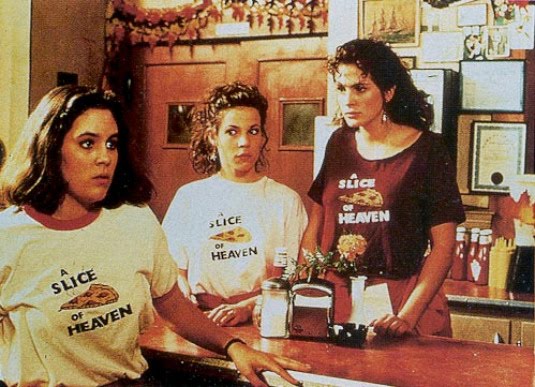
Reeling Backward: "Mystic Pizza" (1988)


A few weeks ago I featured "Steel Magnolias" in this space as an example of a good chick flick. It made me curious to see another early Julia Roberts movie I'd heard good things about, 1988's "Mystic Pizza." I wouldn't call it a bad chick flick, but it's closer to the cliche of a flick aimed exclusively at a female audience.

To put it bluntly, "Mystic Pizza" is more or less a movie version of a soap opera, layered in with some quirky humor and gigantic '80s hair. Roberts has a couple of moments in the film where her 'do seems as tall as her entire head. There are other moments that distant memories of being stuck home sick as a kid with the warbling music of "Days of Our Lives" in the background were brought to the fore.

Roberts, Lili Taylor and Annabeth Gish were all 20-ish starlets just starting out, and the main enjoyment to be had in the movie is watching them emerge as actresses. Roberts plays Daisy, the bad girl offspring of a family of fisherman in the seaside town of Mystic, Conn. Gish is her goody sister Kat, who's saving money to attend Yale. Taylor is Jojo, the scrappy friend who gets cold feet at her wedding in the film's opening scene -- actually, she gets knocked cold when she passes out on the altar.

All three work at the Mystic Pizza restaurant, a downscale place that just happens to have the best pizza around. The proprietor, Leona (Conchata Ferrell), guards her recipe like nuclear missile codes, and vows to pass it on only after retiring.

This is the sort of movie in which a local dining critic is watched dispensing his views on the restaurant's television, and we just know it's inevitable that he'll show up at the Mystic.

The film's title, by the way, was based on a shop screenwriter Amy Holden Jones saw in the real Mystic, and she made up a story around it. Inevitably, the restaurant has become a tourist attraction -- though who knows if the pizza is as good as Leona's.

Anyway, all three girls juggle relationships during the fateful fall in which the story takes place. Jojo resists her fiance's attempts to get her to go through with the marriage. At one point, Bill even refuses sex until they are married. Bill is played by Vincent D'Onofrio, incredibly lean and in blue-collar hunk mode. Jojo confesses that even the sight of his manly wrists drives her into a sexual frenzy.

Daisy's guy is Charles, scion of a local rich family. He has one of those great introduction scenes where he and his preppy friends waltz into a rough fishermen's bar and start slinging money around for drinks and bets. Daisy catches his eye, and the next day he presumptuously shows up at her house, informing Daisy's mother that they have a date. Beats having to ask.

The fiery Daisy enjoys the attention, but is seasoned enough to know Charles probably just wants a fling with a townie. In one of the big comedic scenes, she spots him at a local restaurant with another woman, and dumps a pickup truck full of bait fish into his red Porsche. Of course, the other woman turns out to be his sister.

Kat's fling is with the father of the little girl she's hired to babysit. Tim's wife is away for a few months. He's an architect, about 30 and a fellow Yaley, and soon the good-hearted Kat is casting moony eyes at him. We know it's doomed before things even start, but in this sort of movie Kat is obliged to find that out for herself.

Matt Damon makes a very brief cameo in a dinner scene as Charles' younger brother. "Hey Mom, do you want my green stuff?" is his only line. It was his first role, and four years later he would make a bigger impression in "School Ties," a film like this one that gathers a lot of undiscovered talent in one place.

"Mystic Pizza" was directed by Donald Petrie, and he's still around making similar middlebrow stuff with a romantic comedy bent -- "How To Lose a Guy in 10 Days," "My Life in Ruins," etc.

2.5 stars out of four


Monday, May 24, 2010

Reeling Backward: "Steel Magnolias" (1989)


I am secure enough in my manhood to proudly proclaim that I enjoy chick flicks -- good ones, at least. Two hours of maudlin sentiment and bitchy encounters may be some guys' idea of torture. But if it's well-executed and engaging, I'm there.

Somehow I'd missed "Steel Magnolias" in the 21 years since it came out. It's fair to say my teenage self was not as enlightened about feminine-themed movies, so I didn't catch it in theaters. And even the most ardent film lover will have a few seminal films they just never got around to.

I'm so glad to have rectified the oversight. What a wonderful pageantry of lively Southern womanhood. The film is based on Robert Harling's play (he also wrote the screen adaptation), which is a fictionalized account of his sister's death at a young age. Director Herbert Ross (who also helmed "The Sunshine Boys," featured here not long ago) has a wonderful touch with his huge cast of talented actresses.

This was Julia Roberts' big break-out role (she earned an Oscar nomination for supporting actress), but for me the film is notable for having so many great parts for actresses of a certain age: Sally Field, Dolly Parton, Shirley MacLaine and Olympia Dukakis. It's hard to imagine a movie being made today with so many gray-haired spitfires.

And what great one-liners they get: "Steel Magnolias" is filled to the brim with crackling dialogue. They're delivered in a showy, punchy way -- so much so that you can practically hear the wind-up. But even if there's that bit of inescapable artifice whenever a stage work moves to the screen, we don't mind because the lines are so great, and delivered with such panache.

Consider:

"The only thing that separates us from the animals is our ability to accessorize."
"I'm not crazy, I've just been in a bad mood for 40 years!"
"I'm just screaming at my husband; I can do that any time!"
"Well, you know what they say: if you don't have anything nice to say about anybody, come sit by me!"
"I think we should pray." "Oh, I'd rather eat dirt!"
"We went skinny dipping and we did things that frightened the fish."
The plot itself is pretty simple, centering around the mother-daughter relationship of M'Lynn Eatonten (Field) and her daughter Shelby (Roberts), who's about to get married. M'Lynn has spent her whole life fretting after he daughter because of her severe diabetes, and isn't quite ready to cut the apron strings.

Later, Shelby insists on having a child of her own, despite dire warnings from the doctors about the impact it could have on her health. Sure enough, her kidneys fail and she has to receive a transplant from her mother. But eventually she succumbs and dies.

The men stay on the sidelines, where they belong. (The stage version takes entirely inside a beauty shop, and the males are discussed but never seen.) Tom Skerritt has a nice turn as Drum, M'Lynn's exuberant husband, and Dylan McDermott plays Jackson, Shelby's new husband.

By the way, you can tell we're in the Deep South by all the character's names. There's also Truvy Jones (Parton), the town's best beautician and gossip; Annelle Dupuy Desoto (Daryl Hannah), the resident Bible-thumber; Clairee Belcher (Dukkakis), widowed wife of the mayor and number-one socialite; and Ouiser Boudreaux, the neighborhood S.O.B. who dresses like a charwoman but knows that "the only reason people are nice to me is because I have more money than God."

These names may sound made up, but anyone who's actually spent time below the Mason-Dixon Line knows that colorful monikers abound. Consider Tillie Tooter, the Florida woman who became famous a few years ago for surviving several days trapped in her car.

The story takes place in Chiquapin Parish, a fictional Louisiana town that is apparently devoid of black people. (Actually, one mother and her child crop up near the end.)

"Laughter through tears is my favorite emotion," one of the women says, and it perfectly sums up the wonderful appeal of this Southern-fried gem.

3.5 stars out of four


Wednesday, February 10, 2010

Review: "Valentine's Day"


"Valentine's Day" is more a marketing push than a movie. I have no doubt its genesis occurred in a cynical producer's office with dreams of opening weekend box office tallies -- not the den of a writer with a burning story to tell.

It's a manufactured film about a made-up holiday.

The movie boasts a huge roster of stars in one of those ensemble-casts-with-intersecting-storylines dealies. The boyfriend who proposes to his girlfriend is best friends with the woman who's a teacher with a boy in her class who buys roses from the first guy's flower shop, and so on.

Every time a new character arrives, we wonder where they will fit into this ever-expanding puzzle.

It's like "Crash," but everyone's moony.

I guess it's nice seeing so many cute young couples (and one older one, but still pretty cute) making big declarations of love and encountering romantic surprises. Some of the couplings are more interesting than others, and some of the characters you wish would go away.

The Meet Cute between Bradley Cooper and Julia Roberts is one of the better ones. They're on a long plane flight, she falls asleep on his shoulder and they get to talking. She's an Army captain making a 28-hour round trip so she can spend a single day with someone special. He plays it coy but is impressed by her dedication.

Anne Hathaway and Topher Grace are a couple who've only been dating a couple of weeks when they have to face the daunting holiday that commands romance. She's got a rather kinky side job that might just send him for a loop.

"I'm from Muncie, Indiana," he explains. "The wildest thing I ever did was ... leave Muncie, Indiana."

Less intriguing is the sports newscaster (Jamie Foxx) forced to do man-on-the-street pap for Valentine's Day, when he wants to pursue the story of the NFL quarterback who has something big to announce. The quarterback's agent (Queen Latifah) is the boss of Hathaway's character, while his publicist (Jessica Biel) holds an anti-Valentine's Day party every year.

The movie starts with flower guy (Ashton Kutcher, who apparently actually has a career beyond Tweeting). He proposes to his sweetie (Jessica Alba), and he wants to tell the whole world about their engagement, while she advises keeping it quiet, which sorta hints where things are heading.

And so on. New love is found, old love is shaken, what was thought to be true love is shown to be not.

"Valentine's Day" is directed by feel-good king Garry Marshall ("Pretty Woman," "The Runaway Bride") from a screenplay by Katherine Fugate. It's smarmy but not cynical. What it mostly is is unnecessary -- sort of like a holiday reminding people to be nice to the one they love.

2 stars

Tuesday, August 25, 2009

DVD review: "Duplicity"


A clever, sexy caper, "Duplicity" marked Julia Roberts' big return to leading-lady status after several years of sporadic supporting roles. Audiences seemed to shrug with indifference, but might want to give it a second look now that it's out on video.

"Duplicity" again pairs Roberts with her "Closer" lover, Clive Owen, as a pair of spies who turn their espionage skills to making a killing in the private sector so they can retire in leisure. Their game is to triple-cross a pair of cosmetic companies, one led by Paul Giamatti and the other by Tom Wilkinson, and cash in on the secretive new product one of them has in the works.

Roberts works for one corporation, but secretly spies for the other where Owen is on the security team, and meanwhile they're maneuvering to have the formula for themselves. Much of the film is concerned with the various schemes and crises that emerge as they draw nearer to their goal.

But really the film is about their relationship, and whether two people who have spent most of their lives deceiving others can truly ever be in love, which at its core is an expression of trust. The scenes where the pair meet up in clandestine locations and verbally spar, trying to test each other's loyalty, are reason alone to justify a rental.

Extras are confined to a single item: A feature-length commentary track by writer/director Tony Gilroy ("Michael Clayton") and editor/producer (and brother) John Gilroy. The pair make for entertaining and informative guides, providing behind-the-scenes insights as well as casual banter.

Among other things, Gilroy reveals that he originally wrote the screenplay for Stephen Spielberg, with the proviso that if he passed on it, he'd let Gilroy direct. The siblings also note that the film's opening scene in Dubai was a half-hearted addition that they ended up liking so much, they put it before the title sequence that originally began the film.

Movie: 3 stars
Extras: 2.5 stars


Sunday, February 15, 2009

Oscar countdown: Day 7


The speeches that Oscar winners give are occasionally memorable, more often not, sometimes cringe-worthy.

The biggest factor is time. They want to keep the ceremony moving, so the guy conducting the orchestra will start up the music to cut off people who ramble too long. A fairly common occurrence is when the Oscar winner consists of a team of two or more people, and only the first person gets to talk. I don't know how many times I've seen that second (or third, or fourth) person nose their way to the microphone, to find their words drowned out. Here is their moment in the sun, probably the greatest day of their professional lives, and they get cut off.

Last year host Jon Stewart was so moved by the young woman who co-wrote the best song winner from "Once" (lovely film if you haven't seen it) that he brought her back on after the next commercial break to say her piece. It had never been done before, and she was wonderful.

I remember when Julia Roberts finally won for "Erin Brokovich" and went on and on, and outright dared the conductor to cut her off. He made a little show of setting his conducting wand down as if to say, "It's all yours." Of course, that was when she was Queen of the Box-office. I wonder if Roberts won now, when her status as the world's top female star has been usurped, would she get the same deferential treatment? I doubt it.

Of all the lines delivered by a winner, one of my favorites was the gal who won for best documentary short or some such category a few years ago, and quipped that the dress she was wearing that evening cost more than her movie did.

Who will deliver the memorable speech at this year's Oscars? Tune in her next Sunday to read my take.