Delivering immeasurable volumes of snark about movies and anything else that pops into my head
Showing posts with label Gaby Hoffman. Show all posts
Monday, November 20, 2017
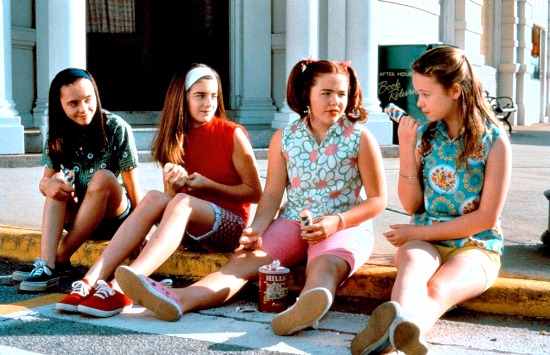
Reeling Backward: "Now and Then" (1995)
Pretty much forgotten today, "Now and Then" was dismissed at the time as a brazen ripoff of "Stand By Me" with girls swapped out for boys. That criticism is legitimate but doesn't completely define this good-hearted coming-of-age story, directed by Lesli Linka Glatter from an original(ish) script by I. Marlene King, two celebrated television creators who continue to work today.
The premise holds promise: gather four well-known adult actresses -- Melanie Griffith, Rosie O'Donnell, Rita Wilson and Demi Moore -- and pair them with four young counterparts to play the same characters at age 12. It doesn't quite hold water, though, as the youngsters carry the movie and the famous stars only turn up for brief bits to bookend the beginning and end.
The film is notable if only because most of the young actresses have gone on to significant careers as adults: Christina Ricci, Thora Birch and Gaby Hoffman. Ashleigh Aston Moore gave up acting a couple of years later, and died quite young a decade hence.
Their characters do line up uncomfortably close to the general personas of the boys from "Stand By Me." Hoffman is Samantha, the pensive writer with troubles on the home front who also narrates. Roberta (Ricci) is the troublesome, surly kid who gets into a lot of fights. Tina aka Teeny (Birch) is the one destined to break out of their cloistered small town and pursue greatness, in her case becoming a big movie star. Moore plays Chrissy, the "fat kid" (barely chubby by today's standards) who's not terribly bright and ends up being the butt of a lot of the jokes.
(Young Moore reportedly was required to gain 20 pounds for her role, which seems clueless at best and downright abusive in less kind lights.)
The idea is the girls make a pact in 1970 to always be there for each other -- "All for one, and one for all" is their borrowed mantra -- which brings them back together two decades later when Chrissy is pregnant, the first child for any of them. The film is set in Shelby, Indiana, though it was mostly shot in Georgia.
As with "Stand By Me," the quest that bonds them is the death of a young boy. Rather than a fresh body by the railroad tracks, though, it involves a gruesome murder of the kid and his mother decades earlier. While performing a seance in the local graveyard, Samantha thinks she's woken the spirit of "Dear Johnny," evidenced by his gravestone turning up broken, and they set off to solve the mystery.
Their antagonists are the Wormers, a foursome of grody brothers who like to play pranks on the girls, and vice-versa. This culminates with our heroines spying on the boys skinny-dipping and stealing their clothes, which results in a plethora of preteen nudity that tests the limits of the PG-13 rating. The oldest Wormer (Devon Sawa) secretly pines for tough Roberta, and they share a kiss... after she trounces him at some 1-on-1 basketball.
The supporting cast is broad and colorful. I really enjoyed Cloris Leachman as Samantha's frenzied grandmother, who takes on more of a role when her father walks out on her mother (Lolita Davidovich). Grandma takes pains to hide the details of Dear Johnny's story, and hustles off to bingo games with such enthusiasm we suspect it's a cover for some other activity.
Hank Azaria turns up as a smarmy candidate for the role of Samantha's stepdad; Bonnie Hunt is Chrissy's mom, passing on her fussy manners and tragically inaccurate information about sex; Rumer Willis has a bit role as Samantha's kid sister; Brendan Fraser plays a burnt-out Vietnam vet who shares cigarettes and a little hard truth with the girls; and Janeane Garofalo plays Wiladene, the town's resident creepy woman who's a diner waitress by day and a moonlights as a psychic-for-pay.
Walter Sparrow has a small but pivotal role as Crazy Pete, the ubiquitous scary old coot with a backstory that will flesh him out in the end.
The modern part of the story is too thin to have any real weight. Chrissy has turned into a prissy fussbudget just like her mom, her home a parade of doilies and reeking of excessive hairspray. Roberta became a doctor, though she doesn't seem very happy about it, or anything. Even during the warm-and-glowy scenes at the end, O'Donnell remains determinedly grim-faced for some reason.
Samantha has become a successful paranormal writer who can't commit to a relationship, wearing men's suits and an air of superiority. Teeny has already been married and divorced three times, and seems to thrive on any kind of attention she can get.
The movie has a clear television feel to it, although the production values are pretty decent. It suffers mostly from a sense of predictability, not to mention a "Wonder Years" type of hazy nostalgia that could use a few more rough edges. Even Samantha's frustration over her parents divorcing feels ephemeral and insubstantial.
To be honest, I'm not even sure how I came to include "Now and Then" in my look-back movie column. As I've mentioned in previous entries, I keep a voluminous list of flicks between my queues for Netflix DVD and streaming, Amazon Prime, stuff I've DVR'd -- mostly from Turner Classic Movies -- and new video releases of old films. The total generally hovers around 100 films, so it might be two or three years between selecting something to add and getting around to seeing it.
Possibly it was the Indiana setting, or the actresses involved, or the fact I once penned a newspaper column called "Now & Then," though that was in reference to the fact it ran only when I had space or time for it.
I at first struggled to get through the movie. The first half-hour or so rather clunky and borderline amateurish. But I warmed to the material as it went on, and ended up with the appropriately fuzzy/wistful feelings the filmmakers no doubt were hoping for.
This exercise has been a helpful reminder that, although Hollywood doesn't pump out the sheer number of movies it did during the Golden Age, the ratio of what stands out in memory and what doesn't has remained about the same. "Now and Then" may be a forgotten film, but it isn't forgettable.
Thursday, December 18, 2014
Review: "Wild"
I was surprised to appreciate “Wild” a lot more than I thought I would. The tale of a young woman who sets off on a seemingly random 1,000-mile trek by foot to find herself, it looked like the sort of simplistic, life-affirming pap you often see in cinemas this time of year.
But buoyed by a terrific, grounded performance by Reese Witherspoon, “Wild” is anything but maudlin. It’s a tough, gritty look at a woman at their end of her rope, who sets out on an expedition in which the destination doesn’t matter, but testing herself in spirit and body is the true aim.
She happened to choose the Pacific Crest Trail, a grueling path through the Western mountains and deserts, as her personal crucible. But really, it could have been anything.
Her story is less about going somewhere, and more about finding your own path, and getting started along it.
The quality of the filmmakers behind the project should have clued me in. Director Jean-Marc VallĂ©e was nominated for an Oscar last year for “Dallas Buyers Club,” and also helmed the high-toned “The Young Victoria.” Screenwriter Nick Hornby is known for cerebral material such as “An Education” and “About a Boy.”
The film is based on the best-selling book by Cheryl Strayed, who hiked the PCT through California, Oregon and Washington two decades ago while in her mid-20s. Her marriage had just come off the tracks and ended in divorce, due mostly to her philandering. (Thomas Sadoski has a tidy, small role as her long-suffering but sweet husband.)
On top of that, her beloved mother (a glowing Laura Dern) had died of cancer, and Cheryl was getting ever more heavily into hard drugs. Clearly things were headed in a foul direction.
Instead of hitting rock bottom, though, she came across the idea of traveling the PCT, despite being an itinerate hiker herself. We see exactly how inept she was in the early going, as she struggles to shoulder a pack that is literally bigger than her, and tears her feet to bloody shreds with too-small boots.
Cheryl meets a few people along the way, mostly men, and there’s an explicit threat of assault or rape with many of these encounters, as a young cute blonde girl all alone on the trail. But she proves quite able, and some scary meetings turn out to be friendlier than first blush. (W. Earl Brown turns up nicely as a gruff bushmaster.) Still, a couple of hunters appear to enjoy frightening her just for the sheer thrill of it.
In the film’s most bizarre (but true!) sequence, she is nearly run over by an enthusiastic African-American reporter for the Hobo Times who says his name is Jimmy Carter. Despite Cheryl’s protestations that she’s not homeless, just in between homes, she ends up becoming an unwilling subject for the publication.
Along the way, our protagonist is revealed to be a thoughtful, literate woman – she writes down quotes from famous writers in the trail station journals – who’s simply made a lot of bad choices in her life. Rather than wallowing in self-pity, she hits the road like a latter-day Jack Kerouac, though on her own two feet rather than behind the wheel.
Instead of just flaunting her freedom, though, Cheryl Strayed was seeking inspiration and forgiveness. “Wild” is the soulful tale of how she learned these were not things out there to be discovered, but gifts only she could give to herself.
Thursday, June 26, 2014
Review: "Obvious Child"
There's a new style of serio-comic storytelling centered around the disheveled lives of twentysomething New York City women. Movies like "Frances Ha" and "Obvious Child," and the HBO show "Girls," revel in the wretched squalor of their stunted careers and the hapless hopelessness of their romantic entanglements.
The fact that these tales usually feature female directors and/or writers only adds to their sense of neurotic authenticity. As is also common with young women singer/songwriters these days, they make use of their messy real lives as fodder for creativity.
I was underwhelmed by "Girls" and "Frances Ha," but "Obvious Child" is the charming best of the lot, mostly due to the vibrant presence of Jenny Slate. You may know her from being on "Saturday Night Live" for about a minute and a half, and punch-funny turns on TV shows like "Parks and Recreation."
But for most people she's a new face and voice, and my guess is it's one they'll want to see more of. She's pitiable and yet admirable, a born screw-up who we end up rooting for.
She plays Donna Stern, a not-much disguised version of her younger status as a rising stand-up comedienne. By day she works/sleeps in the tiny Unoppressive Non-Imperialist Bargain Book Store -- "it's a Manhattan institution," she insists -- and at night plows through drinks and stage sets with her fellow workaday comics.
Her shtick is embarrassingly honest appraisals of her own life, including the opening monologue where describes the spectacularly drone-like sex she has with her current boyfriend -- who happens to be in the audience, and she knows it. He promptly dumps her, and Donna quickly rebounds with an impossibly WASP-y fellow named Max (Jake Lacy) she drunkenly picks up at the bar.
If you've heard anything about "Obvious Child," it's probably in some vague terms about it being an "abortion comedy." This is true, and also not. It's accurate that Donna gets pregnant from her one night stand and speedily decides that she's not ready to be a mother. She schedules an abortion at the earliest convenience, which happens to be Valentine's Day.
Needless to say, this is not a plot designed to elicit warm feelings from the right-to-life crowd.
"You're going to kill it," her best pal Nellie (Gaby Hoffman) offers as encouragement as Donna prepares to do a set the night before the procedure. "Tomorrow I am!" she responds chirpily.
But I don't get the sense writer/director Gillian Robespierre set out to antagonize anyone, and certainly doesn't foist any lectures about 'my body, my choices.' Rather, it's an honest, funny and brave portrait of a young woman trying to navigate her way through life, and often hitting the icebergs. This is Robespierre's first feature film, based on a short movie she made a few years ago with a different cast.
Slate and Lacy have real sparks between them, a magical coupling between the loudmouthed Jewess and the uptight New Englander. They each represent something exotic to the other, and despite the strained circumstances of their situation -- she doesn't share the news with him at first -- they manage some genuine romance, or at least the modern facsimile of it.
A montage dance scene set to the Paul Simon song that gives the film its title is carefree and breathtakingly sexy, despite the fact it doesn't really show much flesh.
The film has a few other drop-in performances from more recognizable actors -- Polly Draper and Richard Kind play Donna's parents, who each love her in their own way, and David Cross turns up as a more successful comedian.
But it's Jenny Slate who gives "Obvious Child" its heart and soul, a silly but satisfying heroine for this day and age.
Subscribe to:
Posts (Atom)


