Showing posts with label demi moore. Show all posts

Monday, December 28, 2020

Reeling Backward: "St. Elmo's Fire" (1985)


 "We're all going through this. It's our time on the edge."

                                                                  --Billy

For another entry in my series of "Films of the '80s I Was Too Busy Doing Nerdy Stuff To Watch" we have "St. Elmo's Fire," a very cool movie starring a bunch of very cool actors that all the cool teenagers and college students went to see.

It's a seminal work in the Brat Pack phenomenon, which played out more in magazines and pop culture than actual celluloid. The story focuses on seven recent graduates of Georgetown University who are trying to get their careers and love lives going in the D.C. area, failing miserably but having a ball while doing it.

Director Joel Shumacher cast Emilio Estevez, Ally Sheedy and Judd Nelson based on John Hughes' recommendation for their work in his "The Breakfast Club," which hit theaters just four months earlier. Reportedly Schumacher had to beg the studio to let him hire them, since nobody really knew who they were at the time. 

Same (mostly) goes for the rest.

Demi Moore had a bit part in "Blame It On Rio" the year before, and Andrew McCarthy had a starring role in "Class," a modest hit two years before. Mare Winningham, the lone non-Packer of the bunch, had similarly been in only a few things.

Rob Lowe, just 20 years old at the time of filming, was the relative established star of the bunch, already a graduate of "The Outsiders," "The Hotel New Hampshire," a leading role in "Oxford Blues" and playing alongside McCarthy in "Class."

Looking back on "St. Elmo's" now, I can see why it was big cultural hit (and to a lesser extent than is generally acknowledged, a box office one). It straddles the the line between late Baby Boomers and Generation X in its appeal to both. The former was graduated from college and partying, and the latter was dreaming about doing so.

It's a spot-on portrait of a very specific point in life for white-collar types, where you have a close circle of friends who are not yet tied down to family and your careers are just getting started. So you are literally around each other all the time, either everybody together or smaller break-off groups. Some people work together or share an apartment. Likely there's a mix of genders, so there's a certain amount of bed-hopping and broken hearts built into the mix.

"St. Elmo's" is terrific at capturing that time. At pretty much everything else, it's atrocious.

My biggest impression after watching it for the first time is that the four male characters are, without exception, terrible human beings. They're manipulative and caddish and make like they're friends with the three women, but are usually just trying to get into their pants, or any woman's.

Any regular reader of this column will know that I generally stay away from political analysis of film, and I absolutely loathe bashing movies from long ago for not syncing with today's sensibilities. That said, "St. Elmo's" makes the 1980s in general and the young men of that age look terrible.

Let's take the best first. McCarthy's Kevin is a sullen, chain-smoking mope who hasn't had sex in years. He's landed a plum job at the Washington Post straight out of college -- which is starting a journalism career on third base -- but is upset that he's consigned to writing obits. Everyone seems to think Kevin's gay, and there's a brief, interesting flirtation with the idea that would've been interesting to explore in a mainstream 1985 movie. 

So, of course, it doesn't.

Kevin seems like the quintessential "friend zone" dude that girls love as a pal but don't want to jump in the sack with. Veeeerrrryyy late in the movie -- so late it feels tacked on -- we learn the object of his mopey obsession is Leslie (Sheedy), an ambitious architect with cold feet about getting tied down too soon.

Unfortunately, Leslie is pre-engaged to Alec (Nelson), the most aggressively awful of the boys. A gung-ho liberal in college, he's working for a Republican senator because it pays better and because it's the current flavor of the decade. Alec keeps pressuring Leslie to marry him, though hides the real reason: he's a serial cheater, and has deluded himself into believing that if he puts a ring on it, it'll settle his Lothario urges. 

In one of the film's few clever tweaks, Alec and Leslie begin dressing more alike as the movie goes on, with heavy doses of the popped collars and skinny ties of the era.

Alec is the unofficial, self-appointed leader of the group of friends. One of his prime duties is bailing out Billy (Lowe) from his latest scrap or finding him a new job. A saxophone-playing party machine on campus, Billy is gorgeous and guileless, without a mean bone in his body but self-absorbed down to his guts. 

Billy already has a wife (barely seen Jenny Wright) and baby girl, the result of a schooltime romance and quickie marriage, but he's barely ever home. The group fuckup, Billy crashes with whoever will take him.

He leans most heavily on Wendy (Winningham), who's 22 going on 50. The straight-arrow virgin Jewish girl, Wendy comes from money but has taken a job working for the city public assistance agency, where she's hollered at or ignored by the entitled downtrodden. She is infatuated with Billy, who "borrows" money via her father (the great Martin Balsam), a greeting card store baron who wants to bribe his daughter with a Chrysler LeBaron to marry a nice Jewish boy who has committed the unpardonable sin of being homely.

(Really, dad? Couldn't even spring for a Corvette?)

In the movie's calculation, being a total loser who looks like Billy is better than being smart, stable and doting.

Billy uses Wendy quite poorly, making a mockery of her affection for him, then offering to bed her like a master passing out table scraps to the family pooch.

He makes much the same offer to Jules (Moore), the hard-charging self-described slut of the group. Julies is a party-every-night girl who's failing at her banking job while spending her way into a pile of debt. On the surface she seems like the toughest one in the group but we know it's a matter of time before her house of cards comes piling down on her. 

Probably the most underwritten of the main characters, Jules registers as a retrograde "type," the have-it-all feminist who's really a narcissistic weakling.

The one character who seems to operate more or less outside the rest of the gang is Estevez' Kirby, who works at the titular bar while studying law. Early on he bumps into Dale (Andie MacDowell), an ER doctor who was three years ahead of him at college. He more or less decides on the spot that he's still in love with her... and therefore she must be with him, too.

Kirby contrives all sorts of sitcommy contretemps to lure her in, from booking a table at a fancy restaurant (arriving two hours early and paying double to secure it), switching to medical school to follow in her footsteps, borrowing his boss' limo to pretend to be suddenly rich, and tracking Dale down at a ski lodge where she's canoodling with another doctor. 

Kirby's behavior is straight-up psycho stalker, and the fact the movie tries to spin it into some kind of adorable love quest seems really skewed. Things wind up with him stealing a kiss so rapturous that as he drives off, Dale is left touching her lips with a "what if" look on her face.

Date rape -- it means he really likes you!!

You can practically see the seeds of "Friends" being sown her, along with a dozen other TV shows about single young people in an urban setting. Indeed, "St. Elmo's" has a very situation dramedy feel to it, and we feel like it starts in the third season. So the audience is assumed to intuitively grasp the characters' backstories and various magnetic poles, and pulls.

They even have their own built-in nonsense catchphrase, where they all lean into a circle and chime something like, "Boogedy boogedy boogedy Ah Ah Hah!"

The film starts out very light and goofy and steadily tries to get more serious. The script by Schumacher and his former assistant, Carl Kurlander, is fast-paced to the point of approaching a slamming-doors comedy or the patter of "His Girl Friday." We never have time to become emotionally invested in the characters, so we don't.

(It was, appropriately, Kurlander's only feature film writing credit.)

There was an attempt a few years back to turn "St. Elmo's Fire" into a TV series, but I think its best expression would be as a limited streaming series of 13 one-hour episodes or so. Each of the characters' journeys could start and stop at different points, overlapping and intersecting with each other.

Instead, it feels like a music video version of a movie -- lots of teased hair and pop rock, then we're on to the next cool thing.


Monday, November 20, 2017

Reeling Backward: "Now and Then" (1995)


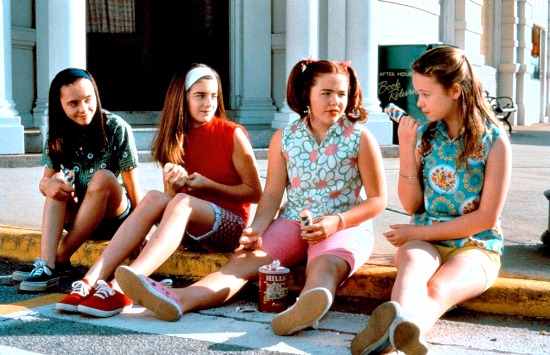
Pretty much forgotten today, "Now and Then" was dismissed at the time as a brazen ripoff of "Stand By Me" with girls swapped out for boys. That criticism is legitimate but doesn't completely define this good-hearted coming-of-age story, directed by Lesli Linka Glatter from an original(ish) script by I. Marlene King, two celebrated television creators who continue to work today.

The premise holds promise: gather four well-known adult actresses -- Melanie Griffith, Rosie O'Donnell, Rita Wilson and Demi Moore -- and pair them with four young counterparts to play the same characters at age 12. It doesn't quite hold water, though, as the youngsters carry the movie and the famous stars only turn up for brief bits to bookend the beginning and end.

The film is notable if only because most of the young actresses have gone on to significant careers as adults: Christina Ricci, Thora Birch and Gaby Hoffman. Ashleigh Aston Moore gave up acting a couple of years later, and died quite young a decade hence.

Their characters do line up uncomfortably close to the general personas of the boys from "Stand By Me." Hoffman is Samantha, the pensive writer with troubles on the home front who also narrates. Roberta (Ricci) is the troublesome, surly kid who gets into a lot of fights. Tina aka Teeny (Birch) is the one destined to break out of their cloistered small town and pursue greatness, in her case becoming a big movie star. Moore plays Chrissy, the "fat kid" (barely chubby by today's standards) who's not terribly bright and ends up being the butt of a lot of the jokes.

(Young Moore reportedly was required to gain 20 pounds for her role, which seems clueless at best and downright abusive in less kind lights.)

The idea is the girls make a pact in 1970 to always be there for each other -- "All for one, and one for all" is their borrowed mantra -- which brings them back together two decades later when Chrissy is pregnant, the first child for any of them. The film is set in Shelby, Indiana, though it was mostly shot in Georgia.

As with "Stand By Me," the quest that bonds them is the death of a young boy. Rather than a fresh body by the railroad tracks, though, it involves a gruesome murder of the kid and his mother decades earlier. While performing a seance in the local graveyard, Samantha thinks she's woken the spirit of "Dear Johnny," evidenced by his gravestone turning up broken, and they set off to solve the mystery.

Their antagonists are the Wormers, a foursome of grody brothers who like to play pranks on the girls, and vice-versa. This culminates with our heroines spying on the boys skinny-dipping and stealing their clothes, which results in a plethora of preteen nudity that tests the limits of the PG-13 rating. The oldest Wormer (Devon Sawa) secretly pines for tough Roberta, and they share a kiss... after she trounces him at some 1-on-1 basketball.

The supporting cast is broad and colorful. I really enjoyed Cloris Leachman as Samantha's frenzied grandmother, who takes on more of a role when her father walks out on her mother (Lolita Davidovich). Grandma takes pains to hide the details of Dear Johnny's story, and hustles off to bingo games with such enthusiasm we suspect it's a cover for some other activity.

Hank Azaria turns up as a smarmy candidate for the role of Samantha's stepdad; Bonnie Hunt is Chrissy's mom, passing on her fussy manners and tragically inaccurate information about sex; Rumer Willis has a bit role as Samantha's kid sister; Brendan Fraser plays a burnt-out Vietnam vet who shares cigarettes and a little hard truth with the girls; and Janeane Garofalo plays Wiladene, the town's resident creepy woman who's a diner waitress by day and a moonlights as a psychic-for-pay.

Walter Sparrow has a small but pivotal role as Crazy Pete, the ubiquitous scary old coot with a backstory that will flesh him out in the end.

The modern part of the story is too thin to have any real weight. Chrissy has turned into a prissy fussbudget just like her mom, her home a parade of doilies and reeking of excessive hairspray. Roberta became a doctor, though she doesn't seem very happy about it, or anything. Even during the warm-and-glowy scenes at the end, O'Donnell remains determinedly grim-faced for some reason.

Samantha has become a successful paranormal writer who can't commit to a relationship, wearing men's suits and an air of superiority. Teeny has already been married and divorced three times, and seems to thrive on any kind of attention she can get.

The movie has a clear television feel to it, although the production values are pretty decent. It suffers mostly from a sense of predictability, not to mention a "Wonder Years" type of hazy nostalgia that could use a few more rough edges. Even Samantha's frustration over her parents divorcing feels ephemeral and insubstantial.

To be honest, I'm not even sure how I came to include "Now and Then" in my look-back movie column. As I've mentioned in previous entries, I keep a voluminous list of flicks between my queues for Netflix DVD and streaming, Amazon Prime, stuff I've DVR'd -- mostly from Turner Classic Movies -- and new video releases of old films. The total generally hovers around 100 films, so it might be two or three years between selecting something to add and getting around to seeing it.

Possibly it was the Indiana setting, or the actresses involved, or the fact I once penned a newspaper column called "Now & Then," though that was in reference to the fact it ran only when I had space or time for it.

I at first struggled to get through the movie. The first half-hour or so rather clunky and borderline amateurish. But I warmed to the material as it went on, and ended up with the appropriately fuzzy/wistful feelings the filmmakers no doubt were hoping for.

This exercise has been a helpful reminder that, although Hollywood doesn't pump out the sheer number of movies it did during the Golden Age, the ratio of what stands out in memory and what doesn't has remained about the same. "Now and Then" may be a forgotten film, but it isn't forgettable.


Tuesday, December 20, 2011

Video review: "Margin Call"


One of the best movies of 2011 hardly anyone's seen, "Margin Call" is a fictionalized take on the collapse of a Lehman Brothers-type company at the precipice of the Great Recession. It's an insider's look at greed, hubris, and the willingness of an elite few to flush the entire economy down the drain, so long as they are the ones who get to decide when.

First-time writer/director J.C. Chandor makes an audacious debut with this taut potboiler, and he's got a killer cast to help him: Kevin Spacey, Zachary Quinto, Paul Bettany, Stanley Tucci, Demi Moore, Simon Baker and Jeremy Irons.

The entire story takes place during one night. After being laid off from his firm, an older worker tips off a young stock trader to evidence that the entire company is on the verge of plunging into a sea of red ink. The smart hotshot calls in his boss, who calls in his boss, and so on into the night.

It's a parade of human flaws and cavalier attitudes, as each person recognizes the imminent threat, and calculates how much personal exposure they have to the calamity.

Irons tops things off as the company CEO, who sees everything in the cold calculation of dollars and cents, and the human factor never enters the equation. Spacey, who has a knack for playing loathsome characters, is the floor boss who starts out as the film's villain and somehow ends up as its moral conscience.
Don't miss this tightly-told indie.

Video extras are good, though not blue-chip quality. Chandor and producer Neal Dodson team up for a feature-length commentary track. They also have a commentary available to accompany several deleted scenes.

The goodies are rounded out by a making-of featurette, photo gallery and behind-the-scenes snippets with cast and crew.

Movie: 3.5 stars out of four
Extras: 3 stars


Wednesday, October 19, 2011

Review: "Margin Call"


At the beginning of "Margin Call," we meet a man we think must surely be the most loathsome creature ever to roam the Earth.

Sam Rogers is the head of the New York branch of a huge corporation that has just laid off 80 percent of its stock traders. Though he weeps openly for his dog dying of liver cancer, he spares not a moment's thought for the dozens of human lives he has just thrown into turmoil. Rallying the remaining troops, even forcing them to applaud themselves, Sam gives a speech:
"They were good people and they were good at their jobs. But you were better. Now they're gone. They are not to be thought of again."
Turns out, Sam is the hero and moral conscience of this story.

Sam is played by Kevin Spacey, who has a gift for portraying men lacking a moral compass. But as a devoted company man with 34 years of loyalty, even Sam is repulsed by what his bosses ask him to do to save the firm. Not because he's opposed to cutting throats when necessary, but because he's been around long enough to know if you slit too many of your customers' throats, nobody will buy from you again.

This edgy, terrific indie drama comes from first-time writer/director J.C. Chandor, making the sort of debut that bellows at the arrival of a major new talent.

He's helped, of course, by a dream cast that includes not only Spacey but Jeremy Irons, Zachary Quinto, Demi Moore, Paul Bettany, Simon Baker and Stanley Tucci. It would be easy to say that it's hard to screw up with a cast like that, but plenty of other films have had the talent but not the tools -- solid storytelling -- to bring it all together.

"Margin Call" does.

It's set about four years ago, at the beginning of the Great Recession, and the company in question is a not-too-thinly-veiled reflection of Lehman Brothers. A century-old firm known for never losing money on a deal, it calculates debt and risk on home mortgages like chips in a massive pile on a poker table, never considering that these are real people with real futures at stake. Until, that is, their cards come up wrong.

Chandor doesn't get too far into the thickets on the specifics of the bad debt that threatens to tip the company over. His film is more concerned with the personalities involved in rationalizing the sort of insane gamble that seemingly conservative firms took in pursuit of ever more profit.

Things get rolling when Eric Dale (Stanley Tucci), a senior risk analyst, is among those who get the axe. He's been working on something big, and before he takes his last walk out the door -- escorted by a beefy security goon -- he passes his findings on to a young hotshot, Peter Sullivan (Quinto).

Peter quickly puts it all together, and alerts his boss, who calls in Sam, who brings in his superior, and so on. It all plays out in the middle of one night, with ever-bigger executives flying in on the company helicopter. Just when you think the newest one is the worst yet, another guy swoops in (literally) to do him one better.

Bettany is very good as Will Emerson, Sam's number two guy who's closer in age to the young guns like Peter, but puts even Sam's cold-eyed calculations to shame. Will is utterly loyal to Sam ... as long as the percentages favor him.

John Tuld (Irons) is the last to arrive, and makes the biggest show of ruthlessness. If his underlings are willing to make other individuals suffer to earn the company a few dollars more, the CEO will happily flush all of Wall Street down the drain, as long as it's his hand on the handle.

"It's just money. It's made up. Pieces of paper with pictures on it so we don't have to kill each other just to get something to eat," Tuld says.

With its tight bookends of a single location on one tumultuous night, and pressure cooker of a business setting, "Margin Call" resembles a stage play. It reminded me very much of "Glengarry Glen Ross" (in which Spacey also starred), about a bunch of real estate salesmen under the gun.

"Margin Call" takes place about 15 spaces up the corporate ladder, the suits are much more expensive, and the guns are big enough to blow a hole in the entire financial system.

3.5 stars out of four

Wednesday, April 14, 2010

Review: "The Joneses"


Some movies present a bigger challenge to review. I'd prefer to write about "The Joneses" without revealing the film's big surprise, but I would have to be so circumspect and vague as to be of dubious use to you.

So I'm trying something new: Review A and Review B. Only read the first one if you want to discover the film's secret for yourself. Move on to B if you want a fuller picture.

REVIEW A

The Joneses, the new family in an unnamed town, are a curiosity. Steve and Kate (David Duchovny and Demi Moore) and their teen children Jenn and Mick (Amber Heard, Ben Hollingsworth) seem to have it all. Each of them is gorgeous and charismatic, and immediately grab the center of attention in their respective social circles.

Their huge house has been tastefully outfitted with the poshest furniture and decorations, and they have all the newest gizmos, golf clubs, clothes, beauty products and toys.

They are, by all measures available, perfect.

But strange clues abound. While the envy of other married couples for their copious gift exchanging and passionate PDAs, Kate and Steve sleep in separate beds. The kids seem especially emotionally detached from their parents -- even by teen standards.

With all their newfound friends and neighbors trying to emulate their swank lifestyle, the Joneses have to work hard to maintain appearances. And yet, none of them seem to have jobs to pay for it all. Steve spends most of his time at the golf course, and Kate apparently gets a mani-pedi every other day.

Clearly, there's more to keeping up with these upscale Joneses than meets the eye.

OK, read no further if don't want to learn the big reveal. Spoilers, ahoy.

REVIEW B

The Joneses are not a real family. They're "self marketers" -- peopled hired by companies to peddle their products indirectly. Instead of knocking on doors to sell stuff, the Joneses move from city to city living the high life, subtly convincing their neighbors to buy the high-end goods of their clients.

K.C. (Lauren Hutton), the mysterious supervisor who occasionally shows up in a black limo to go over the numbers, explains it best:

"You're here to sell a lifestyle, an attitude. If they like you, they'll want what you've got."
This may sound conniving and underhanded, but some version of it is already happening in all sorts of industries. Heck, film studios have been putting "plants" into promotional screenings for years, to laugh and cry at just the right places to pump up the audience's reaction.

So in reality, Steve is a failed golf pro and car salesman, hired to play dream hubby to Kate, an ambitious veteran and the boss of this "unit." And Mick and Jenn -- played, appropriately enough, by actors in their mid-20s slumming as high schoolers -- have more grown-up proclivities than their would-be peers.

Writer/director Derrick Borte (working from a story by Randy T. Dinzler) ladles on the satire of consumer culture with a generous hand, but manages to keep the tone light and biting -- at least until the ending, which is pat and predictable.

Given our current economic trough, it can be a bit sickening to witness all the conspicuous consumption of luxury cars and unnecessary junk -- "He who dies with the most toys, wins!" is Steve's declared motto.

I feel compelled to point out that the merchandise featured in "The Joneses" is real stuff from real companies, who are duly listed in the end credits. It would seem strange that they would want to be identified as product placement perpetrators in a film mocking such practices.

Maybe K.C. was right, and if people like the movie, they'll want the stuff they saw in it. "What a wonderful send-up of the culture of envy! Now where can I test-drive one of those Audi R8's?"

3 stars out of four