Showing posts with label indianapolis. Show all posts

Monday, August 23, 2010

Reeling Backward: "An American Crime" (2007)


Although Reeling Backward has come to be known as the classic film column, I've stated several times that I reserve the right to reel back as far -- or as near -- as I want. In this case, I'm only going three years into the past.

"An American Crime" was a big story in Indianapolis when its production was announced in 2006. The torture murder of Sylvia Likens remains the city's most notorious crime, and has been the subject of a number of books, magazine articles and even other movies. In the same year it was released, "The Girl Next Door" also came out, with names changed and more of a horror film bent, but clearly based on the Likens case.

And for good reason: The 16-year-old girl was beaten, starved, burned, sexually assaulted and tied up over the course of several weeks in 1965. For good measure, the words "I'm a prostitute and proud of it" were branded onto her stomach with a hot wire. Horrifically, many of these despicable acts were carried about by neighborhood children, who were convinced they were merely participating in an elaborate "punishment" meted out for a wayward teen.

The making of the movie made local news -- including an A1 story for The Indianapolis Star by film critic Bonnie Britton that I edited -- but for all the wrong reasons. Chiefly among those was that the film, despite being set explicitly in Indianapolis and directed by native son Tommy O'Haver, was shot elsewhere for financial reasons. (Indiana has film incentives, but they're among the lowest of any state that offers them.)

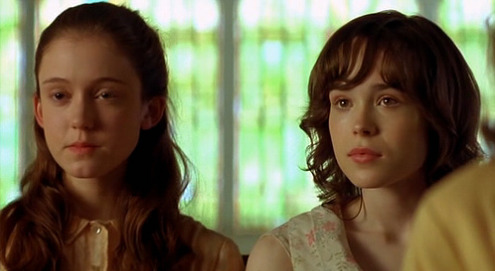
Another reason "Crime" drew the bad kind of notoriety was that it couldn't get a theatrical release, despite starring Ellen Page after her big breakout in "Juno," not to mention indie queen Catherine Keener and other name actors such as James Franco, Bradley Whitford and Michael O'Keefe. I think the film is flawed, but certainly is of sufficient quality to warrant more than the paltry television debut it received.

The final and most insidious reason for the film all but dropping off the face of the earth is the depiction of Gertrude Baniszewski, the caretaker who directed the assault against Sylvia and was responsible for her death. I remember when Bonnie was working on her story, she said something about the movie being sympathetic to "Gertie."

In Indianapolis, saying you're sympathetic to Baniszewski is akin to saying you think Stalin got a bum rap. People say it's wrong to demonize others, but sometimes the bill fits.

"An American Crime" couldn't be called a celebration of Baniszewski, but maybe a feminist defense of her actions. The film goes out of its way to depict her as a victim of abuse by men that she internalized and passed on to the girls under her care.

The depiction is reminiscent of Charlize Theron's portrayal of Aileen Wuornos in "Monster," which also drew accusations of treating a female killer with kid gloves. The unifying theme here is a cycle of abuse that women may perpetuate but not originate.

I do have to say something about the casting of Keener as Gertie. While not a classic Hollywood beauty, Keener is certainly easy on the eyes -- even disheveled and with little or no makeup during most of her screen time. The real Gertrude Baniszewski was one of the most fascinatingly ugly creatures you ever laid your eyes on.

If you Google her image, you'll see that somehow she looked even more frightening when dolled up for her court appearance. Compare that with Keener's put-together look on the stand, and I think it's fair to say a good deal of misplaced Hollywoodization has gone on.

The problem with the filmmakers' approach to such a well-known crime -- O'Haver co-write the script with Irene Turner based on the court transcripts -- is that it's so hard to comprehend such unspeakable acts, the audience can't relate to the people on the screen. The majority of Sylvia's torture at the hands of other children is related in a montage sequence of little power.

By instead focusing more on the character of Baniszewski, the film relegates Sylvia Likens to a cypher with no real identity -- she's simply a vessel for abuse. As depicted by Page, Sylvia is a nice church-going girl who is falsley accused of spreading rumors about Paula, the eldest daughter of the Baniszewski clan. Sylvia and her sister Jenny had been left in Gertie's care by their parents, who were itinerant carnies.

Sylvia never rails against her "punishment," even as it quickly escalates from paddling to burning her arms with cigarettes, and then growing much worse. She's not a person; she becomes a thing that others maltreat. We never understand why she does not protest when accused of doing something of which she is innocent.

"An American Crime" had one notable effect. The house at 3850 East New York Street had lain vacant for most of the time since the Likens murder, but interest renewed when word about the movie got around. Vandalism and break-ins, not exactly isolated given the building's infamy, ramped up. Eventually, authorities saw fit to have it torn down last year.

2.5 stars out of four


Tuesday, September 22, 2009

"Precious" to play Heartland


"Precious," the hard-bitten drama about a teen urban girl that made a big splash at Sundance, will be featured at the Heartland Film Festival, which runs Oct. 15-24 in Indianapolis.

The annual fest, whose mission is to feature life-affirming movies, will play "Precious" as part of a special engagement of sneak peeks of upcoming mainstream films that have earned Heartland's "Truly Moving Picture" designation. "Bright Star," the newest film from Jane Campion ("The Piano") about the young romance of John Keats, will also play.

The opening night film for Heartland will be "Hachi," starring Richard Gere in a tale inspired by the true story of a dog who showed unbelievable loyalty to his master -- even after his death.

The closing night film will be a documentary -- a first for Heartland -- titled "The Horse Boy," about an American autistic boy who found help with a Mongolian tribe of horse masters.

A total of 17 Crystal Heart award winners will play in competition: five dramatic features, five documentaries and seven shorts. They will split a total of $200,000 in prize money, including a $100,000 check to the top award winner -- the highest cash award of any film festival in the world.

A complete schedule of films will be posted Wednesday, with tickets going on sale the same day.

Friday, August 7, 2009

Thoughts on judging the 48 Hour Film Project


So last night myself, my Film Yap co-conspirator Joe Shearer and several others served as judges for the 48 Hour Film Project contest here in Indianapolis. It was a fun but exhausting night, watching a few dozen short films in a row, and then rendering a verdict. We didn't get out until almost midnight.

For those who don't know about the 48 Hour Film Project, it's a national contest where local filmmakers are loaned equipment and given two days to make a movie, with a certain amount of the criteria set. The winner goes on to the national contest, with some big bucks at stake.

We selected "Gno Man Is An Island" as our overall winner. It's about a guy trying to find out who's sabotaging his garden gnomes. We sent in our ballots this morning for the individual category winners like best directing, editing, acting, etc. Those should be announced later today.

We rated the films on a scale of 1 to 10. I won't divulge exact numbers, other than to say "Gno Man" was the clear winner, distancing its runner-up -- "I'm Not Talking to You" -- by a number of points. There were several also-rans that followed right up behind, however.

The judges were fairly much in agreement on some movies, and all over the map on others. One film that got a "1" from me and a "2" from a couple other judges got an "8" from another. Always interesting to see how opinions will vary.

The filmmakers drew lots to see what genre they would receive -- drama, comedy, horror, holiday, family, etc. Not surprisingly, several of the films deviated wildly from their assignment. Perhaps the best example was "Bunny," the entry from The Super Aggro Crag, which clearly wanted to do a horror film, and did so despite pulling the "holiday" category. Never have I seen the Easter Bunny associated with so much death. Another film labeled a comedy was not even remotely funny, although kind of interesting in a deranged way. And one of those who did pull the "horror" card decided to do a surrealist hobo fantasy instead. It was like Salvador Dali meets Ingmar Bergman meets Jim Jarmusch.

Each film also had to include three randomly selected elements: a character who's a professor with the name Shirley or Sherman Kane, a ball, and the line of dialogue "I'm not talking to you." Interestingly, many of the films decided to use the professor Kane character as a psychologist, so we had quite a few scenes of people on couches. There was also a mathematics professor, some English profs, and a guy who studies deer. No one decided to make their professor character a mad scientist.

Well, none of the films in competition, anyway. There was one with a guy who invents a time-travel machine, but it was one of the "late" films. Apparently, some people miss the 48 hour deadline and are shown at the screening, but are not eligible for judged prizes. They are eligible for the Audience Award, and one late film, "Magic 8 Ball," won that for the first group of films. ("Coming Soon" won in the other group.)

The judges discussed the late films, even though we were not scoring them, and we agreed that "Magic 8 Ball" would have had a good shot of winning the top prize if they'd submitted in time.

Beyond the set categories and three things they must include, I noticed a lot of similar themes occurring in several of the films. Clowns were a clear favorite, appearing in at least a half-dozen films. There also seemed to be a lot of people carrying around really big bottles of liquor -- I always thought people stuck to smaller bottles when they're getting drunk, but one guy must have had a gallon jug of Johnny Walker.

Altogether I was rather impressed with the level of talent and originality displayed for our local filmmakers. There was only one movie I thought was truly bad; most were pretty decent, a bunch of good ones, and two or three outstanding.