Most people will go into "Flag Day" knowing that it was directed by Sean Penn, who stars alongside his own kid, Dylan Penn, as they play a real-life father and daughter with a fraught relationship. Penn's son, Hopper, also appears in a smaller role playing the son. You don't often see parent-child acting combinations in movies, but when you do ("On Golden Pond") they tend to be indelible.
This one certainly is.
When I say the movie is small, that is not meant as diminishment. Little movies can often have the biggest impacts. By small I mean it doesn't look or feel like a big Hollywooded-up production.
“Avengers: Endgame” is the culmination of more than a decade of painstaking cinematic world-building. However you feel about the merits of the individual films of the Marvel Comics Universe (MCU), you have to be impressed by the way they coordinated multiple cast members and sets of filmmakers toward this moment.
It’s a great big sprawling movie that incorporates virtually every superhero, from Robert Downey Jr.’s now-venerable Iron Man to Brie Larson’s Captain Marvel, who was just introduced in her own movie earlier this year.
If this feels like end times, that’s because it is.
If you’ll recall at the end of last year’s “Avengers: Infinity Wars,” galactic madman Thanos (Josh Brolin) had succeeded in his quest to gather the all-powerful Infinity Stones from the corners of the galaxy and use them to snuff out half of all life in existence. We watched as billions of people disintegrated into black ash.
This story picks up a few weeks after, as the remnants of the Avengers, Guardians of the Galaxy and other supers track down Thanos in a bid to reverse the apocalypse. They fail, and five years pass.
But then Ant-Man returns with an opportunity to travel through time, steal the Stones from earlier points in history, and make everything right again.
Needless to say, it doesn’t all go according to plan. Without giving anything solid away, suffice it to say that some of the heroes we thought dead return to life, some living ones meet their maker – and some of the deceased stay that way.
Despite being three hours long with literally dozens of characters to keep tabs on, “Avengers: Endgame” still manages to feel like a living, breathing story where we feel the consequences of having all this cosmic power unleashed – and humanity has to bear the brunt of that.
Even though this is definitively the finale for many of the heroes we’ve come to love, it’s also a new beginning as upstarts take their place: Falcon, Spider-Man, Captain Marvel and more.
While some people are undoubtedly sick of comic book movies by now, I think I speak for many when I saw: if it’s this good, keep it coming.
Bonus features are quite expansive, and include an audio commentary track by the writers and directors, six deleted scenes, a gag reel and video introduction by directors Joe and Anthony Russo.
There are also seven documentary featurettes: “Remembering Stan Lee,” “Setting the Tone: Casting Robert Downey Jr.,” “A Man Out of Time: Creating Captain America,” “Black Widow: Whatever It Takes,” “The Russo Brothers: Journey to Endgame,” “The Women of the MCU” and “Bro Thor.”
If the first “Avengers” movie felt like a convergence, the point toward which years of disparate superhero film franchises had been building, then the third, “Avengers: Infinity Wars,” is the beginning of the end times.
I don’t say that to mean superhero flicks are on their way out. Anything but. You can take a look at the box office tallies for this movie, “Black Panther” and other recent iterations from the Marvel Comics Universe and know they’re going to keep making them until people stop going.
But my take is that in the hereafter fans of these movies will refer to the genre in terms of “before AIW” and “after AIW.”
This is a game-changing film that takes all our hopes and dreams bound up with the modern mythology of superheroes, and dashes them against the wall. The story arc of dozens of future movies will hinge upon this movie and its sequel, due out next May.
I won’t give anything away for the few people who haven’t seen it, but before “Avengers: Infinity War” came out it was a common parlor game to guess how many characters would die in it, and choose which ones. Afterward… let’s just say a lot of people making picks were right.
You know the story. World-beater Thanos (Josh Brolin) is coming to Earth to claim the last of the Infinity Stones, which will essentially render him all-powerful. His goal: to eradicate half the living beings in the cosmos so the others can prosper on the remaining resources.
This is more than just an Avengers movie, as almost every single hero of all the Marvel franchises make appearances -- the Guardians of the Galaxy, Spider-Man, and so on. There’s too many characters to list, but Iron Man (Robert Downey Jr.), Thor (Chris Hemsworth), Gamora (Zoe Saldana), Captain America (Chris Evans), Black Panther (Chadwick Boseman) and Doctor Strange (Benedict Cumberbatch) are the most pivotal.
The plot lines move through a number of smaller battles, culminating in a massive one in the hidden nation of Wakanda. On a number of occasions the heroes have a chance to sacrifice one of the Stones in order to prevent Thanos from collecting them all, and decide that the principle of protecting one life is more important than emulating their enemy’s behavior.
We’ll see how that works out for them.
“Avengers: Infinity War” is the culmination of the superhero cinematic adventure that’s been growing for more than two decades. Where things go from here, I can only wait to see.
Bonus features are good, not great. There’s a feature length commentary track by directors Anthony and Joe Russo and screenwriters Christopher Markus and Stephen McFeely; a gag reel; four production documentary shorts totaling about a half-hour; and deleted and extended scenes adding another 10 minutes of footage.
The first “Deadpool” was the naughty, foul-mouthed cousin of the Marvel Comic Universe -- sharing much DNA but separated by sensibilities and different studios. One of the running jokes of the lively sequel is that they can’t afford any of the “expensive” other heroes to share the screen as they did in the latest “Avengers” flick… though they manage to sneak in some cameos.
Once again, unkillable killer Wade Wilson (Ryan Reynolds), aka Deadpool, visits the mansion of the X-Men school, only to find the same two downmarket mutants around: the steely Colossus (voice of Stefan Kapičić) and the firecracker teen Negasonic. Though there’s a quick peek at some of the other X-folk hiding out in an antechamber.
It’s another slapdash, freewheeling train of one-liners and ultra-violence, with Deadpool as our merry ringmaster. If you’ll remember from the last movie, Wilson was a special forces soldier turned mercenary who was experimented upon nastily, rendering him a scarred monster who can nonetheless heal virtually any wound.
The thing about Deadpool isn’t that he’s indestructible -- he’s most very destructible. He gets destructed, or deconstructed, on several occasions, only to knit himself back together. In an early sequence he decides to blow himself up over some sad occasions, only to have the pieces bundled up to reform again.
Without giving anything away, Deadpool finds himself in need of a new purpose in life, and latches onto a 14-year-old mutant from New Zealand, Russell (Julian Dennison), who dubs himself Fire Fist. (He likes the kid too much to tell him how awful the moniker is.) He’s a troubled youngster heading down a dark path.
Around this same time, a strange cyborg dude from the future, Cable (Josh Brolin, playing his second super-baddie this month), pops up to take out Russell for some crimes his adult self committed. He’s got a metal arm, robotic eagle eye and a surly attitude. It becomes a running battle, with Cable wielding a variety of futuristic weapons and Deadpool his ability to take a punch and give a quip.
When things don’t work out with joining the X-Men, he even decides to start his own super-team, naming it X-Force for reasons of gender equality, and because he couldn’t think of anything more original. It’s a gangly crew of low-level mutants and one extraterrestrial, although Domino (Zazie Beetz), a churlish lass who claims her power is “good luck,” seems like a keeper.
The film is directed by David Leitch, a veteran stunt coordinator who made the leap behind the camera with “Atomic Blonde,” which for my money was even better than the similar “John Wick” flicks. The screenplay is a return of the same trio, Simon Kinberg, Lauren Shuler Donner and Reynolds himself.
The sequel has a few dead spots around the middle, though it’s still an insanely smart, fast-paced merry-go-round of fun and f-words. Deadpool again repeatedly breaks the fourth wall, commenting upon the movie as it unspools.
For instance, one background player from the last movie gets a brief, nervous speech, and Deadpool immediately declares, “No more speaking lines for you!”
Or, when Cable delivers another gravelly bit of doom dialogue: “You seem very dark. Are you sure you’re not from the DC Universe?” Before Colossus is about to go toe-to-toe with a very large, cult favorite villain, Deadpool announces “the big CGI fight.”
Make sure to stick around for the end credits, where Deadpool makes some unexpected appearances in related superhero venues, including one hilarious reprisal, which I’ll not spoil. “Just cleaning up the timelines,” he offers.
It’s not quite as funny or filthy as its predecessor. But “Deadpool 2” still has a gleeful sense of shamelessness to it that, at least in this little corner of the superhero genre, fits like leather spandex.
We’re 20 years and more than 50 movies into the renaissance of cinematic superheroes, when you count the various iterations of Marvel Comics and the handful of DC. It’s usually a time when middle age sets in, a sort of creative malaise where stars age out of their roles, studios grow covetous of their cash cows and the storytelling inevitably suffers.
Caution, and reliance on tried-and-true formula, becomes the name of the game.
Then here comes “Avengers: Infinity War” to blow everything up in ways we completely didn’t expect or, indeed, would have said could never happen if foretold to us. Watching it, I kept saying to myself, “Well, there’s no way they’re going to go there,” and then they went there, and then they want past there.
This is a dazzling, ambitious, overpowering film experience that gives bracing new life -- and some deaths -- to the superhero genre. This feels like a watershed moment, a paradigm shift. Wherever this type of filmmaking goes, from now on we’ll think of superhero movies in terms of “before” and “after” this film.
Here’s the unpleasantness: the earth-shaking nature of this movie makes it very, very difficult to review. If I were to even hint at half the stuff that happens in this movie, your mind would be blown. I will endeavor to do my best in the rest of this review not to commit any spoilers. I advise you to avoid conversations or social media posts from anyone you don’t trust in that regard.
Things pick up a couple years after the events of “Captain America: Civil War,” with the group cloven by internal strife and government interference. Thanos, the world-conquering villain who’s been alluded to in previous Marvel Cinematic Universe films, finally makes his big push on Earth -- and a number of other planets -- to gather the six Infinity Stones that will give him virtually unconquerable power.
Literally everybody in the MCU appears in this movie, or nearly so. Just listing the cast would take up the rest of this review, but it includes Iron Man (Robert Downey Jr.); Norse god Thor (Chris Hemsworth); patriot/headman Captain America (Chris Hemsworth); Black Panther (Chadwick Boseman); Star Lord (Chris Pratt) and the rest of the Guardians of the Galaxy crew, notably Gamora (Zoe Saldana), rebel adopted daughter of Thanos, muscleman Drax (Dave Bautista), raccoon pilot/warrior Rocket (Bradley Cooper), and tree creature Groot (Vin Diesel); sorcerer supreme Doctor Strange (Benedict Cumberbatch); super-spy Black Widow (Scarlett Johansson); Scarlet Witch (Elizabeth Olsen); robot sentinel Vision (Paul Bettany); teen supe Spider-Man (Tom Holland); and many, many more.
Josh Brolin plays Thanos, in an oddly emotive motion-capture CGI performance. He truly believes himself to be the universe’s savior, making the hard choices no one else is willing to. A vaguely purpleish titan with a craggy face and muscles big enough to beat the Hulk (Mark Ruffalo) senseless, Thanos pursues ultimate power, and is willing to pay the ultimate price to obtain it.
Directed by Anthony and Joe Russo, who helmed the last two Captain America movies, from a script by Christopher Markus and Stephen McFeely, “Avengers: Infinity War” is an action-packed maelstrom that somehow manages to fit in enough little moments for the actors to let their characters’ essential nature shine through.
I often complain that movies these days ramble on too long, but at 2½ hours, this film flew by. Again, I really don’t want to give anything away, but when the credits started to roll, I truly couldn’t believe the film was going to end the way it does. I was left shocked, amazed, exhausted and spectacularly entertained.
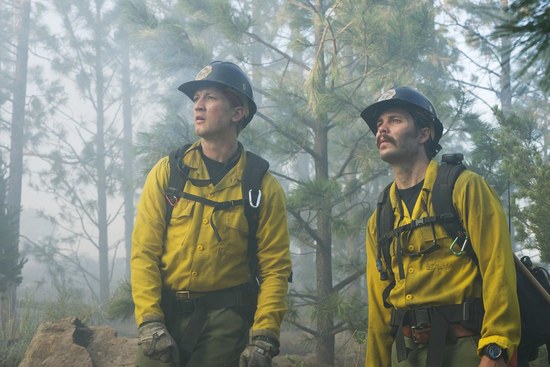
It didn’t gain a lot of enthusiasm during its theatrical run, but “Only the Brave” is a sturdy, well-acted drama about the Granite Mountain Hotshots, an elite group of wildlife firefighters. They’re the sort of guys who run into a gigantic blaze threatening to overrun towns, while everyone else is fleeing the other way.
Josh Brolin plays Eric Marsh, the veteran leader of the Hotshots, and this may just be the finest performance of his career. Resembling Paul Bunyan mixed with Teddy Roosevelt and a little bit of hippie thrown in, Eric is a tough, strong leader who’s determined to see his band of upstarts attain the highest certification for fighting wildfires -- the first municipal outfit to attain that rank.
Eric reads the movements of a fire like an expert tracker stalking his prey, communing mystically with an enemy he strives to defeat.
Miles Teller plays Brenda McDonough, the newest recruit. He’s a junkie wastrel trying to turn his life around in the aftermath of an unexpected pregnancy by an ex-girlfriend. Eric sees some grit behind the younger man’s smirky façade, and takes a risk on him.
Jennifer Connelly plays Eric’s wife, and I was glad to see the Oscar winner given more to do in this Y-chromosome-heavy flick than just sit on the home front and pine for her man. There’s pain in the couple’s past we don’t expect to encounter.
Ol’ reliable Jeff Bridges turns up as a local businessman who uses his connections to help the Hotshots. Rounding out the cast are James Badge Dale, Andie MacDowell, Taylor Kitsch, Ben Hardy, Geoff Stults and Natalie Hall.
A very old-fashioned sort of filmmaking -- it’s essentially a war movie with fires swapped in for terrorists or Germans -- “Only the Brave” has heart, vitality and unexpected wisdom.
Bonus material includes deleted scenes, a feature-length commentary with Brolin and director Joseph Kosinski, a “Hold the Light” music video and three making-of featurettes.
"Only the Brave" is really a war movie, with the characters battling wildfires instead of Germans or ISIS. It's throwback sort of filmmaking -- manly men doing manly things, while occasionally tussling with the womenfolk back on the home front.
I liked it a lot more than I thought I would. Josh Brolin is a rock-solid presence as Eric Marsh, the "supe" of the Granite Mountain Hot Shots. The "Seal Six" of wildfire containment, Hotshots go wherever the big forest fires are, digging break lines and back-burning to keep the blaze from overrunning towns or destroying entire swaths of the American West.
Marsh is basically a mystical warrior, staring the "black heart" of the wildfire dead in the eye, spying signs others can't see to predict where the devastation will spread. Thick-armed with a steely gaze behind Harry Potter glasses, he loves his crew proudly but gruffly, encouraging plenty of Y-chromosome joshing and light hazing.
Miles Teller is the other lead as Brendan McDonough, a young screw-up and junkie who sees the light when a daughter is born to an old girlfriend, and he realizes he needs to step onto a worthier path. Marsh sees something of his younger self in Brendan and gives him a shot.
The first half of the movie, directed by Joseph Kosinski from a script by Ken Nolan and Eric Warren Singer, covers Brendan's efforts to make the team, and the team's attempt to be certified as Hotshots, the elite of the elite in outdoor firefighting. As the story opens they are "deucers," a local team funded by the city of Prescott, Ariz., who do mop-up and other drudge work far from the front lines. All the other Hotshots are federal outfits, and they're trying to become the first municipal group to become Hotshots.
I'm sure you can guess how it turns out.
Marsh is hot-headed but his instincts are nearly always true. Brendan is dubbed "doughnut" because of his inability to answer any questions about firefighting strategy when quizzed. (At least, during his early going.) He gets razzed pretty hard by the other members of the crew, but gradually begins to prove himself.
He also steps up as a father, dropping off diapers and groceries on the doorstep of his baby mama (Natalie Hall), who wants nothing to do with him. Though heroism has a way of changing minds...
The second half covers the Yarnell Hill Fire of 2013, in which the Granite Mountain team faced tremendous odds, a "skunker" -- an easily contained fire -- that turned into a fast-moving death trap.
Jennifer Connelly plays Amanda, Marsh's wife, and it's a lot meatier than the usual "wife at home" role. She's a tough nut herself, running her own business rescuing abused horses, and the two share a relationship that's close but not without strife. She gets a great speech late in the story on what it means to love long-term.
Jeff Bridges plays Duane Steinbrink, a local man of influence who helps with the Hotshot certification and acts as mentor to Marsh. Andie MacDowell is his wife, with wisdom of her own. James Badge Dale is Jesse Steed, Marsh's reliable right-hand man. Taylor Kitsch is Christopher MacKenzie, Brendan's chief tormentor-turned-wingman. Geoff Stults, Ben Hardy and others round out the background players.
The firefighting scenes are pretty terrifying, as we see just how quickly a fire can spread, jumping trees like an angry zephyr. The men both love and hate the fire, and see it as a living foe. Marsh's nickname is "Bear," and we'll find out why.
Marsh shows his trainees a beautiful forest view, then tells them that soon they'll only be able to look upon it as fuel to the fire. Plumped up with resin, the burning trees can literally explode when they fall.
"Only the Brave" is straightforward and unironic movie-making. I could easily see this film coming out in the 1940s, though the special effects wouldn't be nearly as good. In this time of so much focus on toxic masculinity, here's a movie that reminds us why he-men are worth having around.
At some point the Coen brothers are going to remember they're funny. Not this time, though.
"Hail, Caesar!" is the latest from the writer/producer/director siblings, Joel and Ethan, and the latest strikeout. It's not nearly as dour as "Inside Llewyn Davis," nor does it have the dragging sense of self-importance of the overpraised "No Country for Old Men."
But the fact that "Hail" is actually trying to be caustic and funny, and fails pretty miserably at it, perhaps makes the disappointment even more keen.
It's a daffy send-up of the Hollywood studio system circa 1950, when chiefs ran the show and stars were just playthings to be shuffled and traded like cards in a deck. It's the sort of movie in which everybody comes off looking bad -- the behind-the-scenes overlords, the dimwitted actors, the narcissistic directors, the nosy press, the whole kebab.
Even the screenwriters, who usually get portrayed as the put-upon heroes of the trade, are seen as stooges of the Communists, happily spouting Marxist theory but really desiring more of the dough and limelight for themselves.
The Coens doubtless intended this as caricature, a joke-within-a-joke about how artistic types were often viewed during the McCarthy era. Call me old fashioned, but I just don't find the Blacklist every funny.
The central character is Eddie Mannix, the fixit man for Capital Pictures. The sign on his office door says Head of Physical Production, but he really runs the studio on a day-to-day basis while the man ostensibly in charge keeps a careful remove in New York. Mannix's job is a quotidian nightmare of putting out fires, making sure the trains run on time, preventing the embarrassing stuff from getting into the press and keeping the tantrums/temptations of the stars to a manageable minimum.
Things go haywire when his biggest star, Baird Whitlock (George Clooney), is kidnapped from the set of the Roman drama that bears the title of this film. It's Mannix' big prestige picture for the year, and soon the gossip columns have heard about the disappearance -- including rival sisters, Thora and Thessaly Thacker, both played by Tilda Swinton.
The kidnappers are... not terribly organized. They're a bunch of egghead scriptmen who bring Baird to a beatific beachside home, still in his Roman soldier get-up. They don't even bother to lock the doors, and we wonder why he doesn't simply walk up the driveway and thumb a ride back to town. But Baird is fascinated by the lefty "scientific theory" of the crew, who apparently just requisitioned it from a visiting professor. He happily chats them up, trading stories about drinking with Clark Gable, having to shave Danny Kaye's back and such.
Hanging around the periphery is Hobie Doyle, a singing cowboy star in the mold of Audie Murphy who's just been asked to change his image with a switch to erudite romantic dramas. Deliciously played by Alden Ehrenreich, Hobie is hopelessly ill-equipped for anything more than ridin' and ropin', but gamely gives it a go.
If Baird is dim, then Hobie's mind is just about pitch black. But somehow the simpleminded, earnest young star always seems to point himself in the right direction, while Mannix and his henchmen are confounded by the kidnapping.
Also turning up in bit roles -- just a scene or two apiece -- are Ralph Fiennes as Laurence Laurentz, an uppity director trying fruitlessly to whip Hobie into thespian shape; Scarlett Johansson as DeeAnna Moran, a swimsuit beauty a la Esther Williams who's more Bronx moll than angel; Jonah Hill as the ever-ready fall guy; Frances McDormand as the editing whiz toiling in her cave; and Channing Tatum as a Gene Kelly-esque song-and-dance man.
Tatum shines in one of the better scenes, a homoerotic romp with a bunch of Navy sailors already missing the dames as they're about to put to sea. Kelly was light as a feather on his feet, while Tatum's tapping has a more of a lumbering quality to it, but I still appreciated the effort.
"Hail, Caesar!" is a wonderful-looking picture, photographed by Roger Deakins in the saturated colors and crisp tones of the era. The Coens seem to be having a grand old time, amusing themselves with musical numbers and other homages to Golden Age Hollywood -- while simultaneously undercutting the whole industry as trivial and silly.
It's a schizophrenic film without much narrative semblance or sense of purpose. A few bits dazzle, fool's gold for those of us who used to believe the Coens could do no wrong.
Good movies misdirect us; less accomplished ones misdirect themselves. Such is the case with "Sicario," a well-intentioned political/crime thriller set amidst the violence spilling across the Mexican/U.S. border, especially the volatile El Paso/Juarez crossing point.
This film features a couple of effective performances by Emily Blunt and Benicio del Toro. But it spends so much effort keeping its main character in the dark about what she's gotten herself into, the audience is kept ignorant, too. And when people don't know what's at stake, they have a hard time getting emotionally invested in the proceedings.
Directed by Canadian filmmaker Denis Villeneuve, who made the wonderfully harrowing "Prisoners" a couple of years ago, "Sicario" sets us off into a labyrinth and then is content to let us wander lost and perplexed. The screenplay by Taylor Sheridan, a TV actor with his first produced screenplay, is strong on mood and character but seems to think that's enough in itself to sustain a two-hour story acrc.
Blunt plays Kate Macer, a young but well-regarded FBI foot soldier in the war against narcotics. "She's a thumper," praises her boss (Victor Garber), meaning she's strong on tactics -- with the shaded implication that she's less accomplished at the subtler aspects of the job. The story opens with her leading a raid on a house of horrors in the Phoenix area, which starts bad and ends worse.
Thinking she's about to get the hook, Kate is instead offered a plum assignment with Matt Graver (Josh Brolin), an "advisor" who is putting together an ambitious task force to take the fight to the Mexican and Columbian cartels.
"We're here to shake the trees and create chaos," Graver says, which would be more reassuring if not for his flippant manner and barefaced disregard for following the rules. She insists on bringing her partner along (Daniel Kaluuya), though Graver turns him into a glorified chauffer.
At first Kate is impressed by the apparent resources and mojo behind this task force -- they fly on private airplanes, commandeer equipment, recruit soldiers fresh from Afghanistan to be their door-knockers.
Most intriguing is the presence of a man named only as Alejandro (del Toro), whom Graver introduces as his "bird dog." He follows along on their adventures, seemingly not doing very much, but quietly nudging events this way and that. He and Kate form something less than a bond, but more than professional regard.
Scraps of information about him leak out: he used to be a prosecutor, incurred some sort of tragedy that deep-sixed his career, now he's on loan to whatever governmental agency, south of the border or north, that currently needs him. The film's title, which in Mexico essentially means hit man, refers to Alejandro.
Things go on from there. We witness how the drug trade is plied in Juarez: naked, headless bodies strung up everywhere like totems; policemen who essentially operate as another arm of the drug lords; the implication that the American government tolerated the illicit trade when they had more control over it, etc.
Everything builds up to the central question: what is the group's real mission, and what is Kate's role in it? The way Graver keeps her on the wings, it seems clear she's in some way being used. The only real mystery is finding out in exactly what way she's the patsy.
Big reveals in movies are more impactful when it's a "what," not a "how."
You may have read that a sequel to "Sicario" has already been greenlit even before this film made it into theaters, and will follow del Toro's character. That's fine; perhaps that movie can more satisfyingly unwrap the portentous pretensions of this one.
Normally I’m not the sort to engage in I’m-right-and-you’re-wrong type of critical demagoguery. Different people have varying reactions to movies, and everyone’s entitled to own their own opinion.
But in the case of “Labor Day,” a critically savaged drama that bombed at the box office, I truly believe a lot of people missed the boat. Badly.
Based on the novel by Joyce Maynard and adapted for the screen by writer/director Jason Reitman (“Up in the Air”), it’s the tale of a runaway murderer who escapes from prison and takes an isolated mother and her young son hostage over the titular weekend. Their victim/hostage relationship quickly evolves into a more sympathetic dynamic, with the boy looking up to the convict as a replacement father figure, and his mother finding a sense of intimacy she thought lost to her forever.
While some found this storyline too bizarre, the cast and crew maintain a careful balance in tone that renders the drama believable and engaging. Josh Brolin has a quiet, sad grace as Frank, the would-be protagonist, and Kate Winslet shows her considerable range as the meek, wounded Adele. Gattlin Griffith is terrific as her inquisitive son, Henry, who acts more as her caretaker than vice-versa.
Give “Labor Day” a chance now that it’s out on video. On this one, everybody’s wrong and I’m right!
Video extras are decent, and include a feature-length commentary track by Reitman, cinematographer Eric Steelberg and producer Jason Blumenfeld. It’s a pity it doesn’t include the principle cast members, since this is the sort of the film that’s entirely reliant on the performances for its success.
You also get a making-of documentary and some deleted scenes.
You’ll have to buy the Blu-ray edition to get all this stuff, however; the DVD comes with exactly zilch by way of extra features.
"Labor Day" is a movie about the in-between spaces. It's less about the things that we do than how we do them, and why. It's about the parts of ourselves we hide from each other -- the loneliness, the fear, the crippling sense that things are not turning out as they ought to have. And it's about breaking down these walls we construct around us.
Writer/director Jason Reitman ("Up in the Air"), adapting the novel by Joyce Maynard, tackles a difficult subject matter that, at first blush, sounds ridiculous or even exploitative. And yet the film continually surprises us, believably bending an odd setup into a deeply affecting story.
A wounded divorced mom, Adele (Kate Winslet) is so shut inside her own world that she can barely manage to leave her New England house once a month to buy groceries with her 13-year-old son, Henry (Gattlin Griffith). While shopping they are accosted by a strange man (Josh Brolin) who has blood on his clothes and is looking for a place to hide.
He turns out to be Frank, an escaped murderer from the local prison who jumped out of a hospital window after having his appendix removed. He more or less forces his way into Adele and Henry's home, and yet he does not seem belligerent. Frank ties up Adele, gathers together food and supplies, and promises to jump aboard the next train through town.
Since it's Labor Day weekend, though, trains are in scarce supply. Meanwhile, police turn the entire town upside down looking for Frank.
And then a weird thing happens. Adele and Henry earn Frank's trust and cease to be his prisoners. He starts fixing things around the dilapidated house, teaches Henry (he calls him "Hank") how to throw a curveball and demonstrates the recipe for the world's best pie crust. Adele, so crushed by her divorce that she has fallen out of love with the very idea of romance, finds herself drawn to this strange, charismatic man.
Through flashbacks and asides, Reitman and his cast delve deeper into each character's past and their potential future. We learn how Frank came to be in prison, why Adele seemed to have given up on life, and more about Henry's burgeoning interest in girls, including a morose, sharp-witted newcomer to town (Brighid Fleming).
The performances are uniformly splendid, with young Griffith bringing assurance to the role of a young man who's not at all sure of himself. Winslet, though stumbling a bit with an American accent, projects an aura of fractured goodness.
On paper Brolin's part is rather thin, but he gives Frank such a deep-centered calmness and sense of purpose, it's easy to see why his erstwhile prisoners soon latch onto him. He seems both a hard man and a sensitive one.
"Nothing misleads people like the truth," Frank tells Henry, and much the same could be said about this film. It takes a cheap potboiler scenario and turns it into something completely unexpected and revelatory.
January, normally a cinematic desolation, has delivered a gem.
"Men in Black 3" has an obligatory feel to it, like it was made to provide a few people a career boost and satisfy quarterly profit margins for the studio. Arriving a full decade after the second (horrible) film in the franchise, "MIB3" is reasonably entertaining, contains some nice special effects and a few interesting new characters.
But there's very little heart and soul in it, making it the perfect home video rental. Pop it in, get a few yukks and thrills, and never think of it again.
Agents J (Will Smith) and K (Tommy Lee Jones) are back as members of the secret government agency that protects humankind from the knowledge that bug-eyed aliens are living among them in disguise. But when a particularly nasty alien criminal named Boris the Animal fiddles with the flow of time, J must travel back to 1969 and team up with Agent K's younger self (Josh Brolin) to set things right.
The 1960s fashions and vibe are a hoot, and I liked how director Barry Sonnenfeld and his crew make sure the aliens from back then resemble products of era-appropriate pop culture. (Think Sleestaks and planets full of apes.)
"MIB3" may just be warmed-up leftovers, but at least it slides down pretty smooth.
The movie comes with decent extras, though you'll have to shell out for the pricier Blu-ray editions to get the best stuff.
The DVD comes with only a making-of documentary and a music video of Pitbull's "Back in Time."
With the Blu-ray combo pack, you add a gag reel, three more making-of featurettes, special effects progression reels and a "Spot the Alien" game. Go for the 3-D Blu-ray version, and you add a pair of extras focusing on 3-D modeling.
Please note, "Men in Black 3" arrives on video Friday, Nov. 30.
"Men in Black III" gets brownie points simply for not being "Men in Black II."
It's been 10 years since "MIIB," and while I've completely forgotten the plot of that movie, the bad taste it left in my mouth lingers. I remember thinking it was one of the laziest sequels I'd ever seen, simply taking the quirky original film and repackaging its key elements for a cynical, money-grubbing do-over.
Despite that, it made something like a half-billion dollars, so the question becomes: why did it take a decade to make another movie?
The jaded, cynical critic in me can't help but take note that the careers of star Will Smith and director Barry Sonnenfeld have not exactly been afire as of late.
Sonnenfeld's been stuck doing low-profile television since the disastrous "RV" six years ago, which also pretty much marked the end of Robin Williams as a leading man. Smith hasn't starred in anything since 2008, when he gave us the lackluster "Seven Pounds" and the lackluster-er "Hancock."
Even if "MiB III" exists simply to gobble up cash and rejuvenate some careers, it's a reasonably engaging bit of disposable entertainment.
It's not nearly as funny as it ought to be, and I kept feeling like the characters were explaining the movie to me rather than letting it just happen. But there's plenty of slapsticky action, more enjoyably scary/goofy aliens, and a few unexpected poignant moments.
Agents J (Smith) and K (Jones) are back as footmen in the Men in Black, a super-secret agency serving to protect the many alien species that are secretly residing on Earth (and the humans from them). Their jobs and their relationship have grown stale, with J frustrated with K's inability to ever open up to him.
"I'm getting too old for this. I can only imagine how you feel," J riffs after a particularly nasty dust-up in a Chinese noodle shop.
Unfortunately, a superbad dude named Boris the Animal -- "It's just Boris," he repeatedly insists, not that anyone pays any attention -- breaks out of Lunar Max, the alien prison on the moon. A creepy alien with camera lenses for eyes and a pet that lives inside his hand and spits deadly spikes, Boris (Jemaine Clement) swears vengeance on K, who blew his arm off back in 1969.
Boris goes back in time and alters the temporal reality so K no longer exists. Now it's up to J to travel back to the days of hippies and decent rock 'n' roll and put things right.
Josh Brolin plays the young K, expertly mimicking Jones' curt mannerisms and high-pitched Texas drawl. The '60s-era aliens are a trip, made up to resemble extra-terrestrials from movie and TV of that time.
I really enjoyed Michael Stuhlbarg as Griffin, the sole survivor of his alien race who can see across the dimension of time and envision all possible outcomes at once. He's a got a daffy lost-puppy vibe, sweet-natured but with a bit of bite.
There's also a clever bit where J and K encounter Andy Warhol, who turns out to be another Men in Black agent in deep undercover (Bill Hader) to infiltrate the counterculture. "I'm so out of ideas I'm painting soup cans and bananas!"
The run-up to the big showdown is a blur of chases and quips, culminating in a fight on the launch pad of the Apollo 11 rocket as it's getting set to shoot the moon. There's also something about an ArcNet protecting the earth from a Boglodite invasion, and a love flame for K (played by Alice Eve when young and Emma Thompson when not) and a half a dozen other untidy story threads that screenwriter Etan Cohen never bothers to knit together.
It's hard to say that "Men in Black III" is worth the wait, since I don't get the sense much of anyone was really waiting for it. But now that it's here, at least you won't feel like zapping yourself with one of the MiB forget-it-all gizmos after watching it.
The Coen brothers' version of "True Grit" goes completely sideways from the 1969 film starring John Wayne. It is not really a remake of that iconic Western, but a new interpretation of the novel by Charles Portis.
Jeff Bridges' Rooster Cogburn is not likely to be confused with Wayne's. Though both played the one-eyed, over-the-hill lawman with a penchant for shooting first and asking questions whenever he felt like it, but the similarities end there.
Bridges' character seems not merely ill-tempered but downright morally indifferent to the violence he perpetrates. The only real difference between his actions and those of the men he hunts down is that he has the protection of the law on his side.
Hailee Steinfeld is a revelation as Mattie Ross, a 14-year-old farm girl who hires Cogburn to capture -- and preferably kill -- the man who murdered her father. Mattie is smart as hell and even more stubborn, and insists on tagging along. Along the trail they throw in with a Texas Ranger (Matt Damon) with similar motives but very divergent sensibilities.
With its deliberately stilted, formal dialogue and black moodiness, the new "True Grit" is an entirely novel take on familiar material.
Video extras are a bit pokey. The DVD version comes with four featurettes about the cast, the costumes, re-creating Fort Smith and the character of Mattie.
Upgrade to the Blu-ray/DVD combo pack, and you get three more featurettes about the weapons of the Western genre, Charles Portis and the film's bleak cinematography. It does at least come with a digital copy of the film.
Movie: 3.5 stars out of four Extras: 2.5 stars
Rent "True Grit" from the the comfort of your own home today. Sign up to LOVEFiLM today to recieve your free 2 week trial and get dvds straight to your door or watch movies on line. Visit www.lovefilm.com now to start your account!
The Coen brothers' remake of John Wayne's signature role seemed like a bad idea. And yet, despite not departing significantly from the 1969 film in plot, they've managed to put an entirely new and highly engaging twist on "True Grit" in terms of tone and mood.
Wayne's outing as one-eyed drunkard/lawman Rooster Cogburn -- he won an Oscar for it, and Jeff Bridges probably will get nominated, too -- was a G-rated picture of high adventure and comedy. The Coen writing/directing duo, Joel and Ethan ("No Country for Old Men"), deliver an unsurprisingly darker version, both in the quantity of the violence and the timbre of the humor.
(Although, how this paean of bloody shootings, stabbings, hangings and severings got a PG-13 rating is another testament to the vagaries of the MPAA.)
Perhaps the Coens' "True Grit" is best thought of not as a remake of the Wayne film, but an entirely new interpretation of the novel by Charles Portis. It is told from the perspective of an older woman remembering the seminal experience of her life at the age of 14 -- her recollections no doubt colored by the passage of time and some intrusion of imagination.
Mattie Ross is surely the most obstinate, opinionated girl from Yell County, Arkansas. After her father is shot down by a no-account halfwit named Tom Chaney (Josh Brolin), she attends to all the affairs, including transport of the body and haggling with a local businessman over the disposition of his mules.
Mattie is played by newcomer Hailee Steinfeld in a film debut that immediately announces the arrival of a young but formidable talent. Her clear-eyed, head-on performance is so immediate and pure that we do more than adore Mattie; we respect the hell out of the little son of a gun.
Set on hiring a U.S. Marshal to hunt down Chaney, she chooses Cogburn because he is reputed to be the meanest. We first meet him being grilled in a courtroom by a defense lawyer who demands to know how many men he has shot in the line of duty. "Shot or killed?" Cogburn lazily retorts, though it doesn't feel like bluster.
Bridges goes completely sideways from The Duke in portraying Cogburn, whom he inhabits with a slouching, slurring, nonchalant competence. Rooster is overly fond of whiskey, and is the first to admit he has grown too old and fat for this line of work, yet there's no denying he gets the job done -- even if it means waylaying culprits rather than arresting them, and arranging facts to fit the outcome.
Mattie tags along through sheer stubbornness; she wants to see the job done, and if possible pull the trigger on Chaney herself. Joining them is La Bouef (Matt Damon), a Texas Ranger who wears flamboyant buckskin and might seem boastful if he didn't have the goods to back it up.
La Bouef has been hunting Chaney on another warrant for months, and throws in with them, despite Cogburn's constant insults and the presence of a girl. There's also a thrilling, slightly creepy hint of attraction between the Ranger and Mattie, despite at least 20 years age difference.
The Coens' world feels rich and detailed; the characters do and say things not just to further the plot but make us believe they have an expansive history of which we're only seeing a tiny slice.
Cogburn talks while he rides, ruminating over ex-wives and the Green Frog, a tavern he used to own and run. He circles rope around his bedroll to keep snakes out, which sounds like nonsense -- until you Google it and find out it works. (Their soft underbellies don't like the feel.)
The language of the dialogue is comically formal and stiff, with hardly a contraction: "The ground is too hard. If these men wanted a decent burial, they should have got killed in the summer," Cogburn notes.
But the Coens, who love to play around with the conventions of film genres, aren't just goofing: They're setting the audience up.
There's a scene about an hour in of sudden, horrible violence, and we sense the filmmakers have been easing a noose around our necks with the tongue-in-cheek humor and stilted talk. That sharp bloodletting is them jerking our heads back, like the snap of a hangman plying his trade.
Remake, re-imagining, call it what you will -- "True Grit" is truly the Coens' best movie in a decade.
I'm enough of a Woody Allen fan to say there's no such thing as a bad Woody Allen movie. The problem with "You Will Meet a Tall Dark Stranger" is not that it isn't good, but that it feels like we've already seen this movie too many times before.
The narcissistic writer, the ambitious career woman trapped in dead-end marriage, the workplace flirtation that turns into (maybe) something more -- we've encountered these characters many times before in various iterations over Allen's 40-plus years of filmmaking. The only thing that changes is which actors play them.
Allen is a famously prolific writer/director, cranking out about a movie a year. There's bound to be repetition of themes and plots across such a huge body of work, but lately it seems he sticks to a formula with interchangeable parts.
Even the plain, spare black-and-white title sequences and old-timey musical score feel less like the affectations of a stubbornly independent artist than the rut of someone who can't find anything fresh to say.
That's also the plight of Roy (Josh Brolin), an American novelist living in London with his wife Sally (Naomi Watts). Roy gave up a career in medicine to write, and after one modestly successful book he's been unable to come up with anything publishers want.
They depend on financial assistance from Sally's mother Helena (Gemma Jones), who recently was abandoned by her husband of 40 years, Alfie (Anthony Hopkins). He didn't seem to have any real reason for divorcing Helena, other than fear of getting old, and she took it rather badly -- first attempting suicide, and then turning to a fourth-rate psychic for spiritual help.
Sally has recently taken a job working for successful art gallery owner Greg (Antonio Banderas), and it's not long before she's longing for the attention of her sexy boss. Roy, meanwhile, has become enamored with the young Indian girl (Freida Pinto) who moved into the apartment across the way, allowing him to play peeping tom.
Helena takes to popping in at Roy and Sally's any hour of the day, chattering away about her latest revelation from the psychic. She believes she's destined to meet a new love, and that Alfie won't be nearly as happy with his new wife as he was with her.
That psychic may just be stringing Helena along, but proves prescient about Alfie's new relationship. Charmaine (Lucy Punch) is half his age and a prostitute -- that's actually how Alfie meets her. But the old dodderer convinces himself she's got a the proverbial heart of gold, instead of just being a digger of it.
When Allen is really clicking -- say, with "Hannah and Her Sisters" or "Annie Hall" -- these self-deluded creatures seem, for all the ridiculousness of their relationships, at least believable. But here, the characters are mere comedy constructs, built to be laughed at.
Is Alfie such an aging lothario that he'd hand over his life to an obvious tart? Could Roy be any more obvious and piggish in his overtures to his lovely neighbor? Would level-headed Sally really throw herself at a man who makes no pretense of returning her affection?
Only Jones, as the increasingly discombobulated Helena, has any real weight or plausibility to her character. She's wallowing in self-pity and half a loon to boot, but we at least deem her a real person we could pass on the street.
"You Will Meet a Tall Dark Stranger" is cookie-cutter Woody Allen. His fans will savor the familiar taste, while the rest of us wish he'd seek out new recipes.
"Wall Street: Money Never Sleeps" starts out as a big-stakes film attempting a grand statement about the rift lines in the machine of American capitalism. It ends up going small-time, as a miserly story about people we do not understand behaving in ways we don't believe.
It has been 23 years since Oliver Stone solidified the image of the Decade of Greed in the pop culture zeitgeist, and the sequel wants to be an update of how things have changed -- for the worse. It's set in 2008, when our entire financial system nearly sputtered to a standstill, and instead of being the merchant of inside information, this time Gordon Gekko (Michael Douglas) has positioned himself as the oracle of fiscal sanity.
Or is he?
After spending eight years in prison for insider trading and other crimes, Gekko is out hocking his book, "Is Greed Good?" He gives speeches to rapt audiences talking about how the leveraged debt and other shady dealings carried on now put anything he did to shame.
"While I was away it seems greed got greedier, with a little bit of envy mixed in," he says.
His would-be protege this time is Jake Moore (Shia LaBeouf), a hungry young trader with a passion for green technology. He's also engaged to one Winnie Gekko (Carey Mulligan), the estranged daughter of Gordon. She won't speak to her dad, and runs an anti-Wall Street web site called Frozen Truth.
Now, think about that for a minute. Here's a principled young woman who despises her father, despises the abuses of the financial markets, and has centered her career around denigrating them both. And yet she would fall for a young shark like Jake who relishes making deals and cutting the throats of the competition? The sort of guy who buys her an engagement ring worth a house in the suburbs?
Winnie remains an unbelievable figure throughout. She's supposed to be smart, but a few words from Jake and she's ready to turn over the keys to her family legacy (amortizing in a Swiss bank) to him. A few words from Gordon and she's ready to forgive him, too.
Stone was never very good with centered, plausible female characters, and Winnie is just another in a long line of women who exist merely to further the plot.
The heavy is Bretton James (Josh Brolin), head of the powerful firm of Churchill-Schwartz. There's bad blood between him and Gekko, and Gordon's looking to use Jake to exact a little revenge -- some for himself, and some for sending Jake's company down the tubes, and his beloved mentor (Frank Langella) along with it.
But Bretton throws them a surprise, by offering Jake a job instead of crushing him. Soon the idealistic young Jake is inside the enemy's camp, carrying water for Gekko and keeping secrets from Winnie. At this point, a little more than halfway through, the movie has no more secrets that we haven't already guessed.
Stone displays his usual visual flair, sending his camera spinning around stock tickers and up and down the sleek walls of Wall Street, showing us the environment of steel dedicated to the hoarding of wealth for its own sake. "Money is a one-eyed bitch who lays in bed staring at you ... if you're not careful, in the morning she'll be gone," is how Gekko puts it.
The screenplay by Allan Loeb and Stephen Schiff is filled with zippy dialogue and crisp scenes. I especially liked one where Gekko, having dinner with Winnie and Jake at a swank Manhattan restaurant, greets one of the Wall Street titans and the guy blows him off, not even recognizing him. Douglas gives a terrific reaction that reveals his mortification -- not at the social faux pas, but at the fact it demonstrates he's not a player anymore.
I also loved when Gekko calls a bunch of college students the "Ninja generation": No income, no jobs or assets.
But despite these slick elements, the movie is a confused mix of personal story and indictment of the financial sector that never really tie together. The central dynamic seems to be whether Gekko has truly reformed or not, but he's really a secondary character who flits in and out of the background for most of the film, until he takes on a sudden importance close to the end.
The Bretton James angle holds no mystery -- the way Brolin snorts and glares, we know it's just a matter of time before he's buried under a mountain of his own arrogant missteps.
Fairly or not, "Wall Street" nailed the culture of avarice that undeniably existed in the 1980s ... but so it did in the '90s, '00s and every decade before (and will after). Stone's haphazard sequel reshuffles the deck, but relies on the same old cinematic card tricks.
The standard for this summer's crop of flicks is already depressingly low, with one high-profile disappointment after another. But even if we lower our standards so that our entertainment merely has to be coherent, "Jonah Hex" seems cursed.
When I was writing my summer movie previews, I spotlighted this Western-oater-meets-supernatural-thriller as one of those I was most looking forward to. Based on the dark-and-dreary previews seen earlier in the spring, it looked like an adaptation of a graphic novel much in the same vein as "The Dark Knight."
But then another trailer emerged a few weeks ago, much lighter in tone -- full of the scarred, taciturn anti-hero (Josh Brolin) casually shooting people and tossing off comedic one-liners. It was Dirty Hero meets Arnold Schwarzenegger, with spurs on its heels. This, unfortunately, was a much more accurate preview of the film.
Perhaps I should have been tipped off that the comic books (by John Albano and Tony Dezuniga) were adapted for the screen by the execrable filmmaking duo that calls itself Neveldine & Taylor (the first names they so eschew are Mark and Brian, respectively). Their credits include the "Crank" movies and "Gamer," and that tells you pretty much all you need to know about what "Jonah Hex" is like: Fast-paced to the point of ADD, jumpy editing and characters drawn with the broadest brush available.
The director is Jimmy Hayward, whose only other credit is the strange "Horton Hears a Who!" from a couple years ago. His action scenes are muddy and confusing, to the point that we have trouble understanding exactly what is going on. Josh Brolin, a talented actor, gives a more or less one-note performance as Jonah Hex. Megan Fox does little but pout and flash her ubiquitous cleavage. And John Malkovich, whose intensity as an actor is best when reigned in by a strong director, is allowed to burn through every scene he's in.
The story is a straight revenge flick: Confederate turncoat Jonah, who defied an evil general's order to destroy a hospital, suffers a terrible punishment. Quentin Turnbull (Malkovich) wreaks his vengeance by killing Jonah's wife and son in front of him, and branding his face with his mark. Jonah is left (after a little self-adjustment) with the entire right side of his skull a web of ruined flesh.
Turnbull is believed dead, but when his men appear to be stealing the plans to make the ultimate weapon the U.S. government designed but feared to build, President Grant assigns his men to track down Jonah -- now a bounty hunter -- to help capture or kill Turnbull.
Jonah has special powers that allow him to communicate with the dead by touching their bodies. It's never explained exactly how he acquired this power, although there's a reference to some American Indian magic hokum. Because he came so close to death himself, or something like that.
Anyway, the dead reconstitute themselves to the way they looked when they were alive, but they start to burn painfully the longer Jonah holds them in this state. He can ease the hurt by pouring soil on their heads -- see, "the dead need the dirt, and the dirt wants the dead." One long-dead corpse, whom Jonah slew with his own hand, immediately starts fighting with him the moment he's resurrected. Although resurrection isn't the right word, since to everyone but Jonah, the corpses remain still.
Jonah likes to carry an arsenal of fancy weapons that are entirely implausible, but at least look like they were manufactured in the film's era, much like the gear in "Van Helsing." Jonah rides around with two hand-cranked machine guns strapped to his horse (even though they must weight a few hundred pounds) that he uses to mow down some nasty townfolk who refuse to pay a bounty in the film's opening scene.
There are also these funny-looking pistols that show up. Apparently they have sticks of dynamite stacked underneath like a magazine of bullets, and when Jonah fires one of them is lit and flung by a mini-crossbow at his enemies. Of course, they explode upon impact, no matter what point the fuse has reached in its burning. After blowing away a few dozen men with them, he then drops these unique weapons that he just paid a lot of money for on the ground.
Megan Fox shows up as Lilah, a knife-wielding prostitute who wants Jonah to settle down and build a house with her. Lilah must not be very sharp herself if she thinks a man with half his face burned off and an obsession with death is the best the Old West has to offer in a mate. It's never even mentioned how such a gorgeous woman can look past Jonah's gruesome visage.
Even the prosthetics Brolin wears on his face aren't very convincing. It's supposed to appear that Jonah has a huge hole in his cheek -- even if we hadn't seen him drawn that way in the comics, the movie's animated exposition depicts him so. Brolin just looks like they added an extra strip of skin over the side of his mouth that forces him to mumble all his dialogue. Hell, "Darkman" did a better job of this 20 years ago.
Barely 80 minutes long, "Jonah Hex" is an interminable, dusty disaster.