Delivering immeasurable volumes of snark about movies and anything else that pops into my head
Showing posts with label jeff bridges. Show all posts
Monday, January 27, 2020
Reeling Backward: "Thunderbolt and Lightfoot"
Clint Eastwood planned to direct "Thunderbolt and Lightfoot" himself, but then he met Michael Cimino, the young screenwriter who had written the script for "Magnum Force," the second Dirty Harry movie and a big hit.
Road pictures and Eastwood were both hot commodities in the early 1970s, and Cimino had been commissioned by agent Stan Kamen to do a script on spec with the squinty star in mind.
Eastwood, who'd already directed three movies himself by then, decided to let Cimino have his shot, leading to his first feature film as a director. His second movie behind the camera was "The Deer Hunter," winning him a pair of Oscars by the age of 40. His next was "Heaven's Gate," which ended his brief tenure as an A-list filmmaker. He made four more movies, none of them consequential.
I'd been meaning to see this buddy crime caper for years, and came away a teeny bit disappointed. It's now out in a handsome Blu-ray edition that's well worth a look.
It's a fine movie, and the screen relationship between Eastwood and Jeff Bridges is just as lovely and spirited as I'd hoped. Or at least it starts out promising.
Eastwood is Thunderbolt, an expert in breaking into banks vaults using a 20mm cannon, hence the nickname. As the story opens he's been hiding out as a preacher in a tiny unnamed town in Big Sky country.
Bridges is Lightfoot, a young hotshot car thief/rapscallion, who wandered off on his own as a youth and never stopped moving. He's repeatedly referred to as a hippie, though his clothing and hair is actually closer to Tony Manero from "Saturday Night Fever." He steals, has a good time with women and booze until the money runs out, then repeats the cycle.
Somehow these opposing personalities just click. Thunderbolt is an aging Korean War vet whose body is crisscrossed with scars, including a badly burned foot that requires a walking brace. He keeps to himself and speaks only when necessary, won't run from a fight but doesn't seek one out, either. Lightfoot is a gadly and gadabout who loves to laugh and avoid conflict whenever possible.
They meet when Thunderbolt literally jumps into the hot rod Lightfoot has just stolen while being shot at by a former member of his bank robbing gang. They pulled off a big job at the Montana Armory a couple of years earlier, and events transpired that the others mistakenly think Thunderbolt kept all the loot for himself.
(They never seem to question why 1) if Thunderbolt had the money he'd pretend to be a poor podunk pastor instead of living the high life behind guarded walls, and 2) they should just just kill him instead of trying to get the money back.)
Lightfoot almost immediately suggests they become friends and pull off some jobs together. Thunderbolt enjoys the younger man's innocence and pep. It's the start of a great Butch/Sundance type of partnership, and I looked forward to accompanying them on their bromance journey.
Unfortunately, the duo becomes a quartet and the movie morphs into a fairly straightforward heist flick, as they plan the job and then watch everything blow up in their faces.
I'm sort of astonished that "Thunderbolt and Lightfoot" is often described as a comedy. Certainly there are hijinx and laugh-out-loud moments. But it's also a movie with sadness and anger at its core.
The latter is personified in Red Leary, a thoroughly nasty piece of work played by George Kennedy. He's the one who wants to assassinate Thunderbolt for pure sake of revenge. They were friends from back in Korea, and each man claims the other saved his life.
At one point Red is asked why he's willing to sacrifice everything instead of just letting go and living his own life, and he responds that because he was (he thought) betrayed by a friend, no other choice was possible. If a stranger did him wrong, he'd probably let it slide if there was no benefit in pursuing retribution.
Red and Thunderbolt hash out their differences in a fistfight, then resolve to rejoin forces along with Goody (Geoffrey Lewis), their submissive wheel man. Lightfoot replaces Dunlop (Roy Jensen), the electronics expert who tried to kill Thunderbolt in the opening sequence and got busted up for his trouble.
It seems the one-room schoolhouse where Thunderbolt and the deceased gang leader stashed the loot was torn down and replaced with a modern building, meaning they have nothing to show for the biggest score of their lives. It's Lightfoot who suggests they pull the same job all over again using the same M.O.
Red takes an instant dislike to Lightfoot, egged on by the latter's teasing and devil-may-care attitude, and threatens repeatedly to do him in when the job is over.
At this point the movie wandered away from me, as the men take jobs in town so they can build a stake while planning the robbery. A few notable actors make appearances here including Gary Busey, Vic Tayback, Jack Dodson, Dub Taylor and "dem teef" background player Burton Gilliam. Catherine Bach turns up as a romantic fling for Lightfoot in a pre-"Dukes of Hazzard" role.
The fatal flaw that trips up the execution of the heist is sneaking into a drive-in movie theater near the armory with Goody and Red hiding in the trunk. The manager spots Red's shirttail hanging out the back and thinks extra people are sneaking in without tickets, setting off the commotion that puts the cops on their tail.
For veteran cons you'd think they'd instead try to get away from the scene of the crime as fast as they can. Or just have Goody and Red sit up front and buy two more tickets. But maybe it worked last time, so they're slaves to the tried-and-true.
"Thunderbolt and Lightfoot" is a notable car movie. Lightfoot repeatedly "acquires" new vehicles to throw people off their trail, so the movie has a hefty listing on the Internet Movie Cars Database. Dunlop rolls up in a black 1959 Cadillac, a model I'm well acquainted with, and things go from there.
At various points the boys drive a '73 Buick Riviera as well as a Pontiac Firebird and a Cadillac Fleetwood Eldorado, both of the same year.
In the film's looniest sequence, the pair are hitchhiking and get picked up by a madman driving a 1973 Plymouth Fury that has been jacked up with racing tires, who immediately careens around the road like a stuntman and intentionally rolls the car over. He then springs the trunk revealing that it is filled to the brim with white rabbits. He's played by Bill McKinney, forever the "squeal like a pig" hillbilly from "Deliverance."
It's a fun bit, but it's bizarreness for its own sake.
The most memorable car of the story is Goody's slate gray 1951 Mercury Coupe, which we suspect has been souped up by the way it keeps up with all the modern cars. It gets put through all sorts of paces, including jumps off cliffs and smashing into multiple police cars during the last desperate chase scene.
The film ends on a major downer note, with everyone in the gang dead but Thunderbolt. Red made good on his promise, repeatedly kicking Lightfoot in the head to cause fatal brain damage. Goody gets shot through the trunk lid and Red is mauled by a guard dog at the store he crashes into, ironically the same place he'd been working as a janitor for his cover job.
The injured Lightfoot and Thunderbolt muddle along for awhile, with the young man growing increasingly dizzy and his speech slurred. They stumble upon the one-room schoolhouse, which had been moved to an interstate rest stop historical display, and recover the half-million from the first heist.
Thunderbolt rides off into the sunset, his friend and partner dead and all the threats against him dissolved. What sort of life lies before him? The movie offers only stubborn ambiguity and the obligatory sad ballad for the soundtrack.
"You know something? I don't think of us as criminals, you know? I feel we accomplished something. A good job. I feel proud of myself, man. I feel like a hero," Lightfoot opines, right before slumping over dead.
"Thunderbolt and Lightfoot" accomplished less than it could. There's a great movie in there, one where Red is a peripheral villain and the duo arrives at their denouement all on their own, having passed through the fire and come out changed men.
Nothing ruins a good buddy movie like interlopers.
Monday, April 23, 2018
Reeling Backward: "Bad Company" (1972)
A teaser I used to like to spring on people was this: "Do you know who is very quietly having himself one of the all-time great film acting careers?"
Prior to 2009, when he finally won an Academy Award after five tries, I don't think many people would have answered "Jeff Bridges." But I think it's true -- and evidently more now agree with me, helped by two more Oscar nominations since.
Seriously: Bogie. Cary Grant. John Wayne. Jack Nicholson. Brando. Pacino. Duvall. De Niro. You name 'em... Bridges can match (or beat) any of them in terms of acting technique, career longevity, range, choice of roles and emotional genuineness.
Think of a time over the last five decades when Jeff Bridges wasn't making great movies. You can't. From "The Last Picture Show" up until "Hell or High Water" a little more than a year back, he's always inhabiting roles with an unpracticed authenticity, from giant blockbusters to little indies, playing everything from presidents to aliens to cowpokes.
Each time, we never question him for an instant. We never think, "Here's the big movie star, doing his thing." (Unlike, say, Harrison Ford, who's roughly his contemporary.) Maybe it's because he's never been much of a public celebrity -- married to the same woman for 40-plus years -- or politically outspoken, but Bridges has that ability to instantly disappear right in front of us. I think part of the reason he didn't get the credit he deserved was because he made it look so easy.
Fresh off an Oscar nomination for "Picture Show," Bridges co-starred in "Bad Company," a Western directed by Robert Benton ("Kramer vs. Kramer"), in his first foray behind the camera, from a script he co-wrote with David Newman. The two had also collaborated on the screenplay for "Bonnie and Clyde," and with this film Benton launched an important directing career spanning four decades, including the underrated "The Human Stain" from 2003. In all, Benton has notched six Oscar nominations with three wins.
Bridges was about 22 when they shot the film, playing maybe 17 or 18 as the leader of a distaff gang of boys fleeing conscription in the Union army to seek their fortunes in the West.
I admit I'd never heard the term "acid Western," which more or less got started with "El Topo" in 1970, and was loosely applied to a number of films in the ensuing years, including "Bad Company." The movie is certainly not surreal or bizarre like Jodorowsky's. In a lot of ways, it's very old-fashioned, with its washed-out colors -- almost sepia-toned -- familiar Western archetypes and tinny piano musical score (by Harvey Schmidt).
Perhaps it got thrown in with the acid crowd because of its youthful cast, which was taken to mean Benton and Newman were espousing a counter-cultural stance. It's a tale of how very young boys were chewed up and spit out by a burgeoning young nation's expansion. For me, it's notable that they set out not out of a sense of adventure, but fleeing from serving in the Civil War. Of course, they end up finding as big a bellyful of violence, malevolence and despair as they would've on the front lines.
Robert Ebert, in his contemporaneous review, noted correctly that the story is essentially a series of self-contained episodes. Drew Dixon (Barry Brown), an upright Christian lad from Ohio, is sent packing by his parents after the bluejacket recruiters come calling at every household, dragging out boys outfitted in dresses to fool the draft. The Dixons already sacrificed their older son to the war, and send the younger one west to seek safety and fortune, with $100 and his sibling's gold watch to guide him.
He soon runs in with Jake Rumsey (Jeff Bridges), a bushwhacker who befriends Drew by warning him about the prevalence of bushwhackers in these parts. After cautioning him that all the stagecoaches west are booked for six months solid, Jake plunks him over the head and steals all the money in his pocket (not knowing that Drew has hidden the bulk of his fortune in his boot).
Coming to, Drew seeks solace at the house of the local preacher, but after the wife leaves to fetch him, who should come calling but Jake, holding the purse one of his gang stole earlier, hoping to return it for a double-dipped reward. The two lads take up a ferocious row, smashing apart the woman's drawing room, before making their peace with Jake offering to take Drew into his gang.
First, Drew has to prove his worth by pulling off a job alone, which he fakes by spinning a story of robbing a local merchant, presenting $12 from his secret stash as evidence.
From there, the story is a gradual descent in fortunes as the boys move marginally westward, encountering bandits, farmers, whores, lawmen and other fates that whittle their numbers until only Drew and Jake remain. Ardent friends who often behave like foes, it's the low-born scallywag trying to make sense of the educated fellow who reads "Jane Eyre" and refuses to steal, and vice-versa.
The supporting cast is a veritable who's who of "that guy" character actors:
- John Savage, in just his third film role, as Loney, the suspicious member of the gang.
- Jerry Houser, forever Killer Carson from "Slap Shot," as Arthur, the nervous one.
- Ed Lauter, a lifetime of cops and robbers roles, as a hard bandit who narrates his own death.
- Geoffrey Lewis, recognizable by his blue eyes and bald pate, as another robber who gets his hands on Drew's watch... for a time.
- Jim Davis as the hard-hearted Marshal who eventually catches up with everyone.
- John Quade, another bald-headed bad guy known for his porcine visage, who often tussled with Clint Eastwood onscreen.
- Charles Tyner, with a scowl that could curdle milk, as a (barely) generous farmer in the boys' time of need.
The real standout of the supporting cast is David Huddleston as Big Joe, the aging leader of the gang of bandits who waylay Jake's crew, after he has fallen asleep during his turn at watch. Wearing a stovepipe hat, a voluminous fur coat and often chewing a pipe, Big Joe serves as Jake's chief antagonist, and teacher.
There's a great moment where Jake levels his pistol at Big Joe, who doesn't even flinch, talking the boy into complacency, then casually whipping out his own sidearm and blasting Jake's revolver away. "Still got it," he mutters to himself, before tendering this sage counsel:
"My boy, let me give you a little piece of advice. If you're going to pull a gun on somebody, which happens from time to time in these parts, you better fire it about a half a second after you do it... because most men aren't as patient as I am."He orders his men to seize every last bit of their wealth -- even their beans and coffee -- but leaves the boys with their guns and horses. Because it's acceptable in this eat-or-be-eaten hellscape to inflict every means of deprivation, but you don't leave another man immobile and defenseless.
In a normal Western the paths of Big Joe, Drew and Jake would cross again with a violent extravaganza. This does happen, but the older man sits the fight out, reassured by his lieutenant that the rest of the men can handle two boys. Jake and Drew manage to get the drop and blast apart Big Joe's entire gang, but he doesn't bother with revenge -- simply gathering up another gang to keep marauding.
After Drew and Jake have inevitably come to cross purposes, after the latter finally discovers Drew's secret stash of cash and thunks him unconscious a second time, it comes as little surprise to us to discover that Jake throws in with Big Joe. Perhaps the hot-headed lad, who loves to boss others around, has finally figured out he has a thing or two to learn.
"Bad Company" is a good, not a great film. The central dynamic between Jake and Drew never fully clicks, though each actor acquits himself well. Bridges is charismatic and slightly skeevy, while Brown comes across has hopelessly blinkered -- a do-gooder who tries to convince himself he's not careening down the slipper slope.
Sad coda to his career: Brown made a few more films, with never such another high-profile role (unless you count his billing as "trooper" in "Piranha") and a little TV, before taking his own life in 1978 at age 27.
Though the film isn't well remembered these days, it does showcase one of the most important actors of the last century, stepping from boyhood roles into grown-up ones, and from the edge of the stage to the center.
Sunday, February 4, 2018
Video review: "Only the Brave"
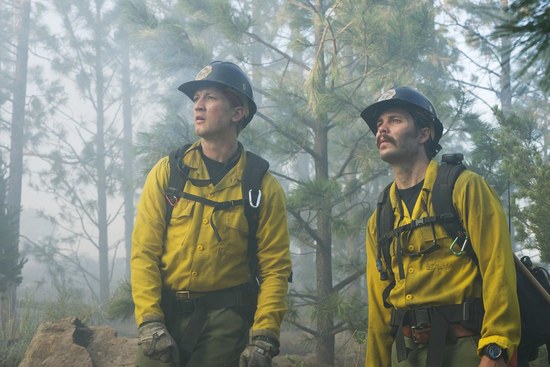
It didn’t gain a lot of enthusiasm during its theatrical run, but “Only the Brave” is a sturdy, well-acted drama about the Granite Mountain Hotshots, an elite group of wildlife firefighters. They’re the sort of guys who run into a gigantic blaze threatening to overrun towns, while everyone else is fleeing the other way.
Josh Brolin plays Eric Marsh, the veteran leader of the Hotshots, and this may just be the finest performance of his career. Resembling Paul Bunyan mixed with Teddy Roosevelt and a little bit of hippie thrown in, Eric is a tough, strong leader who’s determined to see his band of upstarts attain the highest certification for fighting wildfires -- the first municipal outfit to attain that rank.
Eric reads the movements of a fire like an expert tracker stalking his prey, communing mystically with an enemy he strives to defeat.
Miles Teller plays Brenda McDonough, the newest recruit. He’s a junkie wastrel trying to turn his life around in the aftermath of an unexpected pregnancy by an ex-girlfriend. Eric sees some grit behind the younger man’s smirky façade, and takes a risk on him.
Jennifer Connelly plays Eric’s wife, and I was glad to see the Oscar winner given more to do in this Y-chromosome-heavy flick than just sit on the home front and pine for her man. There’s pain in the couple’s past we don’t expect to encounter.
Ol’ reliable Jeff Bridges turns up as a local businessman who uses his connections to help the Hotshots. Rounding out the cast are James Badge Dale, Andie MacDowell, Taylor Kitsch, Ben Hardy, Geoff Stults and Natalie Hall.
A very old-fashioned sort of filmmaking -- it’s essentially a war movie with fires swapped in for terrorists or Germans -- “Only the Brave” has heart, vitality and unexpected wisdom.
Bonus material includes deleted scenes, a feature-length commentary with Brolin and director Joseph Kosinski, a “Hold the Light” music video and three making-of featurettes.
Movie:

Extras:
Sunday, December 10, 2017
Video review: "Kingsmen: The Golden Circle"
“Kingsman: The Secret Service” was a dashing, original and highly entertaining flick that spoofed the conventions of the spy genre while generally adhering to them. Its much-anticipated sequel, “Kingsman: The Golden Circle,” is none of those things.
This bewilderingly limp follow-up brings back the same cast and creative team, yet fails to recapture the magic. It’s got too many characters, a non-scary villain and seems too in love with itself to spare any affection for its audience.
You may remember that in the last movie, veteran superspy Galahad (Colin Firth) was killed, shot through the head. This proves only a mild inconvenience, as he’s resurrected in short order, minus one eye and lacking any memories. Though we just know his killer skills are residing there, Bourne-like, underneath the timid exterior.
Galahad protégé Percival (Taron Edgerton) takes center stage, as nearly the entire Kingsmen coterie of spies is wiped out by Poppy (Julianne Moore), who controls the world’s drug trade from her secret headquarters deep in the jungle, which she’s built to resemble her nostalgic middle America childhood. She has a plan to hold the world’s drug addicts hostage unless the governments pay her a massive ransom.
The key new wrinkle, the introduction of an American version of the Kingsmen, turns out to be the film’s biggest disappointment. They’re Statesmen, Kentucky whiskey-brewin’ cowboys in Stetsons – which suggests the British filmmakers can’t distinguish the New South from the Old West. Channing Tatum turns up as their best and brightest, but he’s soon sidelined in favor of a lesser operative (Pedro Pascal). Jeff Bridges chews his dialogue like cud as their top kick.
Director Matthew Vaughn still has the chops for some seriously fancy action scenes, as the camera spins around the combatants like an untethered raven, the action speeding up or slowing down as aesthetics needs be.
Whenever the bullets and blades aren’t flying, though, “Kingsman: The Golden Circle” is a cringe-worthy retread that’s more embarrassing than enjoyable.
Bonus features are pretty decent. The DVD comes with the “Kingsman Archives,” a collection of concept art photos and behind-the scenes stills, plus “Black Cab Chaos: Anatomy of a Killer Case.”
Upgrade to the Blu-ray edition and you add a feature-length making-of documentary film focusing on everything from the Kingsmen and Statesmen’s respective gear, “Suited and Booted,” to visual effects and Elton John’s guest-starring appearance.
Movie:
Extras:
Thursday, October 19, 2017
Review: "Only the Brave"
"Only the Brave" is really a war movie, with the characters battling wildfires instead of Germans or ISIS. It's throwback sort of filmmaking -- manly men doing manly things, while occasionally tussling with the womenfolk back on the home front.
I liked it a lot more than I thought I would. Josh Brolin is a rock-solid presence as Eric Marsh, the "supe" of the Granite Mountain Hot Shots. The "Seal Six" of wildfire containment, Hotshots go wherever the big forest fires are, digging break lines and back-burning to keep the blaze from overrunning towns or destroying entire swaths of the American West.
Marsh is basically a mystical warrior, staring the "black heart" of the wildfire dead in the eye, spying signs others can't see to predict where the devastation will spread. Thick-armed with a steely gaze behind Harry Potter glasses, he loves his crew proudly but gruffly, encouraging plenty of Y-chromosome joshing and light hazing.
Miles Teller is the other lead as Brendan McDonough, a young screw-up and junkie who sees the light when a daughter is born to an old girlfriend, and he realizes he needs to step onto a worthier path. Marsh sees something of his younger self in Brendan and gives him a shot.
The first half of the movie, directed by Joseph Kosinski from a script by Ken Nolan and Eric Warren Singer, covers Brendan's efforts to make the team, and the team's attempt to be certified as Hotshots, the elite of the elite in outdoor firefighting. As the story opens they are "deucers," a local team funded by the city of Prescott, Ariz., who do mop-up and other drudge work far from the front lines. All the other Hotshots are federal outfits, and they're trying to become the first municipal group to become Hotshots.
I'm sure you can guess how it turns out.
Marsh is hot-headed but his instincts are nearly always true. Brendan is dubbed "doughnut" because of his inability to answer any questions about firefighting strategy when quizzed. (At least, during his early going.) He gets razzed pretty hard by the other members of the crew, but gradually begins to prove himself.
He also steps up as a father, dropping off diapers and groceries on the doorstep of his baby mama (Natalie Hall), who wants nothing to do with him. Though heroism has a way of changing minds...
The second half covers the Yarnell Hill Fire of 2013, in which the Granite Mountain team faced tremendous odds, a "skunker" -- an easily contained fire -- that turned into a fast-moving death trap.
Jennifer Connelly plays Amanda, Marsh's wife, and it's a lot meatier than the usual "wife at home" role. She's a tough nut herself, running her own business rescuing abused horses, and the two share a relationship that's close but not without strife. She gets a great speech late in the story on what it means to love long-term.
Jeff Bridges plays Duane Steinbrink, a local man of influence who helps with the Hotshot certification and acts as mentor to Marsh. Andie MacDowell is his wife, with wisdom of her own. James Badge Dale is Jesse Steed, Marsh's reliable right-hand man. Taylor Kitsch is Christopher MacKenzie, Brendan's chief tormentor-turned-wingman. Geoff Stults, Ben Hardy and others round out the background players.
The firefighting scenes are pretty terrifying, as we see just how quickly a fire can spread, jumping trees like an angry zephyr. The men both love and hate the fire, and see it as a living foe. Marsh's nickname is "Bear," and we'll find out why.
Marsh shows his trainees a beautiful forest view, then tells them that soon they'll only be able to look upon it as fuel to the fire. Plumped up with resin, the burning trees can literally explode when they fall.
"Only the Brave" is straightforward and unironic movie-making. I could easily see this film coming out in the 1940s, though the special effects wouldn't be nearly as good. In this time of so much focus on toxic masculinity, here's a movie that reminds us why he-men are worth having around.
Thursday, September 21, 2017
Review: "Kingsman: The Golden Circle"
Well, that was disappointing.
I absolutely adored 2015’s “Kingsman: The Secret Service.” It was a dizzy, daffy parody of the spy genre that nonetheless was in unabashedly in love with cool gadgets, dastardly plots and slo-mo action scenes. And it featured a bunch of dashing guys in swanky British suits to boot.
So here comes the sequel, subtitled “The Golden Circle,” using the same core cast and creative team, and it’s a discombobulated hot mess of a movie. It's like going to a party where you like all the people, but somehow the conversations are lame.
What I enjoyed about the first film was the brash, giddy tone that combined R-rated mayhem with sharp comic zingers. It featured Colin Firth as Galahad, the oh-so-suave top agent of the Kingsmen, a private spy agency working secretly to keep the world safe. Their cover is as tailors, so they all sport the same style of clothes, right down to the striped tie and spectacles, which double as X-ray goggles and tactical display.
So why does the follow-up go so awry? Director Matthew Vaughn is back along with his co-screenwriter Jane Goldman, based on “The Secret Service” comic books by Mark Millar and Dave Gibbons. Firth also returns -- despite the slight inconvenience of Galahad being killed in the last movie -- along with Taron Edgerton as Eggsy, his young Cockney protégé, and Mark Armstrong as Merlin, their Bond equivalent of Q, the master outfitter.
I’m not giving anything away by saying that Galahad does indeed turn up again, missing an eye and most of his memories, though he does put all the pieces back together again in the end.
(Well, not depth perception...)
It’s also not a spoiler that the Kingsmen are attacked and mostly wiped out by this movie’s villain named Poppy, a bubbly billionaire drug dealer played by Julianne Moore, who’s built her own 1950s nostalgia town in the middle of a remote jungle for reasons that are never entirely clear. Her signature thing is burning a solid gold emblem onto her henchmen.
She’s got some robot guard dogs, a huge meat grinder (guess where that's heading!) and a plan to poison the entire world population of drug users, holding their lives hostage unless the U.S. president (Bruce Greenwood) legalizes narcotics.
Never mind that that would immediately put her out of business. But the conniving POTUS -- who seems to be a cocktail of the worst traits of Clinton, Bush and Trump -- has his own chess move to make.
The other big twist is that Galahad, Eggsy and Merlin team up with their American counterparts, the Statesmen, who are in the whiskey business and dress as drawling cowboys. I guess the Brit filmmakers don’t understand the difference between Kentucky and Wyoming.
Jeff Bridges shows up as their boss, and we think Channing Tatum is going to team up with the Kingsmen, but then something happens. Their real pardner is Whiskey (Pedro Pascal), who carries a mean electrified whip and a few grudges of his own. Halle Berry plays Ginger, their counterpart to Merlin, who secretly yearns to get into the field.
The action scenes are energetic and fun, as the camera swoops around the combatants, the speed picking up and slowing down as needed to highlight an especially nifty move. This movie’s not nearly as gory as the last one, which may be a relief to some but was a letdown for me.
Elton John shows up as himself, kidnapped by Poppy and forced to play his songbook for her entertainment, right down to the iconic feathers-and-star-glasses outfit. It’s one of the most bizarre celebrity cameos I’ve ever seen, bloated and peevish and dropping f-bombs all over the place. I can’t imagine Sir Elton needs the money, so somebody must have talked him into this.
I haven’t even mentioned Poppy’s cyborg lieutenant, Eggsy’s Swedish princess girlfriend or the European rock concert where a tracking device is implanted in a very squirmy location. This movie has too many characters and a lot of moving parts, and many spin merrily in their own, untethered orbits.
“Kingsman: The Golden Circle” feels like pieces from three or four sequels, cut into bite-sized pieces that aren’t enough to satisfy and don’t taste good together.
Sunday, November 20, 2016
Video review: "Hell or High Water"
I’ve seen a lot of great movies so far in 2016, but “Hell or High Water” still rests at the top of the list for me. It’s a combination of old-school Western, film noir potboiler and modern parable. It’s an action-heavy picture that has something thoughtful to say about the banking crisis and how it’s affected dirt-poor folks in hardscrabble rural states.
Chris Pine and Ben Foster play Toby and Tanner Howard, rough-hewn brothers who came up on a farm in West Texas. Tanner went the outlaw route, spending most of his adulthood behind bars, while Toby’s had a rough go with his job, marriage and surviving parent all lighting out on him. Now the siblings are robbing banks at an astonishing clip -- two, even three a day.
They seem to be out for some purpose other than just money, seeing as how they target only banks in small towns. Marcus, a soon-to-retire Texas Ranger played with authority by Jeff Bridges, is put on the case since it seems too insignificant to get the federal authorities involved. Marcus and his partner (Gil Birmingham) start making the rounds, lackadaisically interviewing witnesses, etc.
Marcus has been phoning it in for years, but his dormant instincts get peppered up by the prospect of going out in a blaze of glory. A widower with no family and no real life outside the law, he’s in some ways less afeard of going down in a gunfight than rocking his way to senility on a lonely front porch.
The men gradually converge toward a dark reckoning, in which crimes will be punished and familial struggles played out. It’s a film that feels both urgent and sprawling, iconic and fresh as a daisy pushing up through parched prairie soil.
Bonus features, which are identical for DVD and Blu-ray editions, fall into the decent range. There’s a Q&A with filmmakers, footage of the red carpet premiere and three making-of featurettes: “Enemies Forever: The Characters of Hell or High Water,” “Visualizing the Heart of America” and “Damaged Heroes: The Performances of Hell or High Water.”
Movie:
Extras:
Wednesday, July 20, 2016
Review: "Hell or High Water"
For a decade or so there’s been a thing in Hollywood called the Black List, which is screenplays that are greatly admired but for some reason haven’t been picked up for production. In general these tend to be smaller, more challenging stories that might not necessarily have mass appeal. The idea is to garner these languishing scripts attention so somebody will make a movie out of them.
Roughly one-third have been, including Best Picture Oscar winners “Argo,” “The King’s Speech,” “Spotlight” and “Slumdog Millionaire.” But there have also been many Black List flops like “Black Snake Moan,” “Our Brand Is Crisis,” “47 Ronin,” etc.
“Hell or High Water,” despite that subpar, generic-sounding title -- I at first thought it had something to do with boats -- belongs among any estimation of home runs.
Deeply moody and evocative, yet with a potboiler plot that steadily builds a head of steam, “Hell” is sharp as a leather strap cracked against bare skin in the scorching West Texas sun.
The film is part crime story, part throwback Western, part family reconciliation. It’s about old cowboys and young, lawmen versus bandits, the sins of bank robbers weighed against those of the bankers. It wears the long prairie duster of the Old West, as hard men wander out of the hot, flat pan and converge toward a grim reckoning.
Jeff Bridges, Chris Pine and Ben Foster each deliver some of the best performances of their careers, layered and bone-deep. They’re playing outwardly simplistic men who’ve thought about their lives and found them wanting.
Bridges is Marcus, a Texas Ranger facing mandatory retirement in a few weeks who’d like to go out in a blaze of glory rather than face the terror of sitting on his front porch with no purpose to life.
With a silver mustache, thick middle and a tendency to chew his words like cud, Marcus is a legend fading before his own eyes -- probably been carrying around the same bullets in his sidearm for 15 years. He’s ornery and cussed, likes to insult the hybrid Mexican/Comanche heritage of his partner, then dismiss it as teasing.
“I don’t know how you’re going to survive without someone to outsmart,” the partner (a fine Gil Birmingham) says, giving a little back.
Pine and Foster are Toby and Tanner Howard, brothers both alike and differing in a lot of ways. Toby is reserved, thoughtful, remorseful. His marriage and job have cratered, he’s estranged from his ex-wife and teenage sons, just buried his mother after a long illness and is trying to prevent the bank from foreclosing on the family ranch.
Tanner is a career criminal who calculates he’s spent half of his adult life behind bars, a dead-ender who embraces his outlaw reputation and calls it an ethos. He never makes any plans beyond the limits of the cash in his pocket or what he can steal. He does what he does because he’s good at it and he likes it; as Marcus wryly observes, if Tanner ever got himself a big pile of money he’d probably spend it all on stupid junk just so he could have an excuse to go out and steal again.
The Howard boys are knocking over small-fry banks in tiny Texas towns, places with names like Coleman and Post, sometimes two or three a day. Too small a haul to warrant FBI attention, it’s dropped into Marcus’ lap. He makes the rounds, interviews the witnesses, is confounded by the repeated lack of video surveillance. At first bored, his old juices get flowing again. They’re just the sort of crimes that seem random and stupid, but require a smart mind to string together.
Directed by David Mackenzie (“Young Adam”) from a script by Taylor Sheridan (“Sicario”), this is the sort of movie that’s always on the move but never seems in a hurry. It takes the time to flesh out scenes and polish minor characters, like the sassy waitress who refuses to relinquish the fat tip the brothers left with (maybe) stolen money. Or the elderly cowpoke caught up in one of the robberies who, when asked if he’s armed, spits, “Of course I’ve got a gun!”
“Hell or High Water” is a taut modern masterpiece that learned its lessons well from the classics -- both the tough, unruly Texas folk and the movies made about them.
Monday, April 2, 2012
Reeling Backward: "Seabiscuit" (2003)
I'm going to try something a little different for this edition of the Reeling Backward column. First of all, as you may notice I'm featuring "Seabiscuit," which came out in 2003. Though this is generally a spot for discussing classic films, I've always stated that I held the prerogative to decide exactly how far backward we shall reel. In this case, just nine short years.
Most importantly, though, I'm going to break down the ways in which the film, written and directed by Gary Ross, differs from the nonfiction book by Laura Hillenbrand. I've always been enamored of this movie, and meant to read the book for many years. I had sort of assumed that when you're dealing with such a well-researched, well-documented story like that of Seabiscuit, the movie would have to hold pretty closely to the historical record.
Having just completed the book, I was struck by the number of ways, large and small, that the film strays from what actually happened. So I'm going to document them, and discuss why I think the filmmakers changed things around for the movie adaptation. It's sort of a dissertation (or bloviation) on the screenwriting process.
Red's other injury
The brilliance of both Hillenbrand's book and Ross' film rests squarely on one thing, in my opinion: to make this the story of three men, each in some way broken, and how they were connected by a downtrodden, over-the-hill racehorse and found not just glory in the winner's circle, but redemption in their own lives.
As such, anything that deviates too much from the tale of the trio -- jockey Red Pollard, trainer Tom Smith and owner Charles Howard -- becomes problematic in terms of cinematic storytelling. Even a 2-1/2 hours film cannot cover everything in a 350-page book, so the primary challenge in adapting any written work to the screen is distilling it down to its purest essence.
The film faced an additional challenge with the real, complicated history. When Seabiscuit won his most important race, a match contest against the heavily favored Triple Crown winner War Admiral, he was ridden not by Pollard but George Woolf, perhaps the greatest jockey of his era. As depicted in the movie, Pollard had suffered a horrible leg injury while giving a workout to a horse owned by an old friend who was down on his luck.
But in actuality, Red suffered two serious career-threatening injuries. While riding a mare owned by Howard, he suffered a horrifying crash and had his chest crushed by the horse. It was only while he was preparing his comeback that the leg incident occurred.
This is a classic example of a screenwriter combining events or characters for the sake of simplicity. If you have a character suffer a sickening injury, it shocks the audience. But if they turn right around again and have another awful spill, it takes away the dramatic impact of the first injury. Now he seems not just unlucky but cursed. An audience will have sympathy for a character who suffers, but not for one who never gets a break. It's the line between compassion and pity, the latter of which is not a good way for your audience to regard a main character.
Horses and riders
There's another very important reason why the film omits Pollard's injury while riding another Howard horse. If this is the story about the special bond three men have with the same horse, then you can't have other horses horning in on the relationship.
In the film, Seabiscuit has one rider, until Pollard is injured, then Woolf takes over for awhile until Pollard comes back for the triumphant race at the end. But while the horse had only two riders (as far as the flick is concerned), the two riders rode other horses -- many of them. As Hillenbrand describes in the book, jockeys in the 1930s were essentially independent contractors who moved from horse to horse according to their luck and the shifting situation. While a typical racehorse might participate in 40 races in their entire career, a top jockey might ride in that many in a couple of months. It was not at all unusual from them to run multiple races in one day.
So even while Pollard was riding Seabiscuit, he was riding other horses -- including others from the Howard stable. The movie makes it seem as if Seabiscuit was the only racehorse Howard owned. Smith the trainer was training other horses, too. In fact, major stables are a lot like factories, with new horses being constantly foaled or acquired, aging horses retired out to stud, and young colts and mares developing to replace the current stars. The Biscuit was the top but certainly not the only horse in the game.
Again, from a storytelling perspective the logic here is pretty straightforward. You don't want Pollard and Woolf to seem like mercenaries. They weren't -- both considered Seabiscuit the best horse they ever rode, or saw, according to the book. And you don't want Smith and Howard to seem like barons overseeing a village of horses, even benevolently.
By cutting out any mention of other horses, it makes the connection with Seabiscuit seem that much more special.
The 100-grander
Along those same lines, the movie has two big races that form the dramatic high points: the match race with War Admiral, and the Santa Anita Handicap, known as the "100-grander" for its (for the time) enormous cash prize. Pollard and Seabiscuit lose the 1937 Santa Anita due to a mistake by Red -- another horse closes up on the jockey's blind side (more on that later) and beats them at the wire.
From then on, the 100-grander is presented as their "white whale" -- the big one that got away. After the Biscuit is himself injured and makes an unlikely return to racing, the 1940 Santa Anita becomes their big comeback, and the film's concluding triumph.
But actually, another horse owned by Charles Howard, Kayak, won the 100-grander in 1939, when Seabiscuit was convalescing.
In the book, Howard openly expresses his regret that it was not his top horse who won the '39 race. But still, it's hard in a movie to have a big finale be such a huge emotional catharsis when another horse from the same stable, trained by the same trainer, already won the Big Race.
The movie is generally faithful to Seabiscuit's running style -- he was a "stalking horse" who rarely broke out of the gate well, but ran down the lead horse when it began to tire. But they cheat on the last race at Santa Anita, showing him lagging and falling all the way to the back of the pack before coming from behind to win it.
In reality, the Biscuit never ran lower than third place during the race. But from a dramatic standpoint, it adds to the story of the Little Horse That Could, when everyone thought his return to racing after a serious injury was ill-advised, for ignominious failure to loom so closely.
It was also not Seabiscuit's first race back -- he ran a handful of others before the 1940 100-grander, winning one of them.
"I can't see out there!"
Speaking of Pollard's blind spot: Hillenbrand makes it quite clear that if the fact ever got out that Red had no vision in his right eye, his jockeying career would have ceased immediately. No race official would let him on a track, and any trainer or owner who knowingly allowed a half-blind rider on their horse would probably be banned, too.
So it's highly unlikely that Pollard would have told Smith and Howard, as he does in the movie, about his blindness. And even if he had, they would have felt compelled to turn him in, if only to protect their own positions.
In fact, apparently the only person Red told about his impairment was his wife. (Red had a wife?!? Yep. See next.)
From a cinematic standpoint, having Pollard confess his deepest darkest secret only strengthens the bond between the three men. The movie also romanticizes how Red lost his sight, attributing it to being punched too many times while moonlighting as a boxer during his early, lean years.
While it's true that Red fought in the ring, he lost his vision through pure, dull accident -- he was practicing a horse when a stone in the turf flipped up and smacked him in the head. Not terribly sexy.
Red's wife and early life
One of the biggest omissions in "Seabiscuit" is that during his long recovery from his injuries, Red Pollard fell in love with his nurse and proposed to her. They were already married by the time he won the Santa Anita Handicap. She stood by him all during his subsequent declining years, after he washed out as a budding trainer and went back to jockeying in the bush leagues.
So why leave her out? I would say it comes down to pure economy of storytelling. Again, the movie is about three men redeemed by an amazing horse. Although you could write it so his commitment to hearth and home is part of his character's evolution from proud loner to someone who relies on and is relied upon by others, you already accomplish that with the horse as the medium. You'd have to spend at least several scenes building up that relationship, and with the movie already clocking in close to 150 minutes, the wife becomes expendable. Also, that would have augmented the amount of screen time spent on Pollard, overbalancing the three-legged story triad.
The film cheats on Howard and Smith's families, too. Though the movie (and to a lesser extent the book) seems to suggest that Tom Smith is a mystery man who just rode in off the plains one day, he had a wife and children. In fact, his son was a trainer in his own right, and actually trained horses for Charles Howard's son, Lin. There's a whole chapter of the book devoted to a foul-plagued race between Seabiscuit and Lin's horse, hyped as a "fathers vs. sons" affair.
The movie also plays with the timeline of the death of one of Howard's other sons, making it seem as if it preceded his interest in horse racing fairly closely. That accident actually happened many years earlier.
There's also the timeline of Red's young life. The film shows his father buying him his own horse at the age of 16. Some time later after the stock market crash, the now-destitute Pollards leave young Red in the care of a horseman -- this would have been at about age 18.
In reality, Red was already a seasoned jockey by that age, at a time when it was not unusual for "bug boys," as fledgling riders were called, to start riding at 15, 14 or even younger. His parents arranged for a family member to be his chaperon, but the man promptly abandoned Red to his own devices.
The filmmakers rejiggered things here because the idea of a 15-year-old kid so wantonly kicked to the curb by the grown-ups in his family would be a major turn-off to the audience. Remember: compassion, not pity.
Grogless
The movie spends only a little bit of time on Smith's reticence to talk to the press. In fact, he was fiercely secretive, working out his horse in the middle of the night to avoid scrutiny, and even playing games with the press and the public to misdirect them away from the Biscuit.
It went so far that Smith had Howard purchase Seabiscuit's brother, Grog, who had nothing of his speed or spirit but looked exactly like him. Smith used Grog as a decoy so much that it was said that only he and some of the grooms knew for sure which horse was being paraded around as the mighty Seabiscuit at any given time. Even Howard was fooled on several occasions.
So, thousands of people and reporters who'd traveled far and waited long to catch a glimpse of the famous Seabiscuit were often really staring at a counterfeit.
Movie-wise, the reason for omitting this is simple: It's OK for Smith to seem taciturn and stubborn, but you don't want him to look like a total dick.
Except...
The one sequence where the movie does show Smith working his horse out in the middle of the night was in preparations for the match race with War Admiral. It depicts them working to train Seabiscuit to begin without a starting gate, using a bell as a cue. It makes for some powerfully disquieting scenes of Pollard, still fragile from his shattered leg, riding around the track in total darkness.
But Smith did all of this training for the match race out in the open, during the daytime for everyone to see. The press witnessed and reported on the progress. Smith generally only worked his horses in secret in order to score a low "impost," or carrying weight from the track official. Since the match race was only against one other horse, who were agreed to carry the same weight, there was no benefit in training in secret.
Also, the movie plays a little footsie with that starting bell. It shows Smith and Pollard offering to buy a bell from the local fire department. At the time of the race, Smith sneaks the jury-rigged contraption up to the starter's booth so it gets used as the actual bell to begin the race.
In actuality, Smith built his makeshift bell out of an old alarm clock and some wood planks. And the starters really did use it to begin the race, but only because the official bell wouldn't work. Hillenbrand slyly suggests that Smith may have had something to do with sabotaging the track bell so the one Seabiscuit trained with would be the one used for the race. Again, this is the difference between gamesmanship and being a dick.
Weighing the weights
A huge part of the game-within-the-game of horseracing is imposts -- the amount of weight a horse carries, including jockey, saddle and lead weights. Short version: horses with winning records and big reputations were assigned higher weights than less successful horses. The difference could be 30 pounds or more -- an astonishing handicap where every extra pound of weight can translate to a horse length over the course of a race.
This would be the equivalent of boxers from different weight classes being forced to fight each other, or one team of baseball players being allowed to use corked bats and greased balls, or weaker golf players getting to use the closer tees. Reading the book, it was astonishing to me that any sport can allow such an obvious and meaningful disadvantage to be pinned to its best athletes.
As described in the novel, owners and trainers spent a huge portion of their time strategizing how to get their horses assigned lower imposts. Howard and Smith on several occasions scratched Seabiscuit from races at the last minute because they felt the high weight assigned would either doom his chances of a win, or risk an injury.
At first I was puzzled by the notion of such an important aspect of the strategy of horseracing being left out. But what it comes down to is not wanting Team Seabiscuit to look like a bunch of whiners. Sports heroes are not allowed, at least in the movies, to complain about the advantages enjoyed by their opponents.
On a similar note, in reality Seabiscuit was not a "mudder" -- a horse adept at running well in wet track conditions. Indeed, he was quite poor at it. Hillenbrand notes again and again in her book that it was Seabiscuit's Achilles heel: his only real weakness as a racehorse. Smith and Howard scratched the Biscuit from plenty of races they deemed too wet, raising the ire of the press and the paying public.
The War of the Biscuit
Which brings us to the big showdown between Seabiscuit and War Admiral, the dramatic peak of the film. Here, Ross plays quite fast and loose with the facts in order to build up the cinematic showdown.
He accurately shows Howard trying everything to set up a match race between the Admiral, the best horse in the East, and Seabiscuit, who ruled the West. What the movie doesn't depict is that there actually was a race set between the two, with all the parties agreed -- but Seabiscuit was scratched due to an injury. Then there were other, regular races with a full field that included both champions, but weather or injuries led to one horse or the other scratching.
Not too hard to figure out the reasoning here -- the bumpy reality giving way to the smooth-building dramatic tension in the movie version.
The film also does a lot to build up the physical dominance of War Admiral: he was taller than the relatively small Seabiscuit, was beautiful to look at compared to the Biscuit's mottled "cow pony" looks, and had the regal bearing of a high-bred champion. Smith goes so far as to call Admiral "a monster" when scouting him before their race.
Reality check: though shorter, Seabiscuit was more muscular, possessed a wider chest and in fact outweighed the Admiral substantially.
Another thing "Seabiscuit" fails to mentioned: the two horses were closely related. In fact, though he was a couple years older Seabiscuit was War Admiral's nephew. They were both descended from the great Man O' War -- War Admiral directly, while the Biscuit was his grandson. They also shared some of their forebearer's personality traits, including stubbornness and a streak of rebelliousness.
So why paper over the horses' similarities? Easy -- when you're making somebody out to the be the Bad Guy, you want him to be seen as The Other: strange, frightening, exotic and threatening.
I should mention that after examining all these variances with the book, I still greatly admire "Seabiscuit" the movie. Though some of Ross' changes might seem like egregious affronts to the historical record, filmmaking sometimes is about changing around the facts to leave the "inner" truth unobscured by pesky realities.
3.5 stars out of four
Tuesday, June 7, 2011
Video review: "True Grit"

The Coen brothers' version of "True Grit" goes completely sideways from the 1969 film starring John Wayne. It is not really a remake of that iconic Western, but a new interpretation of the novel by Charles Portis.
Jeff Bridges' Rooster Cogburn is not likely to be confused with Wayne's. Though both played the one-eyed, over-the-hill lawman with a penchant for shooting first and asking questions whenever he felt like it, but the similarities end there.
Bridges' character seems not merely ill-tempered but downright morally indifferent to the violence he perpetrates. The only real difference between his actions and those of the men he hunts down is that he has the protection of the law on his side.
Hailee Steinfeld is a revelation as Mattie Ross, a 14-year-old farm girl who hires Cogburn to capture -- and preferably kill -- the man who murdered her father. Mattie is smart as hell and even more stubborn, and insists on tagging along. Along the trail they throw in with a Texas Ranger (Matt Damon) with similar motives but very divergent sensibilities.
With its deliberately stilted, formal dialogue and black moodiness, the new "True Grit" is an entirely novel take on familiar material.
Video extras are a bit pokey. The DVD version comes with four featurettes about the cast, the costumes, re-creating Fort Smith and the character of Mattie.
Upgrade to the Blu-ray/DVD combo pack, and you get three more featurettes about the weapons of the Western genre, Charles Portis and the film's bleak cinematography. It does at least come with a digital copy of the film.
Movie: 3.5 stars out of four
Extras: 2.5 stars
Rent "True Grit" from the the comfort of your own home today. Sign up to LOVEFiLM today to recieve your free 2 week trial and get dvds straight to your door or watch movies on line. Visit www.lovefilm.com now to start your account!
Tuesday, April 5, 2011
Video review: "TRON: Legacy"

Like its predecessor nearly three decades back, "TRON: Legacy" is a silly movie wrapped in a bubble-gum package of dazzling computer-generated imagery.
But unlike 1982's "TRON," this new Disney movie takes itself a little too seriously at times, going all apocalyptic and Deep Thoughts on us when what the audience really craves is light-bike races and discus fights between warriors limned in neon.
Fortunately, there's enough of the latter in "TRON: Legacy" to make the former bearable.
Twenty years after the disappearance of rogue video game designer-turned CEO Kevin Flynn (Jeff Bridges), his son Sam (Garrett Hedlund) gets zapped into the same world of computer programs, where everything looks sleek and shiny.
It seems Flynn's quest to achieve a utopian world with the help of a program he created called Clu -- also played by Bridges, aged backwards using CGI -- has backfired miserably. Sam's mission: Find his dad, defeat Clu and remake this universe in a kinder, gentler fashion.
The movie gets downright turgid when Flynn starts talking about "Isos," special computer programs that supposedly will even solve our healthcare woes. (Take that, individual mandate!)
Thankfully, there's always another blissfully fun scene around the corner, such as when the gang invades a nightclub run by a Ziggy Stardust clone (Michael Sheen).
"TRON: Legacy" is at its best when it thinks the least.
Extras are a little on the underwhelming side.
The DVD version has only two featurettes running just over 10 minutes each: One about casting the film, the other about the cutting-edge computerized visual effects.
When you move up to the Blu-ray/DVD combo pack, you add another 10-minute featurette on how the sequel came together. It's interesting mostly in the revelation that showing a few minutes of test footage at a Comic-Con convention helped secure backing to make the final film.
There's no commentary track or digital copy, which grates. There is a "Disney Second Screen" interactive feature that allows you to learn more about the film as you watch it -- but it's only available as an iPad app, or on a computer equipped with a Blu-ray player.
Cutting people out of the experience because they lack the favored technology just seems so ... un-Tron-like.
Movie: 3 stars out of four
Extras: 2.5 stars
Wednesday, December 22, 2010
Review: "True Grit"
The Coen brothers' remake of John Wayne's signature role seemed like a bad idea. And yet, despite not departing significantly from the 1969 film in plot, they've managed to put an entirely new and highly engaging twist on "True Grit" in terms of tone and mood.
Wayne's outing as one-eyed drunkard/lawman Rooster Cogburn -- he won an Oscar for it, and Jeff Bridges probably will get nominated, too -- was a G-rated picture of high adventure and comedy. The Coen writing/directing duo, Joel and Ethan ("No Country for Old Men"), deliver an unsurprisingly darker version, both in the quantity of the violence and the timbre of the humor.
(Although, how this paean of bloody shootings, stabbings, hangings and severings got a PG-13 rating is another testament to the vagaries of the MPAA.)
Perhaps the Coens' "True Grit" is best thought of not as a remake of the Wayne film, but an entirely new interpretation of the novel by Charles Portis. It is told from the perspective of an older woman remembering the seminal experience of her life at the age of 14 -- her recollections no doubt colored by the passage of time and some intrusion of imagination.
Mattie Ross is surely the most obstinate, opinionated girl from Yell County, Arkansas. After her father is shot down by a no-account halfwit named Tom Chaney (Josh Brolin), she attends to all the affairs, including transport of the body and haggling with a local businessman over the disposition of his mules.
Mattie is played by newcomer Hailee Steinfeld in a film debut that immediately announces the arrival of a young but formidable talent. Her clear-eyed, head-on performance is so immediate and pure that we do more than adore Mattie; we respect the hell out of the little son of a gun.
Set on hiring a U.S. Marshal to hunt down Chaney, she chooses Cogburn because he is reputed to be the meanest. We first meet him being grilled in a courtroom by a defense lawyer who demands to know how many men he has shot in the line of duty. "Shot or killed?" Cogburn lazily retorts, though it doesn't feel like bluster.
Bridges goes completely sideways from The Duke in portraying Cogburn, whom he inhabits with a slouching, slurring, nonchalant competence. Rooster is overly fond of whiskey, and is the first to admit he has grown too old and fat for this line of work, yet there's no denying he gets the job done -- even if it means waylaying culprits rather than arresting them, and arranging facts to fit the outcome.
Mattie tags along through sheer stubbornness; she wants to see the job done, and if possible pull the trigger on Chaney herself. Joining them is La Bouef (Matt Damon), a Texas Ranger who wears flamboyant buckskin and might seem boastful if he didn't have the goods to back it up.
La Bouef has been hunting Chaney on another warrant for months, and throws in with them, despite Cogburn's constant insults and the presence of a girl. There's also a thrilling, slightly creepy hint of attraction between the Ranger and Mattie, despite at least 20 years age difference.
The Coens' world feels rich and detailed; the characters do and say things not just to further the plot but make us believe they have an expansive history of which we're only seeing a tiny slice.
Cogburn talks while he rides, ruminating over ex-wives and the Green Frog, a tavern he used to own and run. He circles rope around his bedroll to keep snakes out, which sounds like nonsense -- until you Google it and find out it works. (Their soft underbellies don't like the feel.)
The language of the dialogue is comically formal and stiff, with hardly a contraction: "The ground is too hard. If these men wanted a decent burial, they should have got killed in the summer," Cogburn notes.
But the Coens, who love to play around with the conventions of film genres, aren't just goofing: They're setting the audience up.
There's a scene about an hour in of sudden, horrible violence, and we sense the filmmakers have been easing a noose around our necks with the tongue-in-cheek humor and stilted talk. That sharp bloodletting is them jerking our heads back, like the snap of a hangman plying his trade.
Remake, re-imagining, call it what you will -- "True Grit" is truly the Coens' best movie in a decade.
3.5 stars out of four
Thursday, December 16, 2010
Review: "TRON: Legacy"
The thing everyone remembers about 1982's "TRON" are the light cycles and the discus fights. I watched it again recently (having barely any memory of it) and was surprised to find these action sequences -- which represented some of the first computer-generated imagery -- comprised barely five minutes of the film.
"TRON: Legacy," the much-delayed sequel to the original that flopped at the box office but became a cultural touchstone, is all about the toys. There are light cycle duels, discus fights, some aerial dogfights, and about a dozen other new kinds of CGI mayhem.
Of course, with the benefit of nearly 30 years of technology, everything looks waaaay cooler. The special effects of "TRON" are laughably crude now, while those of "TRON: Legacy" are cutting edge.
The movie aims for a little soul, too, and that's where it gets self-indulgent and silly. The first film seemed to poke fun at itself a little, or at least recognize its modest ambitions as lite sci-fi for kiddies. But the sequel has to go all save-the-world apocalyptic on us.
Still, it's an undeniably entertaining flick, a cornucopia of eye candy and family-friendly violence.
If you don't remember the plot of the original, Kevin Flynn (Jeff Bridges) was a rebel video game designer who got zapped into the world created by computers. It's a place populated by Programs, who here are thinking, sentient beings trying to carry out their intended function. As a User, Flynn is essentially a god, and uses his powers to tumble the reigning tyrant.
No doubt you've heard about the new movie's big trick, which is that Jeff Bridges plays dual roles as Flynn and Clu, the program he created to run things in a more benevolent fashion. Clu took over and remade things in his vision, and Flynn's fate has remained a mystery for the past 21 years.
All things now rest in the hands of his son Sam (Garrett Hedlund), who is officially the inheritor of his corporate empire, but is more interested in pulling a little cyber-terrorism on the company. That, and leading the police on chases aboard his Ducati motorcycle -- boy, I wonder where that skill will come in handy!?!
Sam has serious abandonment issues, so when his dad's old partner Alan (Bruce Boxleitner, who also plays the briefly-seen title character, Tron) says he got a message from Flynn's old arcade headquarters, it piques Sam's interest. Needless to say, he soon finds himself transported into his dad's digital world and forced to fight in the gladiator-style games.
The look of everything in rookie director Joseph Kosinki's world, from the costumes to the vehicles to the buildings, is sleek and shiny. As before, everything is edged in colored lights to announce its allegiance -- white for Sam and other good guys, red for the baddies, and Clu gets his own special burnt orange to let you know he's in charge.
There's a lot of other gobbledygook cluttering things up. Something about "Isos" -- isomorphic algorithms, or special programs that weren't created but just spontaneously evolved. Flynn, eventually tracked down in a self-imposed exile that's part Zen warrior and part Jeff Lebowski, says these Isos are the panacea to all mankind's ills, and will solve healthcare, science and philosophy conundrums.
Old Jeff Bridges looks great, haunted and resigned to his fate, but the young version represented by Clu isn't so convincing. The eyes don't read quite right, maintaining a doll's placidity, and when Clu attempts a smile it looks like someone slipped a switchblade between his ribs.
There's been a lot of talk from technology-embracing directors about using CGI to allow older actors to play their younger selves, or vice-versa, or even digitizing John Wayne or Humphrey Bogart up from the grave. For a movie that makes pretensions at warning us about the limits of technology, "TRON: Legacy," while indisputably fun, still shows a few of its own.
3 stars out of four
Monday, December 13, 2010
Reeling Backward: "Tron" (1982)
"Tron" is at once a supremely silly movie and a groundbreaking one. Watching it nearly 30 years on it's hard to think that Disney saw it as anything other than a merging of "Star Wars"-style science fiction with the rising video game craze -- more market convergence than artistic endeavor.
A simple metric I use to measure the impact a film had on me is how much of it I remember years down the road. The less that sticks with me, the less it mattered in my cinematic life. And I have to confess that I remembered virtually nothing about "Tron." When I saw the trailers for the sequel, "Tron: Legacy" coming out this week, I was mystified by references to Flynn and CLU and Master Control Program.
And yet, for millions of others, "Tron" has endured.
Its special effects, which frankly looked chintzy back in its day and appear comically simplistic now, still represented the first major Hollywood film to employ computer-generated imagery, or CGI, on a large-scale basis. Yes, it was crude stuff, but it was the first stumbling steps of a whole new realm of filmmaking technology.
"Tron" is best seen as the maiden voyage of an expedition that has led us to wonders like Gollum from the "Lord of the Rings" movies and "Avatar."
Hey, Christopher Columbus' ships were leaky deathtraps that took months to cross the ocean, but they got him where he needed to go.
Watching it again recently, it was much better than I remembered. It's still a somewhat dimwitted kiddie flick, but is still enjoyable in a schlocky kind of way.
The thing that most stood out for me is that the title comes not from star Jeff Bridges' character, but from Bruce Boxleitner's. Bridges plays Kevin Flynn, a talented young video game designer ousted by the mega-corporation Encom. It seems the boss, Ed Dillinger (David Warner), stole several of Flynn's game designs and now he's hacking into the system in search of proof and a payday.
Alan Bradley (Boxleitner) still works at the company, and has come up with a security program that will not only protect their system, but also serve as watchdog over the Master Control Program, or MCP, to which Dillinger has turned over an increasing amount of control. Master Control, as is the wont of all 1980s computers, grows sentient and moves to eliminate the interference of those pesky humans.
The cleverest conceit of writer/director Steve Lisberger's script is having all the principle actors play dual roles inside the computer world. Here, all computer programs are thinking individuals who want to carry out their intended functions, only to have them blocked or usurped by MCP. The concept of humans or "users" creating and controlling them has been forbidden, and those who persist in believing thusly are treated as part of a cult.
I also loved that everything there happens on computer time -- which is to say, very very fast. Someone refers to something deep in to the future as being 200 nanoseconds away. The long, evil reign of Master Control began earlier in the same humans' day, when Dillinger shut off his programmers' access.
Boxleitner, of course, plays Tron, who is something of a resolute knight-errant, questing to restore faith in the Users. Flynn's hacking program is Clu, which was captured by Master Control and "de-rezzed" early in the movie. Then Flynn himself is atomized by a laser and transported into the computer world, where as a User he finds he has certain god-like powers to manipulate reality.
Warner had three roles: Dillinger, the voice of MCP, and as Sark, the evil general who carries out its orders. Master Control is Sauron-like, an unmoving entity who wields great power despite being little more than a disembodied voice and face.
Warner has a great, laughable line where they're trying to break through a force field in pursuit of Tron, and he turns to his henchman and shouts, "Bring in the Logic Probe!" For pure '80s cheese, this dialogue rivals "No! Not the bore worms!" from "Flash Gordon."
Cindy Morgan plays the love interest of Alan, Flynn and Tron. Flynn finds that Alan has stolen his girl in the real world, and finds the dynamic replicated in the computer one. As is often the case in movies of this sort, the lead female is completely unnecessary to the plot, and could be written out of the story with little effect.
I was surprised to find that the video game sequences with the light bikes and discuses, which are what everyone seems to remember most about the movie, take up such a small part of it. I still haven't puzzled out the deal with the Recognizers -- those strange, obelisk-like structures that fly around the computer world in search of prey.
I did enjoy "Tron," though it's sort of like my fondness for "Clash of the Titans" -- basking in its nostalgic glow while recognizing the hokiness of its charms.
3 stars out of four
Sunday, January 24, 2010
SAG awards are Oscar harbinger
A week ago, I wrote in this space assessing how much the Golden Globes are an indicator of the Academy Awards. Short version: Not very much.Last night's Screen Actors Guild Awards, though are different. Unlike the Hollywood Foreign Press Association, which is basically a phantom organization, the SAG is the powerful actors union. Like the Producers Guild, Directors Guild and Writers Guild, these groups' awards are notable because of the overlap with Academy voters.
People who are members of one of these guilds are often (though certainly not always) also voting members of the Academy. The SAG awards are especially notable because actors make up the largest voting bloc of the Academy.
So as the guild awards go, so often go the Oscars.
There wasn't too much surprise in last night's awards: Jeff Bridges won Best Actor for "Crazy Heart," Christoph Waltz took supporting actor for "Inglourious Basterds," Mo'Nique won supporting actress for "Precious."
At this point, those three should be considered heavy favorites to win the Oscar. Colin Firth didn't get a lot of traction for "A Single Man," mainly because few people saw it. And everyone loves George Clooney in "Up in the Air," but I think there's a sense floating around that he was playing a version of himself -- or at least his star persona.
Whereas Oscar voters love to award actors (actresses, not so much) lifetime achievement awards. So, often a respected actor will take home the statue for a movie most reasonable people would agree is not their best work. Thus, Paul Newman finally won for "The Color of Money" and Al Pacino for "Scent of a Woman" -- fine movies and fine performances, but hardly the pinnacle of their careers.
Essentially, there's a movement underway pushing the idea that it's Jeff Bridges' time. I don't mind, since in this case I think "Crazy Heart" does represent some of his finest work.
The real surprise was Sandra Bullock winning Best Actress for "The Blind Side." Her SAG win is starting me to changing my mind that she can't win the Oscar.
Unlike the Globes, the SAG awards and Oscars don't split up the acting category into dramas and comedies/musicals. So the fact that Bullock won over award favorite Meryl Streep is an indication of genuine respect for Bullock's performance. I think we could dismiss her Globe win to her film's excellent box office performance -- the Globes are the epitome of favoring the most popular over the best films. Not SAG.
The other big contender, Carey Mulligan, appears to be sliding. Not very many people saw "An Education," which was a critical darling. And given Mulligan's youth and inexperience -- "An Education" represents her first starring role -- there may be a willingness to view an Oscar nomination as its own reward for a rising star. Even Hilary Swank, who seemed to come out of nowhere a decade ago to win for "Boys Don't Cry," had headlined a couple of small movies prior to that.
This is one occasion where it helps to be the established actress in her 40s rather than the ingenue in her early 20s.
Personally, I still think Streep gave the best performance of the year. But it's starting to look more and more like Bullock's turn in "The Blind Side" has come out of nowhere to take the lead.
Subscribe to:
Posts (Atom)